Ethereum posted $74.58M in realized profits as ETH fell 5.5%, with profitable holders selling coins bought below $2,000.
Ethereum just recorded $74.58 million in network realized profits, even as ETH price fell about 5.5% over three days.
The move shows that some holders sold coins bought at lower prices, and they still booked gains during the pullback.
Ethereum traded below $2,000 through much of February and March. During that period, some traders built positions at lower levels.
Those wallets remain in profit, even with ETH now near $2,267.
The latest spike in realized profits suggests that some of these holders sold into weakness.
This selling came as prices moved lower, but their entry prices were still below current market levels. As a result, the network registered profits, not losses.
Ethereum just registered its highest network realized profits in 3 weeks. This may seem counterintuitive to see a spike of $74.58M in realized profits while $ETH’s price has dropped ~5.5% over the past 3 days. But here’s why:
Holders with a much lower cost basis are… pic.twitter.com/YX6N6InkUX
— Santiment Intelligence (@SantimentData) May 14, 2026
The $74.58 million figure marks the highest Ethereum network realized profit reading in three weeks.
It does not mean all ETH traders are profitable. It means coins moved on-chain at prices above their last transfer value.
The price chart shows Ethereum trading in a tight range near $2,241 to $2,300.
This compression often comes with higher market attention. It can also bring more transfers between wallets and exchanges.
More on-chain movement creates more realized profit and loss events. Even small gains can add up when transaction volume rises.
This helps explain why realized profits rose during a short price decline.
The data points to distribution from some profitable holders. However, it does not confirm a broad market exit.
Some traders may be reducing risk, and others may be rotating capital during uncertain conditions.
Ethereum’s recent 12-hour candles show limited trend strength. Buyers have defended the lower range, but sellers have capped rallies near resistance.
That balance has kept ETH locked in a narrow trading zone. CoinMarketCap data shows Ethereum trading at $2,268.39, down 1.5% in 24 hours.
Its market cap fell 1.48% to $273.8 billion, while daily volume rose 2.07% to $15.77 billion.
The rise in volume during a price decline suggests stronger short-term selling activity.
ETH remains under pressure near the $2,250–$2,300 zone, where traders are watching for support or further weakness.
A move below $2,250 could expose ETH to $2,200 and $2,160. On the upside, ETH needs to reclaim $2,300, and then break $2,350–$2,400, to improve its short-term structure.
Read Also:
Ethereum Foundation Advances Glamsterdam Testing and Names New Protocol Leads
Ethereum is trading near $2,267 on the 12-hour chart. The asset is still recovering from a sharp selloff that started near $3,000 to $3,250 in late January.
The drop later carried ETH toward the $1,800 to $1,900 area. Since then, price has made a slow recovery. Higher lows appeared through March and April, but resistance remains close.
The first key resistance zone is between $2,350 and $2,400. A firm 12-hour close above that area could improve market structure. It may also bring attention back to $2,600 and $2,800.
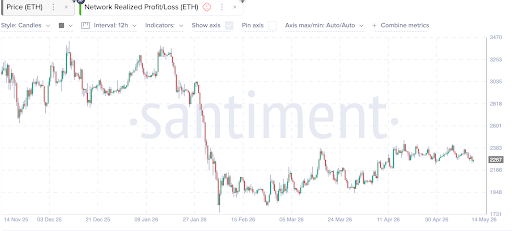
Support remains near $2,160 to $2,180. A break below that zone would weaken the recent base. The next support area sits near $1,950 to $2,000.
Current trader behavior supports a cautious view. Realized profits show that some holders are taking gains before stronger upside confirmation. Deeper realized losses could later mark seller exhaustion, but that has not appeared yet.
For now, Ethereum remains range-bound between support and resistance. Traders are watching whether distribution fades or selling expands. A move outside the $2,150 to $2,400 range may set the next direction.
The post Ethereum Just Spiked $74M in Profits – While Price Fell 5.5% appeared first on Live Bitcoin News.





