The modern crypto trader has access to more information than ever before. Order book data, liquidation heatmaps, on-chain activity, funding rates, macroeconomic news, whale movements, and social sentiment all compete for attention in real time. While this abundance of data creates opportunities, it also introduces a familiar challenge: by the time many traders have analysed everything, the market has already moved.
This is one reason artificial intelligence has become increasingly relevant in digital asset markets. Rather than simply helping traders interpret information, AI is beginning to play a more active role in how trades are planned and executed. As AI trading modes continue to evolve, the conversation is shifting beyond alerts and recommendations toward a new distinction between AI-assisted decision-making and AI-driven execution.
The first generation of AI-powered trading tools focused almost entirely on information. Their purpose was to help traders process large amounts of market data faster than they could manually.
Many of these solutions offered:
This model worked well for traders who wanted better insights without giving up control. However, it also exposed an important limitation.
Markets rarely wait.
A trader may receive an excellent signal, but if execution takes even a few minutes longer than expected, the original opportunity may disappear. High-volatility environments particularly in perpetual futures markets can reward speed just as much as analysis.
As a result, the next phase of AI in trading has focused less on generating information and more on reducing the gap between decision and execution.
A useful way to understand the current evolution is to think of AI in two distinct operating models.
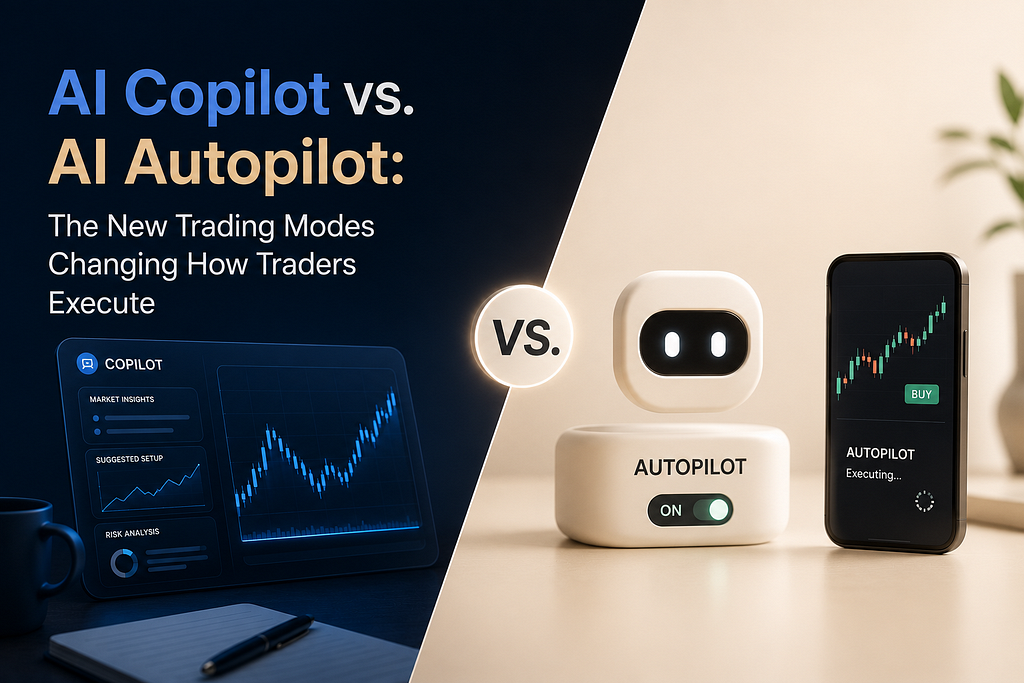
The first resembles the “copilot” concept that has become common across productivity software. Here, AI supports the trader by analysing markets, identifying potential opportunities, highlighting unusual risk conditions, or suggesting possible actions. Importantly, the human trader remains responsible for every execution decision.
This approach offers several advantages. Traders gain faster analysis while maintaining complete discretion over entries, exits, leverage, and position sizing. AI becomes an intelligent assistant rather than a replacement for judgement.
The second model goes a step further.
Instead of simply making recommendations, the system is authorised to execute trades automatically within predefined rules established by the user. These rules might specify maximum position size, acceptable leverage, stop-loss parameters, profit targets, or acceptable market conditions before any order is placed.
Some newer platforms are building this distinction directly into the trading interface itself i5.xyz, for instance, offers separate “Copilot” and “Autopilot” modes alongside standard manual trading, letting users choose their comfort level with automation rather than treating AI as an all-or-nothing experience.
This separation reflects a broader industry trend. Rather than assuming every trader wants fully automated strategies, platforms are increasingly recognising that different experience levels call for different degrees of automation.
For newer participants, AI guidance may be enough.
For experienced traders running predefined strategies, automated crypto trading can reduce execution delays while enforcing disciplined risk management.
Greater automation inevitably introduces new considerations.
One of the biggest advantages of AI trade execution is its ability to remove emotional decision-making. Fear, hesitation, revenge trading, and FOMO have historically contributed to poor trading outcomes. Automated systems, when configured correctly, follow predefined rules consistently regardless of market volatility.
However, consistency should not be confused with certainty.
An automated strategy is only as reliable as the assumptions behind it. Poorly designed parameters, unexpected market conditions, or insufficient liquidity can still produce losses. Automation accelerates execution it does not eliminate market risk.
As more trading platforms introduce AI capabilities, distinguishing meaningful functionality from marketing language will become increasingly important.
Rather than focusing solely on whether a platform advertises artificial intelligence, traders may benefit from asking a few practical questions.
First, how transparent is execution? Users should understand what the AI is permitted to do and which actions remain under their control.
Second, what safeguards exist? Effective risk controls including leverage limits, stop-loss configuration, and capital allocation settings are often more valuable than sophisticated prediction models alone.
Third, can trading activity be independently verified? As decentralised finance continues to mature, greater attention is being paid to on-chain trading automation and auditable execution records that improve transparency.
Finally, flexibility matters.
The evolution of AI trading modes represents more than another feature release it signals a broader shift in how traders interact with increasingly complex markets. Instead of viewing AI as either a simple research assistant or a fully autonomous trader, platforms are beginning to offer a spectrum of control that reflects different experience levels and risk preferences. As this distinction between copilot-style assistance and automated execution becomes more common, traders will likely judge AI less by its promises and more by its transparency, flexibility, and ability to support disciplined decision-making.
AI Copilot vs. AI Autopilot: The New Trading Modes Changing How Traders Execute was originally published in Coinmonks on Medium, where people are continuing the conversation by highlighting and responding to this story.





