
Crypto launches used to run on attention. A project announced a token, opened a sale, pushed social media noise, signed a few influencers, and waited for the market to react. That model still exists, but it no longer carries the same weight. The market has grown sharper. Users now ask harder questions before they buy, hold, trade, or build around a token.
The stablecoin sector shows this change clearly. Visa’s stablecoin dashboard tracks more than $272 billion in circulating global stablecoin supply and $10.2 trillion in adjusted transaction volume over the last 12 months. Chainalysis has also reported that stablecoins processed $28 trillion in real economic volume in 2025, showing how far tokens have moved beyond speculative trading alone.
This is where Tether’s planned Georgia stablecoin becomes a useful case. Tether announced plans to launch GELT, a Georgian lari-linked stablecoin, with support from the Georgian government. The token is expected to support digital payments, cross-border trade, and fintech growth in the country.
That is not a normal token launch story.
It is not built around a meme, a staking promise, or a short-term community rush. It points to a bigger market shift: tokens now need a role inside real payment flows, local economies, business use cases, and public financial systems.
For founders, that message matters. A token launch in 2026 needs more than visibility. It needs a reason to exist.
Stablecoins have become one of the clearest examples of crypto utility. People use them for trading, payments, remittances, savings access, settlement, treasury movement, and cross-border transfers. Their value does not come from price volatility. It comes from predictability.
That changes how the market reads token launches.
A new token tied to payment activity, business adoption, or national currency access will be judged differently from a token built only around speculative upside. Investors, users, and regulators now look for practical use, reserve clarity, legal structure, transaction demand, and long-term circulation.
Tether’s Georgia move sits inside that larger trend. It shows a private stablecoin company working with national-level support to build a token linked to a local currency. That alone makes the launch different from most crypto market entries. It is not only selling a token. It is testing whether a token can sit inside a country’s digital financial activity.
Tether is best known for USDT, the largest dollar-pegged stablecoin by circulation. Its move into a Georgian lari-backed token shows that the stablecoin market is not only about dollar liquidity anymore. Local currency tokens are starting to attract more attention.
GELT matters because it connects three areas that token founders often treat separately:
That combination gives the launch more weight.
A Georgian lari-backed stablecoin gives users a digital version of local currency value. That makes it easier to imagine real payment use inside Georgia than a random utility token with no clear demand.
The use case starts close to daily financial activity.
People and businesses can understand a stablecoin faster when it links to a currency they already use. This lowers the education gap. It also gives the token a clearer job from the beginning.
For token founders, that is a strong lesson. The best launches explain their purpose before the market asks.
Most token launches start with a whitepaper, a website, and a community campaign. Tether’s Georgia plan enters the market with public-sector support attached to the story. Reuters reported supportive comments from Georgia’s prime minister, central bank head, and a member of parliament, though the exact token structure still needs more detail.
That support changes user perception.
A token with institutional backing feels different from a token asking the public to trust a roadmap. It creates a stronger trust signal, especially in payments and financial use cases.
This does not remove risk. It does raise the standard for other launches.
GELT is positioned around digital payments, fintech growth, and cross-border trade. These are practical use cases. They involve users, businesses, and payment rails.
That matters more than a loud launch week.
A token that fits into actual movement of money has a stronger reason to remain active after launch. It can build usage through transactions, partnerships, and integrations rather than social media momentum alone.
Token launches now need that second life after the announcement.
Token launches are not disappearing. They are becoming more demanding. The old question was, “How much attention can this project generate?” The new question is, “What activity will keep this token moving after launch?”
That shift is visible across stablecoins, RWA projects, payment tokens, DeFi infrastructure, and exchange-linked tokens. Each strong launch now needs a practical loop.
A token cannot depend on vague future value. Users want to know what the token does now, who uses it, and what activity supports demand.
That means founders need to define:
Tether’s Georgia stablecoin gives a cleaner example. The token is linked to national currency use and payment activity. The reason for the token is visible.
Many launches fail because that reason is buried under marketing.
Hype can open the door. It rarely holds the room.
A token launch built around real activity has more ways to survive after early attention fades. Users can return for payments, rewards, access, settlement, or platform functions. The project can measure real usage. Partners can build around the token. The market can judge progress from activity, not only price.
That is the stronger model.
Founders need to treat launch as the start of circulation, not the peak of excitement.
A payment token needs different design choices from a governance token. A stablecoin needs reserve logic, redemption clarity, and compliance structure. A gaming token needs reward balance and sink design. An RWA token needs asset linkage, custody, reporting, and legal clarity.
Poor token design weakens even good ideas.
The launch structure must match the token’s purpose. Tether’s Georgia plan shows this well. A local currency stablecoin cannot launch like a meme coin. It needs trust, regulatory alignment, payment relevance, and infrastructure support.
That is the kind of discipline more founders need.
Tether’s Georgia stablecoin is not a direct template for every project. Most founders will not launch with government support. Most will not build a national currency token. Still, the lessons are useful.
The core message is simple: utility must shape the launch before marketing begins.
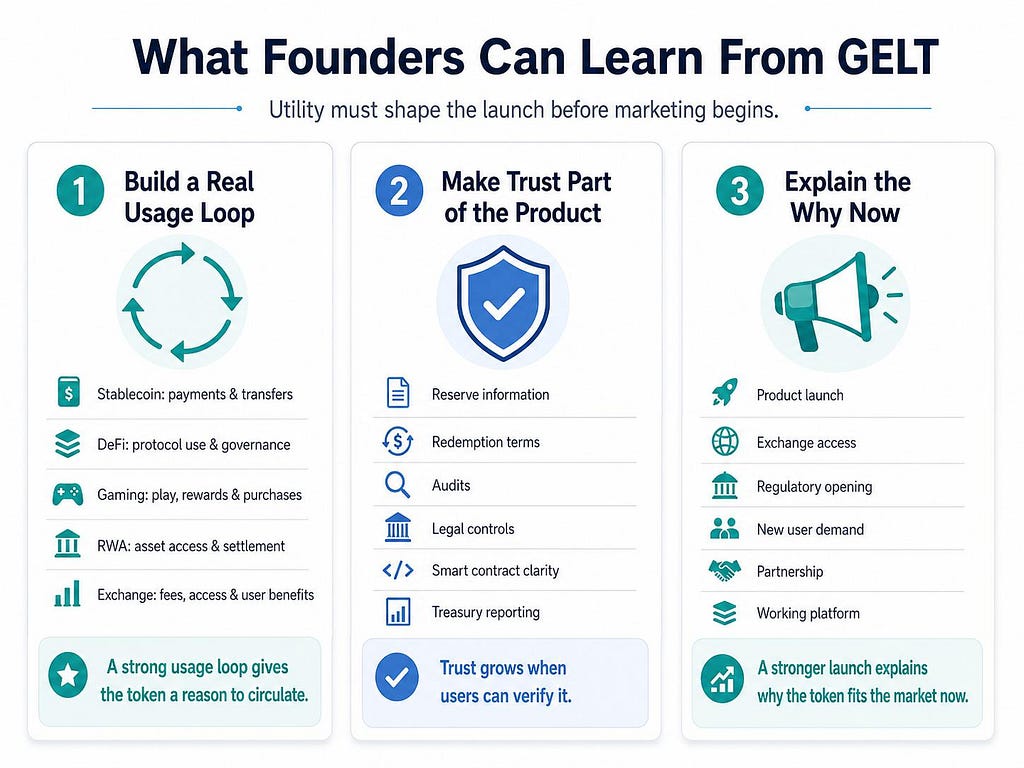
A token should not exist only to be bought. It needs a loop that brings users back.
For example:
A strong usage loop gives the token a reason to circulate.
Without that loop, the token launch becomes a marketing event with a weak second act.
Trust cannot sit only inside a tagline. It needs structure.
For stablecoins, that means reserve information, redemption terms, audits, legal controls, and clear issuer details. For utility tokens, it means smart contract audits, vesting clarity, treasury reporting, and real platform access.
Trust becomes stronger when users can check it.
The GELT story gains attention because it connects a major stablecoin issuer, a local currency, and national-level support. That creates a trust frame before the token enters public use.
Founders can create their own version of that trust through proof, partners, audits, and direct communication.
A token launch needs timing. The market should understand why the token matters now, not just why the idea sounds good.
For GELT, the “why now” sits in digital payments, fintech growth, and local stablecoin regulation. Georgia already has crypto activity, and Tether sees a chance to link stablecoin use with national financial activity.
For other projects, the timing can come from:
A weak launch says, “Here is our token.”
A stronger launch says, “Here is why this token fits the market now.”
Stablecoins are forcing the wider token market to mature. They deal with real money movement, so they face higher scrutiny. This makes them useful models for founders in other sectors.
They show what serious token planning looks like.
The stablecoin value proposition is easy to understand. One token tracks one currency unit. That simple idea supports trading, settlement, payments, and cross-border movement.
Simple utility travels faster.
Many crypto projects make their token story too complex. They pack in governance, rewards, staking, burns, access, and vague ecosystem value. Users get lost. The token feels heavy before it feels useful.
Stablecoins prove that clarity helps adoption.
Tokens with real transfer activity gain stronger relevance. That does not mean every token needs to be a payment token. It means every token needs measurable activity.
Activity can come from:
The token should create data that proves use.
Price alone is not enough.
Regulation used to sit in the background of token launches. Now it often shapes the front of the story.
Stablecoins face direct attention from regulators and central banks. The European Central Bank recently pushed back against proposals to loosen support for euro stablecoins, citing financial stability and monetary policy concerns.
That shows the pressure around tokenized money.
Founders should not treat compliance as a late-stage issue. For many projects, compliance is part of product design, market access, and trust.
The global stablecoin market is still heavily dollar-led. USDT and USDC dominate most activity. Yet local currency stablecoins are starting to matter more as countries, banks, and fintech players look for digital money rails that reflect domestic currencies.
Georgia’s GELT plan sits inside that shift.
A local currency stablecoin can make sense for users who earn, spend, and price goods in that currency. It reduces the need to move everything through dollars.
That matters for merchants, fintech apps, payroll tools, local exchanges, and cross-border trade partners.
A token launch tied to domestic currency use can reach users who are not crypto traders. That opens a different kind of market.
Cross-border payments remain one of the strongest stablecoin use cases. Businesses need faster transfers, lower friction, and clearer settlement paths.
A lari-backed stablecoin can support regional trade use if the right payment partners and liquidity routes exist.
That is the real challenge after launch.
The token needs places to move. It needs wallets, exchanges, payment tools, business users, and liquidity access.
A stablecoin without distribution becomes a digital receipt with no movement.
Georgia gives Tether a focused market for testing local currency stablecoin adoption. Smaller markets can move faster when regulators, private firms, and fintech players align.
For founders, this is worth watching.
Not every launch needs to start in the largest market. A focused launch in a smaller, active market can build proof faster than a broad launch with no clear user base.
The goal is not to be everywhere on day one. The goal is to become useful somewhere first.
Token launch strategy in 2026 needs to be more grounded. Attention still matters, but it cannot be the core product.
A better launch connects story, product, users, liquidity, compliance, and measurable activity.
For founders planning a token with real platform use, working with a utility token development company can make the launch far more structured. Blockchain App Factory fits well in this space, helping crypto startups shape token utility, tokenomics, smart contract logic, launch planning, and post-launch usage flows. This matters because a utility-led token cannot be built only around market entry. It needs a working role inside the product, a clear user action, and a design that supports activity after launch.
Before launch, founders should answer the hard questions.
What will users do with the token on day one? What activity supports demand? What partners or product features already exist? What risks need to be explained early?
Pre-launch work should cover:
A pre-launch campaign should not only build noise. It should build understanding.
The launch phase should reduce confusion. Users need to know where to buy, how to use the token, what risks exist, and what comes next.
For stablecoin-style launches, trust signals matter even more.
Founders should prepare:
A launch fails quickly when users feel lost.
Post-launch work is where many token projects lose energy. The campaign slows. The team posts less. The community asks what comes next.
That gap damages trust.
Founders need a post-launch usage plan before the token goes live. This can include platform features, staking access, payment adoption, partner campaigns, reward events, dashboard tracking, governance activity, and regular reporting.
The first 90 days after launch matter a lot.
That period shows whether the token has movement beyond its first market push.
Tether’s Georgia stablecoin plan gives founders a useful checklist. A project does not need to copy GELT. It should learn from the logic behind it.
The token should serve a defined market role. A lari-backed stablecoin has a clear role as a digital version of local currency value.
Other tokens need the same clarity.
Ask this:
What real activity becomes easier, faster, cheaper, or more accessible with this token?
Trust needs proof. Users need to see why the token deserves attention.
Strong trust signals include:
Trust does not come from one claim. It comes from repeated proof.
A token launch needs places where users can access and use the token.
Distribution can include:
A token with weak distribution stays trapped inside announcements.
Every strong token launch needs data. The team should track activity that proves adoption.
Useful metrics include:
The right metrics depend on the token type.
The point is simple. Show use, not just price.
Real-world utility does not remove risk. It creates a higher duty to communicate clearly.
Tether’s Georgia stablecoin plan still leaves open questions about structure, reserves, redemption, regulation, and central bank involvement. Reuters noted that Tether did not clarify whether the project should be treated like a central bank digital currency.
That detail matters.
Stablecoins sit close to monetary systems. Governments and central banks watch them carefully. A local currency stablecoin can raise questions about reserve backing, monetary control, consumer protection, and banking impact.
Founders need legal planning before public launch.
A stablecoin needs clear reserve management. Users should understand what backs the token and how redemption works.
Any confusion can hurt trust fast.
A token can have a strong concept and still fail to gain usage. Real adoption needs product access, partner support, user education, liquidity, and repeated use cases.
A launch is not adoption.
It is the opening test.
Financial tokens need careful language. Overpromising damages credibility. Hype can attract attention, but weak claims invite criticism.
Founders should explain what the token does, what it does not do, and what users should expect.
Clear writing protects the project.
Token marketing is also changing. The best campaigns now explain utility, show evidence, and guide users through real actions.
A token launch campaign should not only ask people to buy. It should help them understand the system.
A utility token needs utility-led marketing. A stablecoin needs trust-led marketing. A gaming token needs activity-led marketing. An RWA token needs asset-led marketing.
The message should not feel separate from the product.
Tether’s Georgia story works because the product and message connect. The token is about digital currency use, so the campaign centers on payments, fintech, trade, and national adoption.
That alignment matters.
A token community should understand the project well enough to explain it to others. That requires simple guides, frequent updates, public answers, and direct product education.
Good community building turns followers into informed users.
That is more valuable than empty group size.
Media coverage should not only create reach. It should help the market understand why the launch matters.
For utility-led launches, PR should explain:
A strong article can build more trust than a loud promotional campaign.
The Tether and Georgia case shows a larger truth. Token launches are moving closer to real systems. Payments, local currencies, trade, fintech, assets, and user access now matter more than empty attention.
That does not mean hype has disappeared. It still moves markets. It still brings early reach. Yet hype without use has a shorter shelf life now.
Founders need to build launches around the activity they want to create.
A token should not enter the market as a promise waiting for future meaning. It should enter with a role, a user path, and a reason to keep circulating.
GELT may become an important local stablecoin experiment. It may also face hard questions as details emerge. Either way, the launch already shows where the market is heading.
The future token launch will not be judged only by who talks about it.
It will be judged by who uses it, why they use it, and whether the token keeps moving after the first wave of attention fades.
Tether’s Georgia stablecoin launch gives crypto founders a clear signal. The market is rewarding tokens that connect with real financial activity, public trust, and practical use. A launch built only around attention now feels incomplete.
For founders planning a token in 2026, the real work starts before the sale page goes live. The token needs a clear job, a working usage loop, visible trust signals, and a post-launch plan that turns buyers into users.
That is the difference between a token that trends for a week and a token that earns a place inside real activity.
The future of token launches is not only louder marketing.
It is sharper utility, stronger proof, and a launch story people can actually use.
How Tether’s Georgia Stablecoin Launch Shows the Future of Token Launches Is Moving Toward… was originally published in Coinmonks on Medium, where people are continuing the conversation by highlighting and responding to this story.





