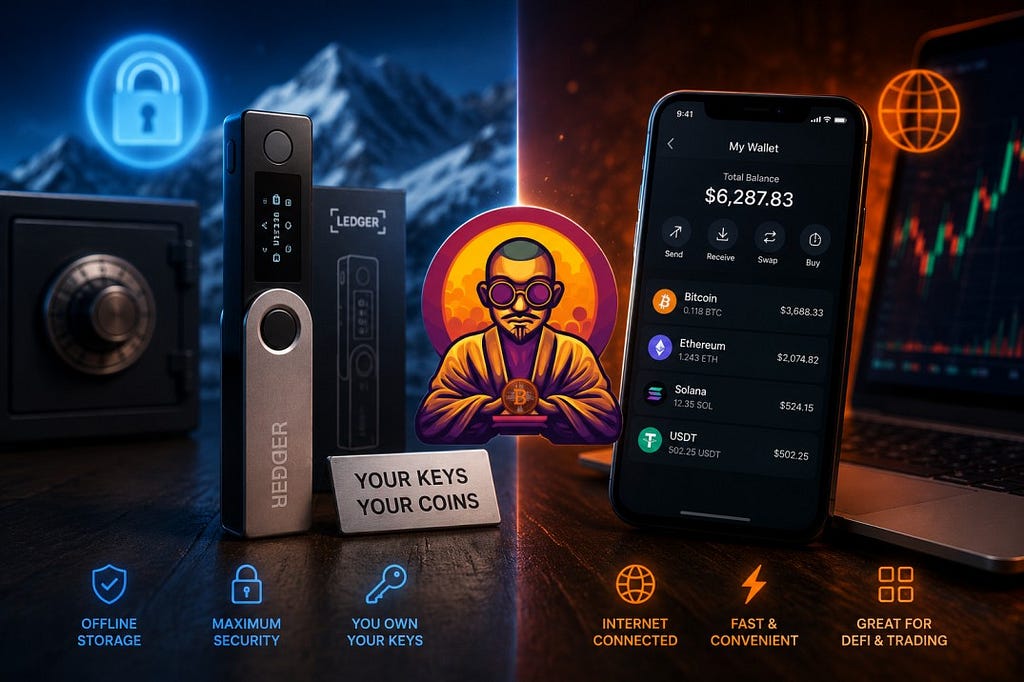
If you’ve been investing in Bitcoin, Ethereum, XRP, or any other cryptocurrency, you’ve probably heard the terms cold wallet and hot wallet. While both allow you to store and manage your crypto assets, they serve different purposes and offer different levels of security.
Choosing the right wallet can make the difference between keeping your digital assets safe and exposing them to unnecessary risks. In this guide, we’ll explain the difference between a cold wallet vs hot wallet, highlight their advantages and disadvantages, and share some of the most popular wallet options available today.
One of the biggest misconceptions is that cryptocurrencies are stored inside your wallet. In reality, your Bitcoin, Ethereum, XRP, and other assets always remain on their respective blockchains.
A crypto wallet simply stores your private keys, which prove ownership of your funds and allow you to authorize transactions. Anyone with access to your private keys can control your crypto.
This is why protecting those keys is far more important than the wallet itself.
Both hot and cold wallets are generally considered non-custodial wallets, meaning you control your own private keys rather than relying on an exchange.
This follows one of the most important principles in crypto:
“Not your keys, not your coins.”
A hot wallet is a cryptocurrency wallet connected to the internet. Because it’s online, it’s incredibly convenient for sending, receiving, swapping, and interacting with decentralized applications (dApps).
Hot wallets are widely used by traders, NFT collectors, and DeFi users because transactions can be approved within seconds.
Some of the most widely used hot wallets include:
These wallets are available as browser extensions, desktop applications, or mobile apps.
Because they’re connected to the internet, hot wallets face higher security risks:
That doesn’t mean hot wallets are unsafe-it simply means users need to be much more cautious with security practices.
A cold wallet stores your private keys offline, making it significantly more difficult for hackers to gain unauthorized access.
Unlike hot wallets, a cold wallet signs transactions on a dedicated hardware device, keeping your private keys isolated from internet-connected computers and smartphones.
Even if your computer becomes infected with malware, your private keys remain protected inside the hardware wallet. Hardware wallets isolate private keys inside secure hardware designed for offline protection and transaction approval.
Some of the most trusted cold wallets include:
These devices typically connect through USB or Bluetooth only when signing transactions.
Cold wallets also have a few drawbacks:
Fortunately, even if the hardware wallet breaks, your crypto can still be recovered using your 12- or 24-word recovery phrase on a compatible device.
This is where cold wallets clearly outperform hot wallets.
Since hot wallets stay connected to the internet, they naturally present a larger attack surface. Cold wallets, on the other hand, keep private keys offline, greatly reducing the risk of remote attacks.
Hot wallets are much more convenient for everyday use.
If you’re actively trading, swapping tokens, minting NFTs, or interacting with decentralized finance protocols, a hot wallet provides the speed and accessibility you need.
Cold wallets require connecting a hardware device whenever you want to approve a transaction, adding an extra security step.
A good rule of thumb is:
Use a hot wallet like your everyday checking account.
Keep only the amount of crypto you need for daily activity.
Use a cold wallet like your savings account.
Store long-term investments and larger holdings offline where they’re significantly better protected.
Many experienced crypto investors actually use both.
The answer depends on how you use cryptocurrency.
If you’re new to crypto or frequently trade, a hot wallet is an excellent starting point because it’s free, simple, and supports thousands of decentralized applications.
However, if you’re planning to hold Bitcoin, Ethereum, XRP, Solana, or other assets for months or years, investing in a cold wallet is one of the smartest security decisions you can make.
Many investors keep a small amount of funds in a hot wallet for everyday transactions while storing the majority of their portfolio in a hardware wallet.
This balanced approach combines convenience with strong security.
After using both types of wallets over the years, I personally prefer a Ledger Nano X for storing my long-term crypto holdings.
To be completely transparent, my device has occasionally experienced issues where it unexpectedly reset itself. In my case, I believe it was most likely related to a hardware problem rather than a security flaw. While it was certainly frustrating, I was always able to restore access to my wallet using my recovery phrase.
Despite those occasional hardware hiccups, I’m still happy to use a cold wallet.
For me, the biggest advantage isn’t the device itself-it’s the fact that I control my own private keys. No exchange, company, or third party can freeze or control my assets. As the crypto community often says, if the keys are yours, the crypto is truly yours.
Yes. A cold wallet is generally considered more secure because it keeps your private keys offline, making them far less vulnerable to online attacks such as phishing, malware, and hacking attempts. That said, users must still protect their recovery phrase, as anyone with access to it can restore the wallet.
Absolutely. In fact, many experienced crypto investors use both. A hot wallet is ideal for everyday trading, DeFi, and NFT activity, while a cold wallet is better suited for storing long-term investments and larger holdings securely offline.
Originally published at https://cryptonews.guru on July 30, 2026.
Cold Wallet vs. Hot Wallet: Which Crypto Wallet Is Right for You? — Crypto Guru was originally published in Coinmonks on Medium, where people are continuing the conversation by highlighting and responding to this story.





