
Before this guide starts, some credit where it is due.
Sim was good. Genuinely good.
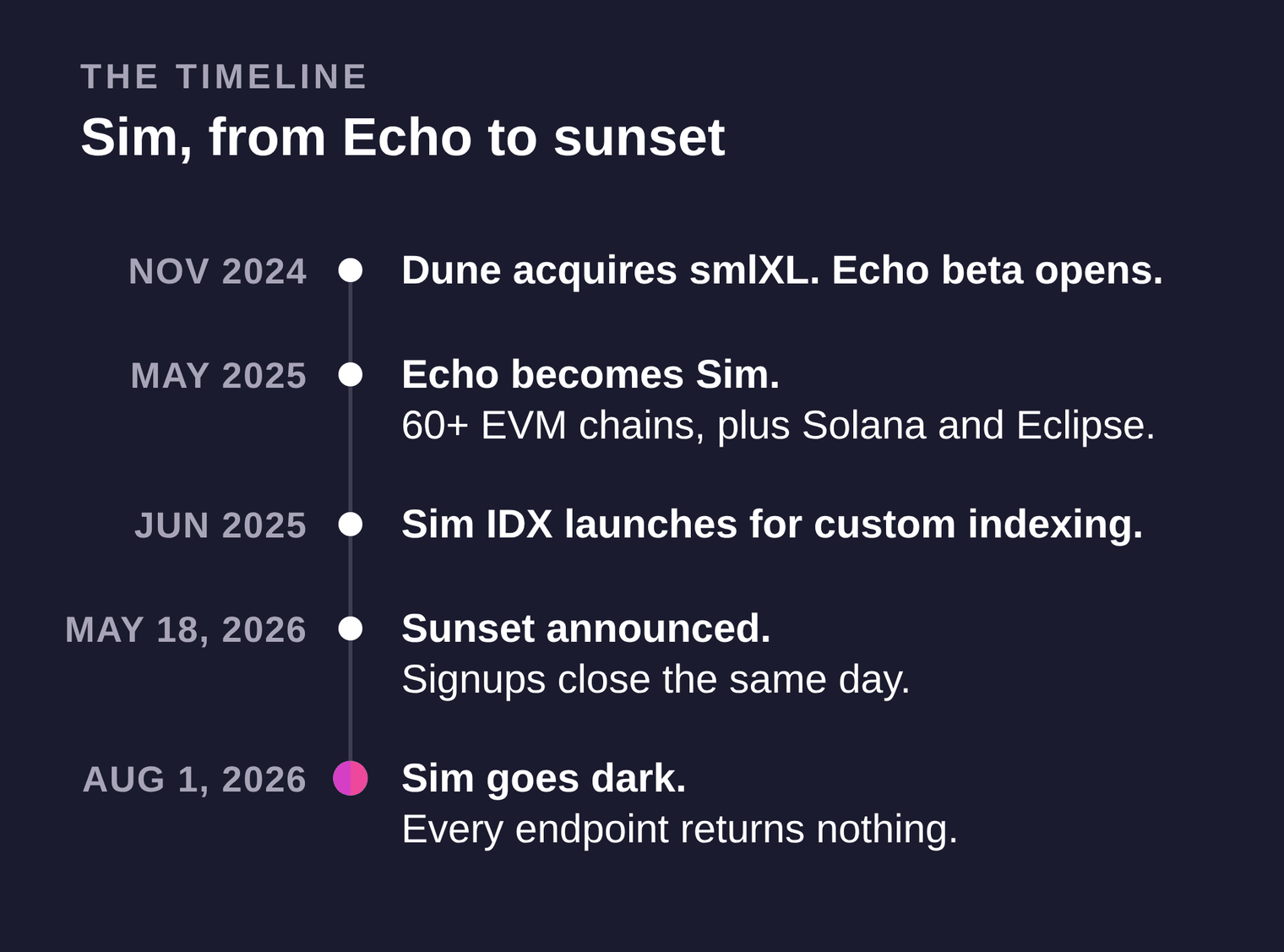
Dune bought smlXL in November 2024 and put its realtime engine to work. The beta was codenamed Echo. In May 2025, Echo became Sim.
Developers took to it fast. Wallet balances across 60+ EVM chains in one call. Prices attached to every token. Solana and Eclipse included. Webhooks for balance changes. Even DeFi positions, resolved per wallet.
Sim IDX followed in June 2025 for custom indexing. The docs read clean and the team shipped weekly. “The realtime data must flow,” they wrote. For fourteen months, it flowed.
Then came May 18, 2026.
Dune announced it was sunsetting Sim. Signups closed the same day. Co-founder Mats Olsen gave the reason in one word: focus. The core data platform had the deeper moat. “Running Sim alongside it diluted both,” he wrote.
On August 1, 2026, Sim went dark. Every endpoint now returns nothing. The login page says the service has ended.
There is no scandal here. A company chose one product over two. That is a fair call. But your app does not care about strategy.
It still needs wallet balances at nine on Monday morning.
The shutdown left Sim’s developers without a data layer. Teams now compare replacements under deadline pressure. That is why searches for Dune Sim alternatives spiked overnight.
Most migration guides out there are vendor pitches. Each one ends with “pick us.” So we wrote the guide we wanted to find. Five real options, compared honestly, including where each one loses.
We checked public pricing pages, docs, and API terms on August 14, 2026. Real pricing, real limits, and honest fits.
You should leave with a clear shortlist, not a longer one. Want the wider field first? Start with our roundup of the best crypto API providers.
Start with the timeline, because it was short. Dune announced the sunset on May 18, 2026. The shutdown came 75 days later, on August 1. Free users could not upgrade past their tier limit. Enterprise customers got prorated refunds and a clean contract release.
That is a graceful exit, by API standards. It is still an exit.
The harder question is what Sim actually did for your stack. It sat between two layers that both still exist. Below it, raw node access via JSON-RPC. Above it, analytics warehouses for historical queries.
Raw RPC gives you one balance, in wei, per call. Sim returned the whole picture. Every token a wallet held, priced in USD, across chains. Activity feeds with decoded transfers. That enrichment layer is what you now have to replace. Our guide to the best crypto wallet APIs covers that layer in depth.
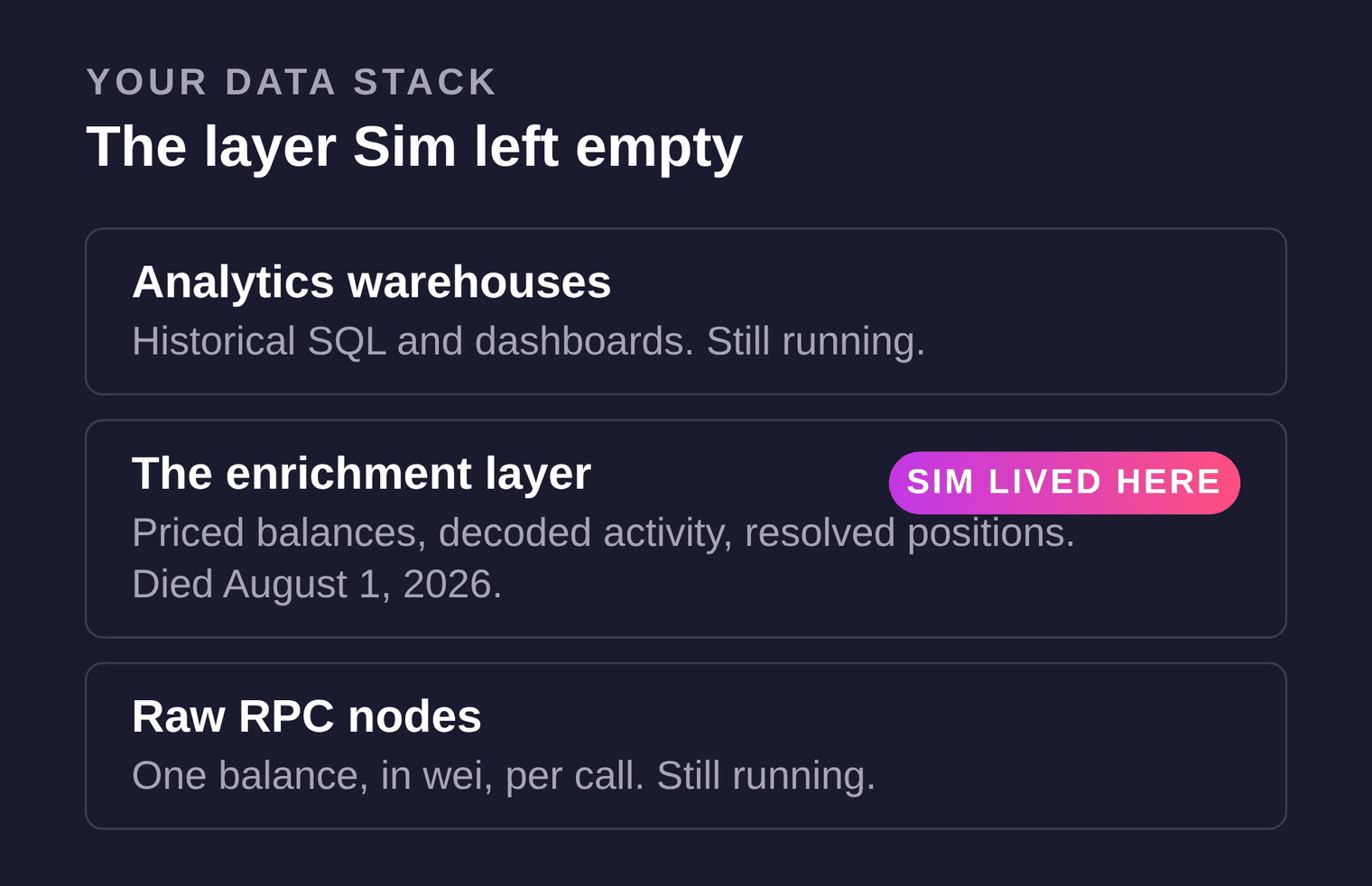
There are two migration paths. Swap in a like-for-like read API and keep your architecture. Or rebuild around pipelines that stream into your own database. This guide covers both, and says which is which.
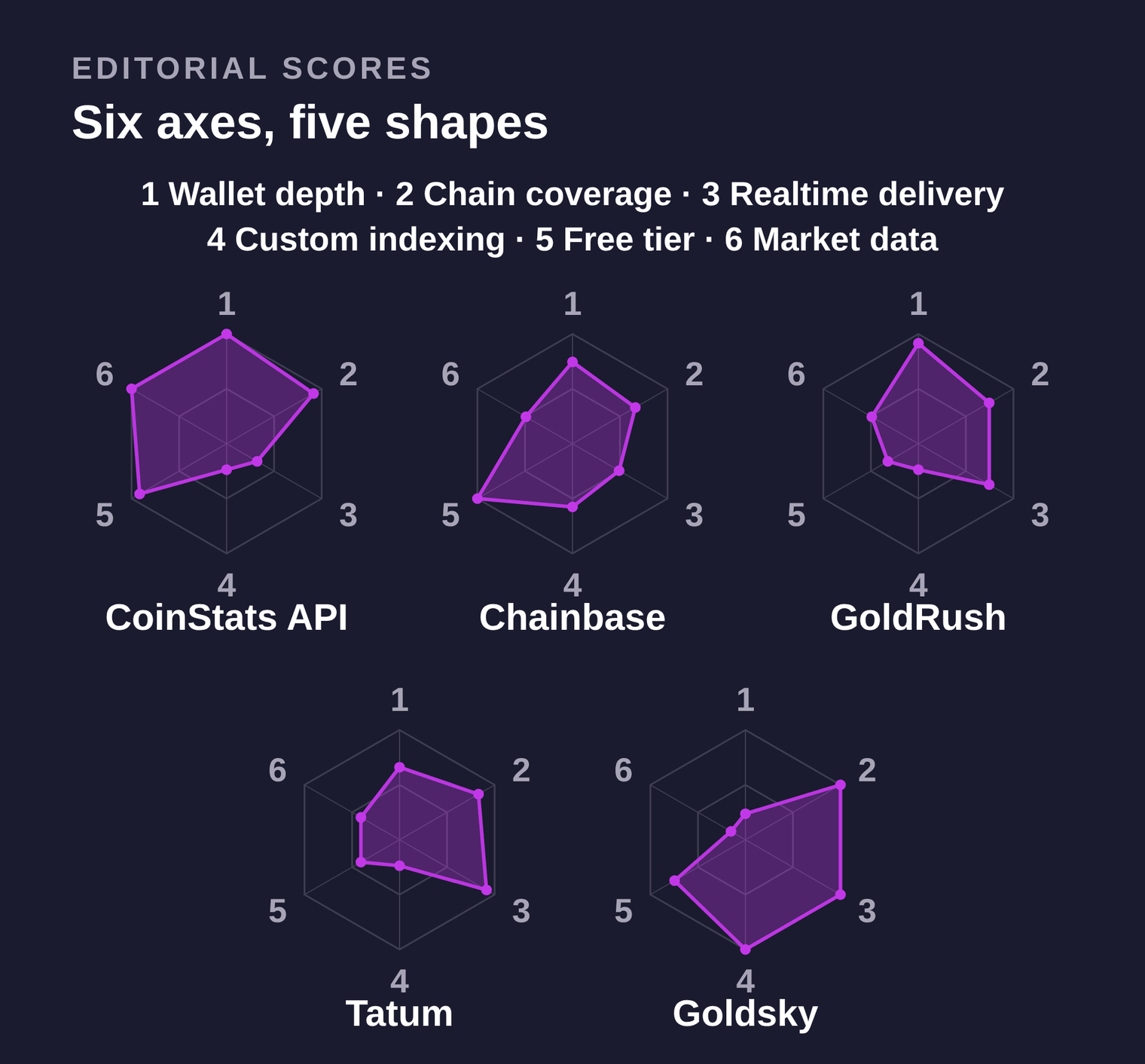
Six factors decided the ranking. They mirror what Sim users actually lose.
One method note. We verified every number on the official pricing pages, all on the same day. Where a figure is only reported second-hand, we say so. Want a wider open list? Cross-check this free crypto APIs repo on GitHub.
| Provider | Best for | Free tier | Entry paid | MCP |
|---|---|---|---|---|
| CoinStats API | Sim’s read surface, plus market, portfolio analytics, and token security | 20,000 credits/mo, commercial use | ~$49/mo, 1M credits | ✅ Wallet, DeFi, market |
| Chainbase | SQL and decoded EVM data | 200,000 credits/mo | $99/mo, 10M credits | ✅ 18-tool server |
| Covalent (GoldRush) | Like-for-like wallet endpoints | 14-day trial, 25,000 credits | $10/mo, 10,000 credits | ✅ Open source |
| Tatum | Webhooks and chain breadth | 100,000 credits, lifetime | $49/mo, 4M credits | ✅ 13-tool server |
| Goldsky | Custom indexing, Sim IDX jobs | 3 subgraphs, 1 pipeline | Usage-based, ~$37/mo per worker | Docs-only |
Only CoinStats API covers Sim’s whole read surface behind one key. The other four each replace a slice of it.
CoinStats API is the shortest path off Sim for most read workloads. It powers the CoinStats app, used by 1.2 million people monthly. The same endpoints are open to developers, across 120+ blockchains.
The wallet layer will feel familiar. One balance call returns every token a wallet holds. USD prices and 24h changes come attached, the way Sim returned them. It works across 74 EVM chains, Solana, and Bitcoin with xpub support. Transactions arrive pre-classified, with USD values and per-trade profit or loss. DeFi positions resolve across 10,000+ protocols. That last one matters. Sim’s DeFi Positions endpoint was the hardest thing to replace. Here, it has an equivalent.
Then it goes past Sim’s scope. Market data covers 100,000+ coins and 200+ exchanges. History runs up to ten years. A news feed aggregates 200+ sources. Portfolio analytics return P&L and performance per wallet. Token Risks endpoint flags honeypots and contract risks on the free tier. And MCP Server exposes all of it to AI agents. Claude Code, Cursor, and VS Code connect directly.
Pricing is published and self-serve. The free tier gives 20,000 credits a month, commercial use allowed, no card required. Paid plans start near $49 a month for 1,000,000 credits. That is roughly $0.05 per 1,000 calls. Sim’s reported paid entry was $250 a month.
Chainbase runs Web3 data infrastructure with three ways in. A REST Web3 API for balances, transactions, and token data. A SQL API over decoded datasets. And Sync, which exports data into your own store. Coverage spans 90+ chains, with the EVM set fully supported.
For Sim migrants, the REST layer maps well. Balance responses include current USD prices. Transaction and transfer history is there, and so are token holders. Sim shipped a Token Holders endpoint too, so that gap closes cleanly. Sync then streams historical and incremental data into PostgreSQL, MySQL, or S3.
Pricing is friendly at the bottom. The free plan gives 200,000 credits a month at 3 credits per second. The Developer plan is $99 a month for 10 million credits. Most API methods cost 1 to 5 credits. A SQL query costs 100. A first-party MCP server ships 18 tools.
Two honest limits. Chainbase’s own networks table marks Solana as partial. Do not migrate SVM reads here. And there is no webhook product. Sync into your database replaces streaming.
GoldRush is Covalent’s data API, rebranded in 2024. It is the closest schema match to Sim’s wallet endpoints in this list. Balances return with USD quotes attached. One cross-chain call fetches balances everywhere at once. Transaction history runs deep on EVM chains and Bitcoin, including xpub wallets.
Delivery options have grown this year. A WebSocket streaming API went live. A Pipeline API streams across 20 chains. There is a CLI, pay-per-call via x402, and an open-source MCP server. Token holders resolve at any block height, another direct Sim parallel.
Pricing is where you should slow down. There is no ongoing free tier anymore. Free usage is a 14-day trial with 25,000 credits. The $10 a month Vibe Coding plan carries just 10,000 credits. Serious volume starts at Professional, $250 a month for 300,000 credits.
One coverage gap matters for Sim migrants. GoldRush lists Solana, but its own chains page excludes Solana transaction history. SVM-heavy workloads need a different home.
Tatum bundles three layers under one key and one credit pool. RPC access across 130+ networks. An indexed Data API for balances, transactions, and token metadata. And notifications, which is the part Sim webhook users care about.
Webhooks fire on 24 networks. Address transactions, contract log events, token movements, and failed transactions all trigger pushes. Price alerts across 500+ symbols shipped in July 2026. So did WebSocket subscriptions, currently on Solana, Ethereum, and Polygon. Solana support overall is first-class, which few here can say.
The catch sits in the data responses. Balances arrive without USD valuations. You join prices yourself through Tatum’s separate Exchange Rate API. Sim users will feel that extra step immediately.
The free plan exists forever but holds 100,000 lifetime credits, not monthly. Paid starts at $49 a month for 4 million credits. Credits do not roll over. An MCP server ships 13 tools over 130+ chains.
Goldsky is the pick for the other half of Sim: IDX. If you ran custom contract listeners, this is the managed equivalent. Hosted subgraphs give you GraphQL endpoints with zero infrastructure. Mirror and Turbo pipelines stream decoded onchain data into your own store. Latency is sub-second.
Pipelines are reorg-aware and manage their own backfills. Sinks include PostgreSQL, ClickHouse, Kafka, Elasticsearch, and plain webhooks. Coverage spans 160+ chains. Solana works through the newer Turbo pipelines, alongside Bitcoin and NEAR.
Pricing starts free. The Starter plan carries 3 always-on subgraphs and 1 pipeline. The Scale plan is usage-based with no base fee. A subgraph worker runs $0.05 an hour, about $37 a month. A pipeline worker runs $0.10 an hour, about $73 a month.
Be clear about what this is not. Goldsky is indexing infrastructure, not a query-ready data API. You bring the database and build the query layer. There are no wallet balance or market data endpoints. Its MCP server only searches documentation.
Same five providers, feature by feature. This is the table to screenshot before your migration meeting.
| Capability | CoinStats API | Chainbase | Covalent (GoldRush) | Tatum | Goldsky |
|---|---|---|---|---|---|
| Chains | 120+, incl. 74 EVM | 90+, EVM core | 100+ | 130+ networks | 160+ |
| Solana | ✅ Full wallet API | ⚠️ Partial | ⚠️ No tx history | ✅ Incl. streams | ✅ Via Turbo |
| Balances with USD prices | ✅ Attached | ✅ Attached | ✅ Attached | ⚠️ Separate price call | ❌ Build your own |
| Transaction history | ✅ With P&L | ✅ Yes | ✅ EVM + Bitcoin | ✅ Yes | ❌ Index it yourself |
| DeFi positions | ✅ 10,000+ protocols | ❌ No | ❌ No | ⚠️ Limited | ❌ No |
| Webhooks / streams | ❌ REST only | ⚠️ Sync to your DB | ✅ WebSocket + pipelines | ✅ 24 networks | ✅ Pipelines + webhook sink |
| Custom indexing | ❌ No | ⚠️ SQL over datasets | ❌ No | ❌ No | ✅ Subgraphs + pipelines |
| Market data | ✅ 100,000+ coins | ⚠️ Token prices | ⚠️ Quotes in responses | ⚠️ Rates API | ❌ No |
| Free tier | 20,000 credits/mo | 200,000 credits/mo | 14-day trial | 100,000 lifetime | Starter plan |
Read it by workload, not by checkmark count. A polling dashboard has different needs than an event-driven bot.
The short version.
Sim earned its users, and its shutdown was handled with more grace than most. That does not make the gap smaller. Five products can fill it, each from a different angle.
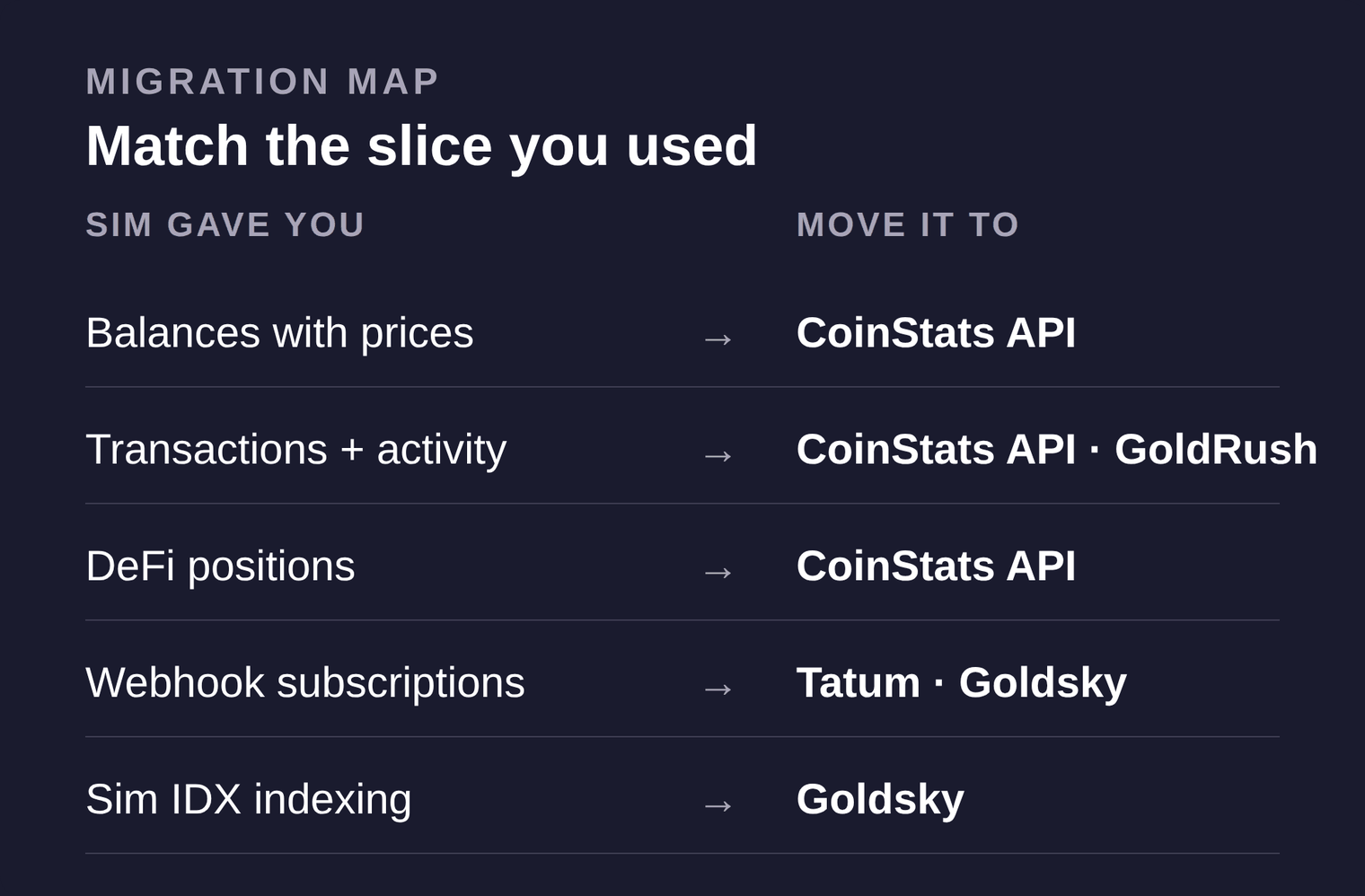
If Sim was your read layer, CoinStats API is the closest full replacement. Balances with prices, classified transactions, and DeFi positions come back in one key. Market data, portfolio analytics, and token security arrive as a bonus. It is also the only one here whose free tier renews monthly.
If your Sim usage was narrower, match the slice. Chainbase for SQL and bulk data. Covalent (GoldRush) for Sim-shaped EVM endpoints with streaming. Tatum for webhooks and non-EVM chains. Goldsky for everything Sim IDX did.
Test with real wallets before you commit. Free tiers exist so migration decisions do not run on faith.
Explore CoinStats API docs →
Tigran is a growth marketer at CoinStats, working across crypto and consumer apps. He has tracked his own crypto since 2017. That spans centralized exchanges, hardware wallets, and DeFi positions. The habit shapes how he tests these products. He connects real accounts rather than reading feature lists.
He writes about portfolio tracking, wallet data, and crypto market tools.





