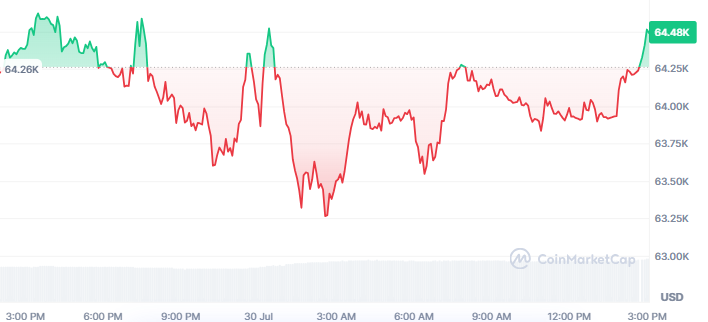
Bitcoin traded at $64,800 on July 30, 2026, with a market capitalization near $1.3 trillion as per CoinMarketCap. That sounds like a strong price.
But BTC miners do not get paid based on price alone. They get paid based on how much it costs to run their machines versus how much Bitcoins those machines produce. Right now, that math is tight.
For miners, the number that actually decides profit and loss is hashprice, and it sat near $32 per PH/s/day in July 2026 as per Hashrate Index.
That gap explains why so many people are asking is Bitcoin mining worth it 2026, and the honest answer is: it depends on the machine and the electricity bill.
Mining got harder this year. More competition joined the network, so each miner earned a smaller slice of the reward. The reward itself shrank in dollar terms.
Network difficulty climbed to roughly 126.23 trillion by mid-2026. At the same time, hashprice slid into the high-$20s per PH/s/day range.
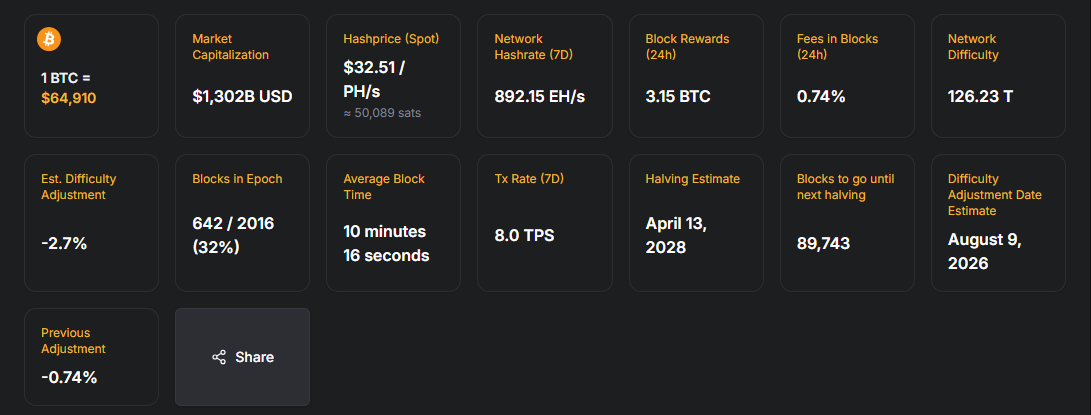
Because of this squeeze, a lot of miners simply turned their machines off. When enough miners do that, the network adjusts itself and gets easier again. That reset happened three times in a row earlier this year, something that had not occurred since 2022. In plain terms, the industry hit a rough patch and a chunk of it gave up.
Big mining companies felt this first. Several of them sold large amounts of the Bitcoin they had been holding just to cover costs.
Public miners cut their combined BTC holdings by more than 15,000 $BTC from peak levels during the squeeze, as per CryptoRank.
Core Scientific sold roughly 1,900 $BTC, worth close to $175 million, in January alone as per its official report. Bitdeer emptied its Bitcoin treasury to zero by February, and Riot Platforms sold 1,818 $BTC, worth about $162 million, in December 2025.
Well-known mining companies like Marathon Digital, CleanSpark, Hut 8, TeraWulf, and Cipher Mining all felt the same pressure. Thin hashprice and rising power bills left little breathing room. As a result, some of these companies changed direction.
Instead of relying only on $BTC mining, they started renting out their buildings and power to big tech companies that need space for artificial intelligence computing.
That is a smart backup plan. A company earning steady rent from a tech giant is safer than one relying only on $BTC's ups and downs.
Here is how the picture looks when the key figures sit side by side.
| Metric | Figure |
| Bitcoin price (Jul 30, 2026) | $64,800 |
| Hashprice (Jul 2026) Daily mining income per machine unit | ~$32/PH/s/day |
| Network difficulty | ~126 trillion |
| Network hashrate | ~0.96 ZH/s |
| Miner BTC sold, Q1 2026 | 15,000+ BTC |
| Current block rewards | 3.15 BTC |
| Newer ASIC breakeven power cost | $0.088/kWh |
The biggest factor in this whole table is electricity price. A newer, more efficient machine can still turn a profit if power costs around 9 cents per kilowatt-hour. Older machines need power closer to 5 cents per kilowatt-hour just to break even. Most homes pay far more than that for electricity, which is why mining from a spare bedroom barely makes sense anymore.
This is now mostly a business for large operations with cheap power deals, not a hobby.
Nothing here is locked in yet. If Bitcoin's price climbs back toward $100,000, hashprice could climb back toward $37 per PH/s/day, based on CoinShares Q1 2026 report. But if Bitcoin stays under $80,000 for the rest of the year, hashprice likely keeps falling as difficulty continues its climb.
A few forces will shape which path plays out. The regulatory environment around digital assets keeps shifting, and any new clarity could pull fresh institutional adoption into the market.
On-chain activity and overall market sentiment will also move alongside Bitcoin's price, feeding back into hashprice either way.
Two dates matter most from here. The next network difficulty adjustment lands within weeks, and it will show whether the recent capitulation phase has run its course. Q3 earnings from listed mining companies arrive in October 2026, and those reports will reveal whether treasury selling has slowed or whether hyperscaler contracts have started covering the gap that mining alone can no longer close. Anyone tracking whether mining still makes sense should mark both dates down.
Hashprice — The daily income a miner earns per unit of computing power.
Hashrate — The total computing power connected to the Bitcoin network at any given time.
Network difficulty — A measure of how hard it is to mine a new block.
Difficulty adjustment — A built-in reset that happens roughly every two weeks.
ASIC — Integrated circuit. It is the specialised machine miners use to mine Bitcoin.
PH/s (petahash per second) — A unit of mining power.
Breakeven point — Electricity price at which a miner earns to cover running costs, without profit.
Capitulation — Point where miners shut down because the machine running cost exceeds earning.
Hyperscaler — A large cloud or data-centre operator that leases capacity from other companies including Bitcoin miners.
Disclaimer: This article is for informational purposes only and does not constitute financial or investment advice. Crypto markets carry significant risk. Always do your own research before making any investment decisions.





