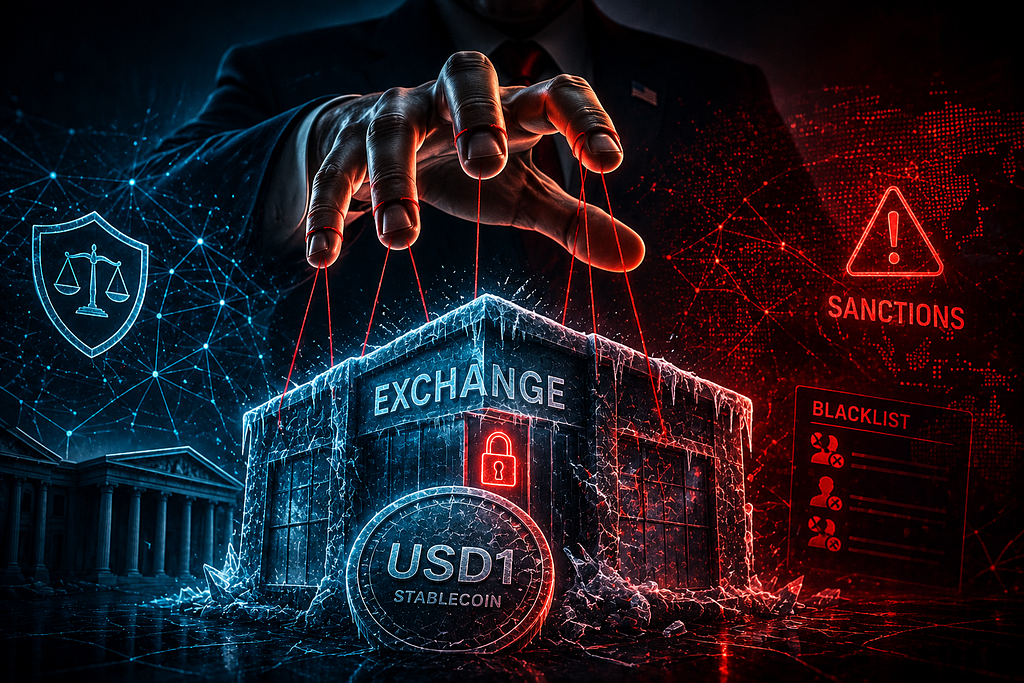
June 5, 2026, was a day nobody in crypto will forget. That’s when a stablecoin tied to a sitting U.S. president literally froze an entire exchange — not just a sketchy wallet or a known hacker, but a major exchange and all the blockchain addresses linked to it. Overnight, those accounts were cut off from the stablecoin’s network.
The stablecoin was USD1, created by World Liberty Financial, a crypto outfit that counted the Trump family as backers. The exchange in question? HTX. And it gets juicier — HTX’s own advisor and main supporter had once helped make USD1 a reality only to find the project turning against him.
At first, everyone called it a feud between the rich and powerful. But there was something bigger at play: it was a wake-up call that centralized stablecoin issuers have way more control over user funds than most people want to admit.
World Liberty Financial and Justin Sun weren’t always at odds. In the beginning, Sun poured about $75 million into the project through several funding rounds, giving it the credibility it badly needed. His name carried weight in the crypto world.
Thanks to that, USD1 wasn’t just another coin — it exploded in popularity and quickly became a multi-billion-dollar stablecoin. Sun’s support opened doors, helped gain attention, and built trust with investors.
But life has a way of turning on you. The same system Sun helped build ended up being used against him.
When people talk about stablecoins, they throw around terms like market cap, liquidity, and reserve audits. Hardly anyone asks about administrative controls.
The truth is, most centralized stablecoins have special functions built into their smart contracts that allow the issuers to blacklist addresses. In plain English: they can lock you out. When they flip that switch:
No need for your private key. No judge banging a gavel. The company just hits “restrict,” and that’s it.
Most people accept this as a compliance tool — something to fight fraud, crime, or sanctions. But it’s more than that. It’s raw power.
Problems started making headlines in 2025, when wallets linked to Justin Sun hit the stablecoin’s radar. Suddenly, transfers involving these addresses triggered restrictions from World Liberty Financial.
Legal battles followed, filled with accusations about how much say stablecoin issuers should have over user deposits. Critics said too much control rested with a tiny group of people. Supporters argued compliance comes first, especially when you’re playing in traditional finance’s backyard.
These debates felt abstract, almost like a thought exercise. That changed in June 2026.
Then, things escalated. British authorities slapped sanctions on an entity tied to the HTX brand. Right after, World Liberty Financial moved to restrict blockchain addresses connected to the exchange.
Trading in USD1 ground to a halt.
HTX responded quickly. They scrapped USD1 from their platform, swapped user balances over to Tether at a 1:1 rate, and tried to calm everyone down.
Still, the message couldn’t have been clearer: a stablecoin issuer had just cut off an entire exchange. What was once a debate about “what if” became reality. Suddenly, the power behind stablecoins wasn’t just theoretical — it was public.
The legal showdown between WLFI and Justin Sun will end, but the impact of that freeze lingers.
We all saw, in real time, just how much sway stablecoin issuers have over the plumbing of global finance.
It’s not about whether WLFI was right or wrong to act. The real shock is how easily they could do it.
If a stablecoin can black out an exchange, people start wondering where the line is drawn. Or if there’s a line at all.
Really, the freeze itself isn’t even the headline. What matters is what’s coming after.
New U.S. laws want stablecoin issuers to have stronger compliance mechanisms. Issuers now have to build in freeze, block, or even burn functions as part of getting regulated.
That “kill switch” isn’t optional anymore. It’s baked into the system.
Banks and big institutions love this, honestly. But for people who got into crypto for decentralization, it’s a nightmare.
There’s a myth that “it’s crypto, so it’s decentralized.” Not true, at least not with big stablecoins.
Issuers have frozen assets for years, usually when there’s a police request, a court order, or an international sanctions case. None of this is new.
What made the USD1 situation different was how open it was. Here you had a politically connected company freezing an exchange’s assets, right in public, over a very public dispute.
A lot of people who weren’t paying attention suddenly understood how much power these issuers really have.
Most investors pick a stablecoin and obsess over reserves. Is the collateral real? Are there honest audits? Can we trust the company?
These things matter, but so does governance. A stablecoin might have impeccable reserves, but if just a handful of people control who can move money, your funds still aren’t safe from interference.
Reserves and admin power aren’t the same thing. They both matter.
The Decentralized Solution? It’s Complicated
Some folks think decentralized stablecoins will fix all these problems. Maybe, but it’s not that simple.
Decentralized stablecoins are usually smaller, with less trading volume and more price swings. Big institutions are wary.
And even the “decentralized” stablecoins often have exposure to centralized collateral. So, you end up with decentralization in name, but not always in function.
It’s a rocky trade-off: the more stable and compliant the coin, the more centralized it tends to become.
The market’s splitting into two camps now:
Regulated Stablecoins:
Decentralized Stablecoins:
Both types solve different problems. Both have upsides and huge trade-offs. The push and pull between them will probably shape the next chapter for crypto.
At last, considering all,
Sure, the WLFI vs. HTX feud will disappear from the news. But what happened won’t.
The event showed, loud and clear, that stablecoin issuers can step into financial markets and cut people off in a heartbeat.
If you want stability and regulation, maybe that’s reassuring. If you wanted crypto to be independent, it’s a warning sign that things are veering toward the old financial system — the very one crypto was supposed to disrupt.
The debate isn’t whether stablecoins can freeze your assets. That’s settled. The real question is: are we okay with a future where that kind of power is just business as usual?
A President’s Stablecoin Just Froze an Exchange🚨 was originally published in Coinmonks on Medium, where people are continuing the conversation by highlighting and responding to this story.





