“This is the end of banker hours. Your batch processing mentality is going to be a thing of the past,” Graseck said, according to CoinDesk’s report on the discussion.
Two executives on a panel represent two views rather than an institutional position, and the transformation they describe has been arriving for roughly a decade. The numbers underneath it tell a more complicated story than the quote suggests.
Banks have accepted instructions outside office hours for years. A customer places an order at night, schedules a transfer on Sunday, agrees a cross-border trade from another time zone. The delay begins after the instruction is submitted.
One firm updates the cash balance. Another records ownership of the security. Custodians, payment networks and clearing houses exchange messages and reconcile separate databases before the trade becomes final. The banking day was never really about opening hours; it was about how long those reconciliations took.
Blockchain changes the sequence by giving authorized participants a shared transaction record. Once the network accepts a valid transfer, the relevant parties work from the same updated state instead of waiting for several internal ledgers to agree.
Tokenization applies that structure to traditional assets. A bond, fund share or bank deposit gets represented by a digital token whose ownership and transfer history sit onchain, letting the asset and the payment for it move together. Delivery-versus-payment logic completes both legs at once, closing the window in which one party has handed over an asset while waiting for the money.
The strongest objection to Graseck’s framing is that round-the-clock clearing arrived without any blockchain involved.
Brazil’s Pix, India’s UPI, the US FedNow service and SEPA Instant in Europe all clear payments continuously, including weekends and public holidays. Pix alone processes billions of transactions annually. None of them uses a token or a chain. Any argument that blockchain ended banker hours has to explain why those systems did not end them first.
The honest answer narrows the claim considerably. Instant rails are domestic, single-currency and carry only the cash leg. They clear a payment; they do not deliver an asset against that payment, and they stop at the national border.
That is where tokenization’s actual case lives. Delivery-versus-payment across jurisdictions, with collateral and securities moving on the same infrastructure as the money, is a harder problem instant rails were never built to solve. Banker hours are ending for assets, and the payments half of the job was largely finished before blockchain arrived.
Tokenized real-world assets reached roughly $36.7 billion in onchain value by June 2026, close to triple the figure a year earlier, per RWA.xyz data. US Treasuries lead the category at about $16 billion, with BlackRock, Franklin Templeton, Apollo, Hamilton Lane and WisdomTree all running live products. The DTCC began piloting tokenized securities in May, and the SEC approved a Nasdaq proposal allowing certain stocks to trade and settle as tokens.
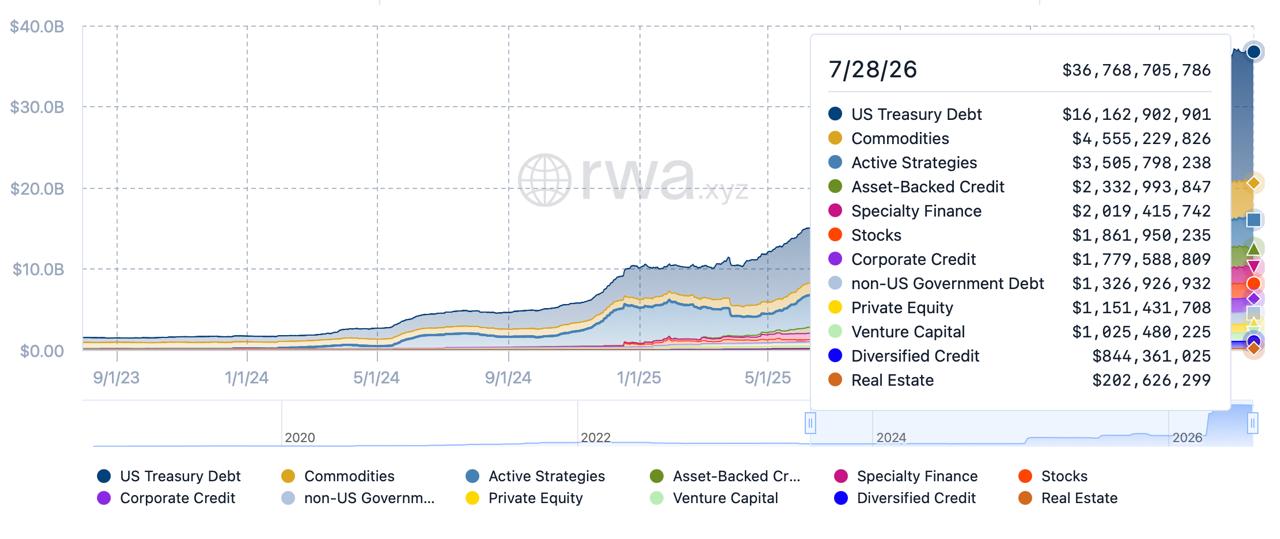
That is real commitment from firms that move slowly by design. It is also small against the balance sheets involved.
Forbes reported in July that across a tokenized market of about $60 billion spanning 7,000 products, more than $32.9 billion across 910 assets recorded zero weekly transfer activity. On a broader definition than the $32 billion figure above, more than half the value sits entirely still.
Separately, only about 10% of tokenized real-world assets currently see use in DeFi, according to Standard Chartered research projecting that share reaching 30% by 2030.
An asset that can move at 3am on a Sunday and never does has been tokenized without being mobilized. The infrastructure argument and the usage evidence point in different directions, and anyone claiming the banking day is over needs to account for the gap.
Most financial assets were already digital before blockchain. Stocks, bonds and bank balances have existed as electronic database entries for decades. What those systems lacked was shared programmability.
A conventional electronic asset stays inside the database of the firm maintaining it, and moving it elsewhere requires messages, confirmations and reconciliation between platforms never designed to talk directly. With tokenization, more of the asset’s operating rules travel with the asset. Its code can determine who may hold it, when transfers are allowed, which jurisdictions qualify and how interest, dividends or redemptions get distributed.
A regulated tokenized fund can restrict access to verified investors while clearing continuously. A tokenized bond can block a transfer failing the issuer’s conditions. Compliance becomes part of the asset’s design instead of a separate process run after each trade.
The practical applications span a financial product’s whole life:
Morgan Stanley Wealth Management strategist Denny Galindo argued during the same panel that tokenized stocks and money market funds could become many investors’ first meaningful contact with blockchain, ahead of buying cryptocurrency directly.
Collateral may be where tokenization creates the largest operational change. Banks and institutional investors hold substantial pools of government bonds and cash equivalents supporting lending, derivatives and trading obligations. Those assets are economically valuable and operationally trapped inside a particular custodian, legal entity or clearing system.
Representing them on a shared network makes ownership and status visible to approved participants, so eligible collateral gets pledged or transferred when required. Capital that sat idle overnight or across weekends becomes available for another permitted use.
The same speed accelerates a crisis. Automated margin calls and continuous liquidations remove the overnight cooling-off period during which risk committees, clearing houses and central banks have traditionally assessed a liquidity problem and coordinated a response. Blockchain reduces counterparty exposure while compressing the time available to contain market stress. A market that never closes needs supervision, liquidity management and emergency procedures that never close either.
Continuous asset trading is hard to achieve when the money still waits for bank cutoffs and correspondent-payment windows.
Stablecoins gave crypto markets an early answer. Dollar-pegged tokens move between wallets at any hour, letting investors, companies and software transfer value without waiting for the banking system to reopen. Tokenized deposits are the industry’s response: instead of a claim against a stablecoin issuer, the customer holds a blockchain representation of money deposited at a regulated commercial bank, with funds staying on the bank’s balance sheet while the token moves through compatible infrastructure.
Similar technology, different legal relationships. Stablecoin holders depend on the issuer and its reserves. A tokenized deposit stays a direct claim against the issuing bank and may keep the regulatory treatment attached to conventional bank money.
Coindoo previously explored this in its analysis of how banks are building tokenized deposit systems in response to stablecoin competition, and in its coverage of Swift’s blockchain ledger for round-the-clock bank payments. Banks are reproducing the speed and programmability crypto introduced while keeping customer money inside regulated balance sheets.
The pressure lands hardest on correspondent banking, where cross-border payments pass through several intermediaries, each screening the transaction, charging a fee and updating a separate ledger. Onchain transfer reduces the number of parties needed purely to relay payment information. Banks still provide identity checks, currency conversion, custody and regulated access; what disappears is the chain of firms confirming that value moved.
Speed is one part of the problem. Banks also need certainty that a completed trade will be recognized by courts, regulators, custodians and insolvency administrators.
A blockchain confirms within seconds that a token moved between wallets. That entry leaves open who legally owns the underlying asset, whether the transfer survives a fraud claim, and how the token gets treated if its issuer, custodian or holder becomes insolvent.
Cross-border cases are hardest. A smart-contract transfer may be operationally final onchain while courts in Delaware, London and Frankfurt apply different property, custody and insolvency rules to the same economic event. One jurisdiction looks at control of the wallet; another at the registered owner in an offchain record, the token holder’s contractual rights, or where the underlying asset sits. Blockchain produces one technical record of what happened and no single legal reading of what it means.
Fragmented liquidity compounds it. An asset tokenized on one network may not work as collateral on another, and bridging adds smart-contract, custody and counterparty risk. Issuing several digital versions of one security divides trading activity across platforms, so a deeply liquid traditional instrument can become less useful once its onchain representations cannot clear with each other.
Privacy adds a further constraint. Public networks provide transparency, and banks cannot expose customer balances, positions and trading relationships to the whole market. Systems have to protect commercially sensitive information while giving regulators and authorized participants enough visibility for oversight.
These problems explain the dormancy figures better than any technical shortcoming does. Rewiring the plumbing turned out to be the easy part.
Blockchain was initially pitched as a technology that would remove financial intermediaries. Adoption by banks has produced something more complicated.
Tokenization still requires regulated custody, enforceable ownership, investor verification and asset servicing. A token representing a bond is useful only when investors trust it corresponds to a valid claim enforceable under applicable law. What changes is the reason the bank remains necessary.
Historically, banks controlled the infrastructure required to move money and assets. Proprietary databases, restricted payment networks and fixed clearing windows made the firm an unavoidable route between two parties. Shared networks weaken that control, forcing competition on the services surrounding the trade:
How much of that control actually shifts depends on the network. Many bank consortia run permissioned ledgers restricted to approved participants, and where every node is a known, vetted firm, the advantage over a well-designed shared database with good APIs is genuinely arguable. The industry has not settled that question, and the answer determines whether tokenization rebuilds market structure or simply modernizes the existing one.
Either way, once one bank moves collateral at midnight, another has a harder time explaining why the same operation takes three business days.
Graseck’s claim holds at the level of infrastructure and overstates where the market currently is. Tokenized assets tripled in a year, major asset managers run live products, and the DTCC and Nasdaq are building rails for them. More than half that market by value has also gone a week without moving.
Banks are rebuilding around continuous operation because the alternative eventually becomes indefensible to customers. The legal, liquidity and privacy problems underneath will decide how long the rebuild takes, which means batch processing is ending at a pace set by courts and market structure rather than by the technology.
The post How Blockchain and Tokenization Are Changing Traditional Banking appeared first on Coindoo.





