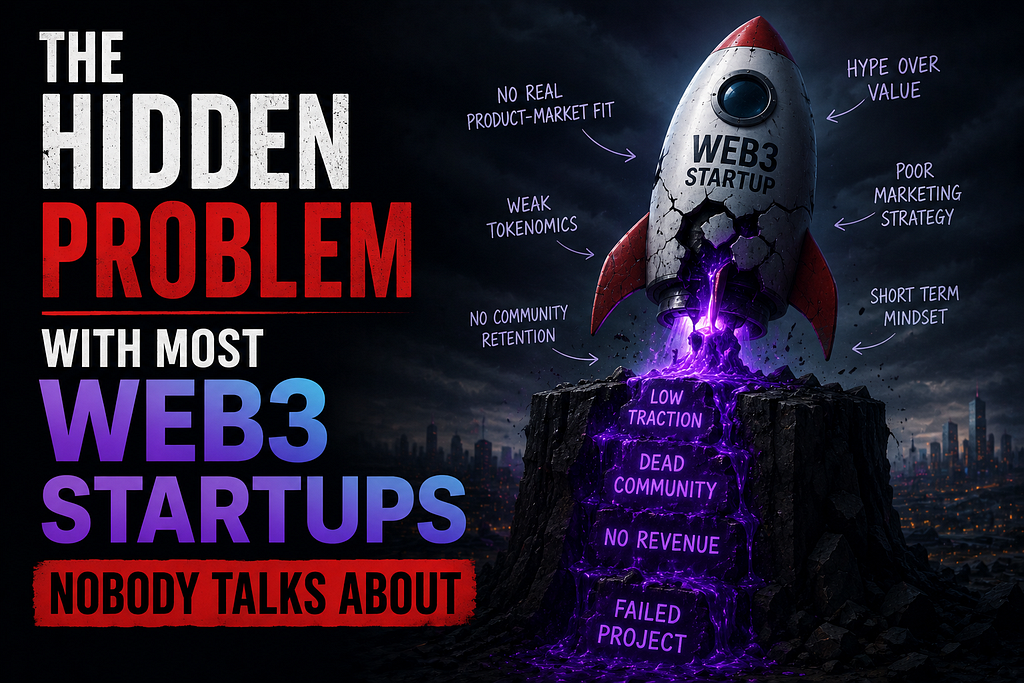
The Web3 industry moves fast. One week a project is trending across Crypto Twitter, Discord communities are exploding with activity, and influencers are discussing it everywhere. A few months later, many of those same projects become quiet, engagement drops, and users move on.
We often hear explanations like market conditions, token prices, regulations, or lack of funding.
But there is a bigger problem that rarely gets enough attention.
Most Web3 startups are building products before building reasons for people to stay.
That sounds strange at first. After all, isn’t building a great product the main goal?
Not exactly.
Many Web3 startups are technically impressive. They launch with strong teams, receive funding, build advanced infrastructure, and create innovative blockchain solutions. Yet many still struggle to create lasting ecosystems.
The problem is not always technology.
The hidden problem is that many startups confuse attention with adoption.
Getting attention in Web3 is easier than it has ever been.
Projects can generate visibility through:
But attention is temporary.
Adoption is different.
Adoption happens when users return because they genuinely find value in what a project offers.
A user joining your Discord for rewards is not necessarily adoption.
A user returning every day because they enjoy using your platform is.
Unfortunately, many startups optimize for the first metric.
Let’s look at a real pattern seen repeatedly across Web3.
Many projects launch reward campaigns where users complete tasks:
Initially, numbers look amazing.
The community grows from 5,000 members to 100,000 members.
>Twitter followers increase dramatically.
>Engagement appears strong.
>Investors become interested.
>Everything looks successful.
>Then the rewards stop.
>Suddenly activity drops.
>People disappear.
>The reality becomes obvious:
>Many users were never there for the product.
>They were there for incentives.
>This isn’t criticism of reward campaigns. Incentives work.
>The problem appears when incentives become the only reason users participate.
We’ve seen versions of this happen repeatedly across multiple projects and ecosystems where user growth looked massive initially but retention became difficult after campaigns slowed.
The NFT market provides one of the clearest examples.
During the major NFT boom, thousands of collections launched almost every week.
Many projects promised:
Some generated enormous hype.
People rushed to buy assets because everyone else was doing the same.
But after excitement faded, many projects struggled.
Why?
Because beyond the initial hype, users had no ongoing reason to participate.
Projects built excitement.
They did not build habits.
Many Web3 founders see community metrics like this:
Those numbers can look impressive in pitch decks.
But community size does not always equal community strength.
A smaller group with highly active users often creates more value than a massive inactive audience.
Consider the difference between:
Community A:
200,000 members
Community B:
20,000 members where people actively discuss products, create content, help newcomers, and genuinely believe in the mission.
Most founders would choose Community A at first.
Long term, Community B usually wins.
Some of the strongest Web3 ecosystems did not grow because people wanted rewards.
They grew because people wanted participation.
Look at large blockchain communities and ecosystems that succeeded over time.
Users:
They become participants rather than customers.
That’s a huge difference.
People stay where they feel ownership.
This happens more often than many realize.
Startups sometimes become heavily focused on:
These things matter.
But eventually users ask a simple question:
Why should I keep using this?
If the answer depends entirely on future promises, problems begin.
Users care less about how much money a project raised and more about whether it solves something useful.
Interestingly, the same pattern is starting to appear in AI.
Many AI startups today are launching rapidly because of market excitement.
Some add AI labels to products without solving meaningful problems.
Web3 previously experienced similar behavior.
AI and Web3 together create exciting opportunities, but hype alone cannot create sustainable ecosystems.
Projects combining AI and Web3 may need to answer bigger questions:
The projects answering these questions effectively may have stronger long-term potential.
Instead of asking:
“How do we get more users?”
A better question might be:
“Why would users stay?”
Some useful areas include:
Understand:
Encourage:
Many users still enter Web3 without understanding products deeply.
Education creates stronger communities.
The hidden problem with many Web3 startups is not weak technology, small budgets, or poor ideas.
It is building ecosystems designed to attract people rather than ecosystems designed to keep people.
Attention creates temporary spikes.
Retention creates long-term growth.
The next generation of successful Web3 startups may not necessarily be the loudest projects with the biggest marketing campaigns.
They may simply be the projects that give users a reason to come back tomorrow.
The Hidden Problem With Most Web3 Startups Nobody Talks About was originally published in Coinmonks on Medium, where people are continuing the conversation by highlighting and responding to this story.





