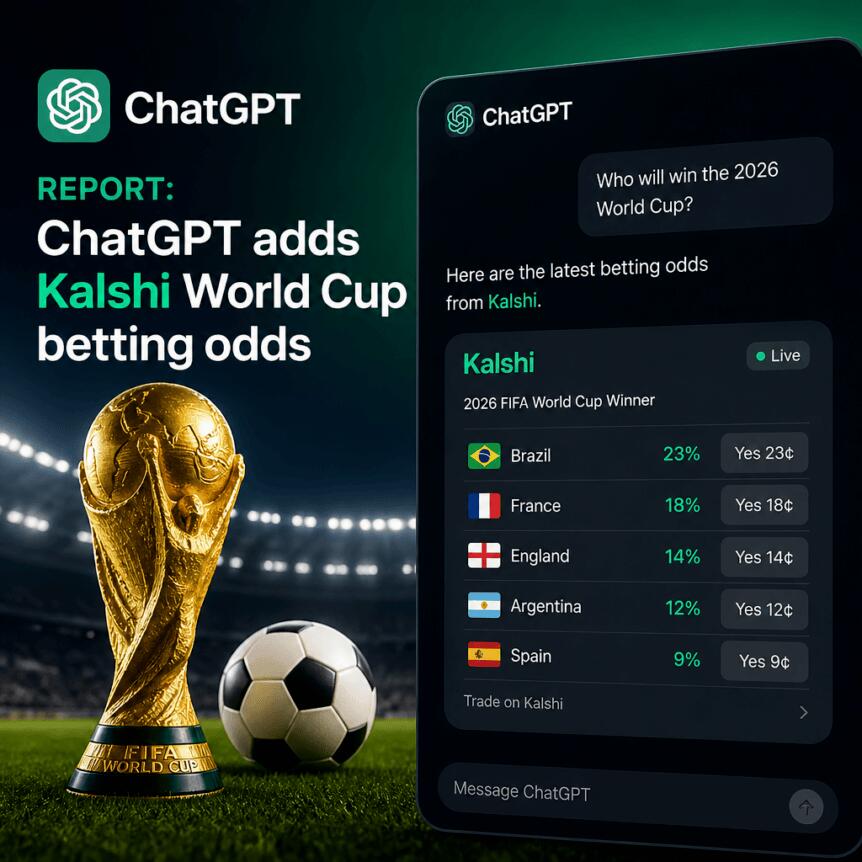
OpenAI has begun surfacing prediction-market odds from Kalshi directly inside ChatGPT search results for FIFA World Cup matchups, according to a report from The New York Times. The integration provides fans with an at-a-glance view of each team’s implied probability of winning, sourced from live market pricing—without turning the chat interface into a betting channel.
The partnership was not publicly announced at the time of the report. Kalshi declined to comment to Cointelegraph, and OpenAI did not respond to a request for comment.
As described by The New York Times, when users search for World Cup fixtures in ChatGPT, the interface can show market-based odds as graphics. These visuals break down each team’s implied chance of winning, reflecting how prediction-market participants price outcomes.
In one example cited in the report, a ChatGPT search for France versus Spain showed France at a 59% probability of victory. Another query—England versus Argentina—displayed England at a 55% chance, with the probabilities attributed to Kalshi’s market pricing.
Importantly, the feature is framed as data display rather than a trading mechanism. OpenAI’s guidance, as referenced by the report, indicates users cannot place wagers through ChatGPT; the Kalshi feed is intended for informational purposes only.
Prediction markets are built on the idea that crowds of participants, acting on available information, can collectively form price-based forecasts for real-world events. Translating those prices into implied probabilities gives users a compact summary of what the market currently thinks is more likely.
For consumer AI experiences, this is a notable shift: instead of relying solely on curated editorial forecasts or static historical analytics, the AI interface can present live, outcome-relevant probabilities that update as the underlying market changes. In practice, that matters for users who want a “current best guess” rather than a delayed consensus.
The World Cup is a particularly test-friendly environment for this approach. Matchups are clear, outcomes are well-defined, and the timing is within a single tournament window—attributes that make it easier for users to compare predictions with results as they unfold.
Kalshi is a regulated prediction market platform where traders can buy and sell contracts tied to real-world events, including sports, economics, and politics. While prediction markets have existed for years, their gradual integration into major technology and media ecosystems has accelerated recently.
Dune Analytics data cited in the report indicates Kalshi recorded more than $33 billion in monthly notional volume in June 2026, roughly $22 billion ahead of Polymarket. That kind of volume signal is often read by the market as evidence of liquidity and participation—factors that can influence how useful price-derived odds are for observers.
Calendar effects likely play a role as well. A World Cup naturally concentrates attention and trading activity, which can pull these odds into the mainstream at the exact moment sports audiences are most engaged.
The ChatGPT feature follows a broader pattern: prediction-market data increasingly appears inside high-visibility platforms rather than remaining confined to trading dashboards.
Kalshi has already established partnerships with major media outlets. According to Kalshi’s announcements, it entered an arrangement with CNN and another with CNBC in December 2025 to integrate its market data into coverage.
Rival platforms have pursued similar distribution deals. Bloomberg reported that Polymarket partnered with Dow Jones in January 2026 to bring prediction market data to products including The Wall Street Journal, extending market-based odds into traditional finance publishing.
Tech search products are also getting involved. Google reportedly integrated prediction-market information from both Kalshi and Polymarket into Google Finance and Search products in November 2025, positioning those odds within everyday discovery flows rather than requiring users to visit a trading website first.
Against that backdrop, OpenAI’s use of Kalshi odds in ChatGPT looks less like a one-off novelty and more like part of a wider supply-chain for “market intelligence” becoming a feature—rather than a separate destination.
For readers, the key question is whether this remains a World Cup-specific display or expands into other event categories and geographies. If OpenAI continues to surface market-based forecasts beyond sports—and if more platforms treat those odds as an everyday reference point—the practical impact will be felt less in trading volumes alone and more in how quickly prediction-market consensus becomes embedded in routine decision-making.
This article was originally published as Report: ChatGPT adds Kalshi World Cup betting odds on Crypto Breaking News – your trusted source for crypto news, Bitcoin news, and blockchain updates.





