Two weeks after the transition period under the EU MiCA Regulation closed, the shape of the region's reorganized crypto market is starting to come into focus — and the early evidence tells two very different stories.
On one hand, licensed exchanges say they are picking up new users under the new regulatory framework. On the other hand, survey data shows the vast majority of European crypto holders have no idea whether their own platform is even allowed to keep serving them.
The transitional window, which had allowed firms previously registered under national crypto rules to keep operating while they pursued full authorization, closed on July 1, 2026.
According to figures cited in recent reporting, roughly 80% of the more than 1,200 firms that held national registrations failed to secure a Crypto-Asset Service Provider (CASP) licence before the deadline.
Only about 230 of those 1,200 providers obtained the authorization needed to keep operating in the bloc, while many others withdrew from the market, searched for buyers, or simply lost the ability to serve EU clients.
Among the casualties was Binance, which withdrew its EU MiCA regulation licence application in Greece on June 24 and confirmed it would stop serving EU customers without authorization once the deadline passed.

Source: Official Banxa X
Against that backdrop, licensed rivals moved quickly to capture displaced users. Exchange OKX, which has held a full MiCA licence since January 2025, said its EU app downloads jumped 158% over the 12 days following Binance withdrawal announcement — more than double the roughly 70% average growth it tracked across ten MiCA-licensed exchanges over the same window, citing Sensor Tower data.
OKX also reported that inflows specifically from former Binance users rose more than 830% compared with the prior 12-day period. Those numbers, however, describe activity on the OKX platform only; no independent, market-wide accounting of where displaced users actually went has yet been published.
The regulatory shift matters because it fundamentally changes how crypto firms reach EU customers. Under the old system, a national registration was often enough to operate locally.
Under the new framework, a CASP authorization is tied to a specific legal entity and grants that entity passported access to serve customers across all 30 European Economic Area countries — but protections apply only to the authorized entity itself, not to affiliated companies elsewhere.
That makes licensing status a gatekeeping factor for the entire industry, from wallets and exchanges to payment processors and stablecoin issuers.
Yet a Paybis survey of more than 850 European crypto users, published July 13, found that 68.6% do not know whether their current exchange is MiCA-compliant. When asked what actually drives their choice of platform, respondents ranked fees highest (31.8%), followed by third-party reviews on sites like Trustpilot and Google (26.9%), personal recommendations (21.6%), and sign-up bonuses (19.7%).
Notably, regulatory status did not top the list. The survey was conducted by Paybis, itself a MiCA-licensed crypto exchange, a detail worth keeping in mind when weighing the results.
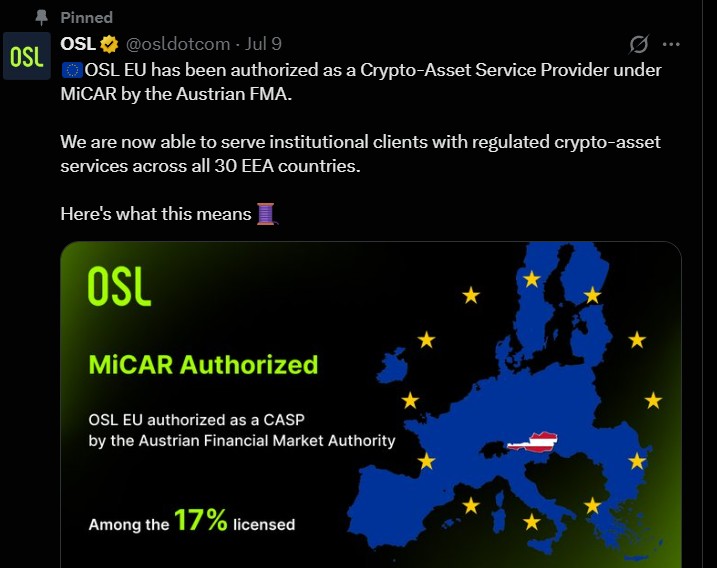
Source: OSL X
Taken together, the two data points complicate rather than confirm the "flight to licensed platforms" narrative. OKX's download and inflow figures suggest movement toward compliant exchanges, but the Paybis survey suggests most users aren't making decisions based on compliance status at all — because most don't know their own exchange's status in the first place.
A separate check of aggregate exchange balances on blockchain analytics platform Arkham Intelligence adds further doubt. It shows OKX and Binance on-chain holdings rising and falling together over the same two-week stretches, rather than diverging in the way funds would move if users were shifting from one platform to the other.
That pattern looks more consistent with market-wide price swings than a one-directional migration of user funds. Because the balance data isn't broken down by region, it can't rule out an EU-specific flow — but it also doesn't support the scale of migration that OKX's own figures imply.
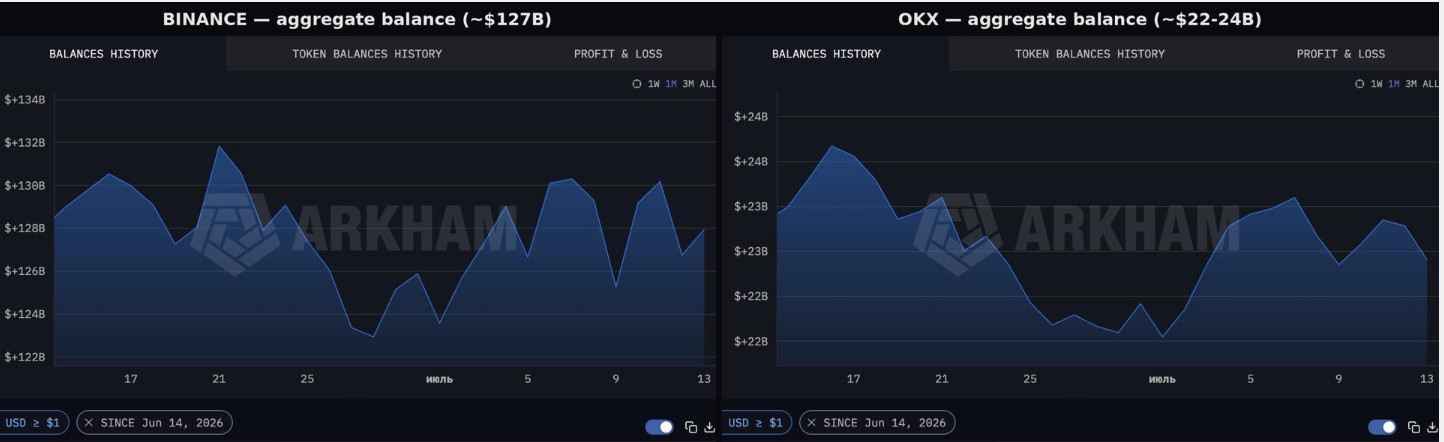
Source: Arkham
The MiCA shakeout has also drawn commentary from within the industry, including from WeFi, a Web3 financial infrastructure platform. WeFi's chairman and co-founder of Tether Reeve Collins, and WeFi's co-founder, Maksym Sakharov commented on MiCA's regulation 2026. Is it creating a more mature crypto industry, or making Europe less attractive for early-stage blockchain startups?
Maksym Sakharov, CEO & Co-Founder of WeFi, offered the following comment:
"MiCA is primarily pushing Europe's crypto market toward maturity, but the pressure will be felt differently by established firms and early-stage startups. Clearer rules can improve user protection, transparency, custody standards, and accountability, which are necessary if crypto and stablecoin payments are going to move into real financial use.
The uncertainty is practical rather than ideological. If compliance becomes too costly, slow, or inconsistent across member states, serious startups may spend more time understanding the framework than building useful products. Clear rules help founders, but only when the path to implementation is predictable enough for smaller teams to follow.
For infrastructure providers like WeFi, the strongest outcome would be a European market where regulation raises trust without narrowing innovation to the largest players. MiCA's success will depend on whether Europe can turn regulatory credibility into a workable environment for building compliant, user-focused financial infrastructure."
Sakharov's comment echoes a tension running through the broader post-MiCA data: licensing is meant to raise trust and consolidate the market around credible players, but the same barriers that filter out weak actors can also weigh disproportionately on smaller, resource-constrained teams — the ones often responsible for early-stage innovation.
Separately, Dutch regulators granted EU MiCA regulation authorization to Webull, one of the first major approvals to follow the close of the grandfathering period, with the firm planning to launch crypto trading and custody services later in 2026.
The licensed population across Europe now sits at around 230 firms. The European Parliament has also urged the Commission to address regulatory gaps that don't fully cover, including DeFi lending, staking products, and the unclear status of NFTs and tokenized assets.
Whether the current reshuffle ultimately consolidates around a small number of licensed exchanges, or scatters across self-custody wallets and platforms winding down EU operations, should become clearer in the coming weeks as the latest ESMA updates its CASP register and more of the roughly 1,200 previously registered firms receive final licensing decisions.
The early data on the EU MiCA Regulation offer competing signals rather than a clear verdict: one exchange's growth numbers point toward consolidation among licensed players, while survey data suggests most users remain unaware that the rules changed at all. A fuller picture will likely require independent, market-wide data — something that, two weeks in, still doesn't exist.
Disclaimer: This article is for informational purposes only and does not constitute financial or investment advice. Cryptocurrency markets are volatile and involve risk; readers should conduct their own research before making investment decisions.





