
The world of cryptocurrencies is rapidly changing and developing, and the use of P2P crypto exchanges has become increasingly popular. This way of conducting transactions allows users to buy or sell tokens by using a platform where people buy and sell directly from each other, providing various payment opportunities and control over the transaction process. Considering the rapid development of the cryptosphere all around the globe, launching a reliable and legally appropriate P2P crypto exchange business can be considered as a promising venture to invest in.
The USA and the UK are two major regions for the development of P2P crypto exchanges owing to their developed fintech market, widespread adoption of cryptocurrency, and highly developed digital economy. Nevertheless, different regulations, licensing, and compliance standards may have a huge impact on the success of the crypto business.
When creating either a custom or white label P2P crypto exchange, it is important to understand the peculiarities of the markets. This comparison helps to see the factors influencing the development of P2P crypto exchanges in the USA and the UK, which will help you choose the most convenient market for your crypto business in 2026.
Selecting the target market is one of the crucial issues for the implementation of P2P crypto exchanges. Depending on the chosen country, the startup faces certain aspects of legal regulation, licensing procedures, development expenditures, strategies for acquiring new customers, as well as possibilities for further growth. Considering these parameters will help to create a platform that would be both scalable and regulated.
The USA and the United Kingdom can be regarded as one of the best countries to develop cryptocurrencies. The USA presents one of the largest and most active crypto markets due to the high trading activity, presence of institutional investors, and an increasing number of people using cryptocurrencies. At the same time, businesses will have to deal with complicated legislation in this sphere.
The United Kingdom is famous for its financial innovation and has established itself as one of the centers for financial innovations, especially for those connected with cryptocurrencies. Due to a favorable ecosystem, good infrastructure, and access to international markets, the UK is a perfect place for the creation of a P2P crypto exchange.
Comparing the USA and the UK allows businesses to:
By understanding the strengths and challenges of both markets, businesses can make informed decisions, minimize operational risks, and choose the best location to launch and grow a successful P2P crypto exchange in 2026.
Both the US and the UK are considered to be the best places where a P2P crypto trading platform can be launched. Still, there are some distinctions between these two markets that affect their sizes, regulations, competition, and development prospects. The analysis of these distinctions will enable the companies to choose the appropriate market depending on their goals.
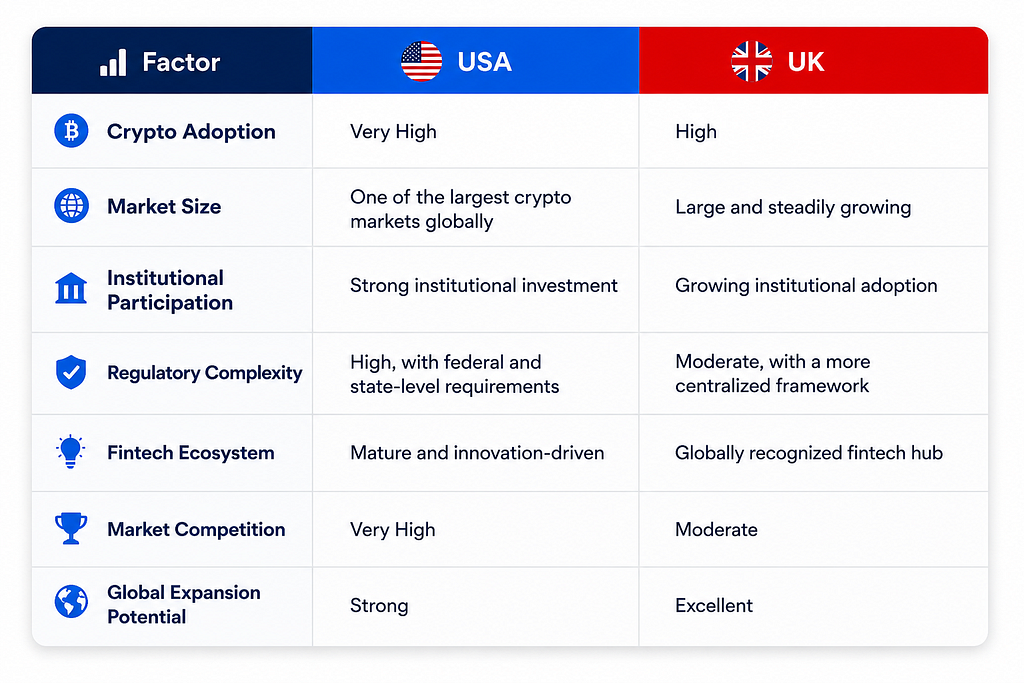
The United States ranks as one of the largest players in the cryptocurrency industry because of its huge population of users, huge trade volumes, and increasing number of institutions investing in it. America has sophisticated financial systems and blockchain technologies which makes it an ideal place for any company to establish a big P2P crypto exchange system. But businesses have to be ready to handle difficult regulations and compliance issues.
It has managed to become a leader in the sphere of fintech innovations and digital assets in the global arena. It has a developed financial sector, a highly educated IT sector, and a clear regulation system that makes it a good option for startups and already existing companies. Although the UK is smaller than the USA in terms of the market, it can provide you with great options to expand globally.
In the end, the USA will provide you with access to the bigger market of cryptocurrencies, while the UK will give you the right combination of regulation, fintech expertise, and business connections.
Compliance with regulations is among the top priorities in the creation of a peer-to-peer cryptocurrency exchange. Compliance ensures that companies are able to conduct themselves legally, gain customers’ trust, and minimize potential risks. Although the USA and the UK require similar standards from crypto exchanges regarding compliance, they have different licensing processes and requirements for compliance.
A peer-to-peer crypto exchange in the US usually operates under the dual compliance of federal laws and state laws in many situations. The legal framework for doing so is not always simple, which makes legal consideration crucial when developing such an exchange.
Businesses generally need to implement:
Depending on the geographical location of the platform, there could be other registration/licensing requirements. Legal assistance will be of benefit when dealing with such requirements.
In the UK, the regulations of crypto businesses are more centralized, and thus, it is easier to comply with them compared to the USA. The crypto exchanges should adhere to regulations aimed at curbing financial crime while securing the users’ interests.
Businesses typically need to:
While adherence to compliance is still key, the organized regulatory structure of the UK could help ease things for companies moving into the cryptocurrency arena. Making the right regulatory choice from the start would be beneficial, both in minimizing legal problems and establishing an effective and trusted P2P platform.
The development cost itself will depend on business objectives, rather than just the country itself. Nevertheless, doing business in various regions may affect compliance costs, infrastructure considerations, and legislation.
The following elements will affect the development costs:
Advanced trading capabilities increase development complexity.
Examples include:
Security is a major investment area for every crypto exchange.
Typical security features include:
Both markets require compliance solutions such as:
The USA may involve higher compliance implementation due to multiple jurisdictional requirements, while the UK generally offers a more unified compliance process.
Additional integrations may include:
Each integration contributes to the overall project scope.
A well-developed P2P crypto exchange can generate revenue from multiple sources beyond trading alone.
Common revenue streams include:
Charging buyers and sellers a small percentage for completed transactions remains the primary income source.
New cryptocurrency projects may pay to have their tokens listed on the exchange.
Businesses can offer premium trading features, lower fees, advanced analytics, or priority customer support.
Small charges on crypto or fiat withdrawals provide recurring revenue.
Secure escrow services help build user trust while generating additional income.
Professional traders and institutions may subscribe to advanced API services for automated trading.
Crypto projects, wallet providers, and blockchain companies often partner with exchanges for promotional opportunities.
The USA generally offers access to a larger customer base, while the UK provides strong international expansion opportunities through its global financial network.
Both the USA and the UK offer strong opportunities for businesses planning to launch a P2P crypto exchange, but the best choice depends on your target audience, growth strategy, and regulatory preferences.
Choose the USA if your business priorities include:
Choose the UK if your business priorities include:
For many businesses, a phased expansion strategy can also be a smart approach. Launching in one market first allows you to establish your platform, optimize operations, and build a user base before expanding into the other market.
Ultimately, the success of a P2P crypto exchange is not determined solely by its location. A secure, scalable, compliant, and feature-rich platform, combined with an effective growth strategy, is what drives long-term success. By choosing the right development partner and building with future expansion in mind, businesses can confidently compete in the evolving global crypto market.
We, at Malgo, are experts in building highly secure, scalable, and completely customizable P2P cryptocurrency exchanges for startups, enterprises, and cryptocurrency businesses. No matter whether you are looking to launch a regional marketplace in the USA and UK or develop a global peer-to-peer trading platform, our development process is geared towards ensuring reliability and success.
We know that there are different regulations governing each market and users have varying demands. This is precisely the reason why we create exchanges which have an architecture that is flexible, robust in terms of security, and can be easily customized according to the needs of the business model.
Given our expertise in blockchain technology and crypto exchange development, we create P2P platforms that integrate security, scalability, and user-friendly functionality. We aim to offer you solutions that will assist you in launching your crypto business with confidence and competing in the thriving crypto environment.
The USA and the UK both offer strong opportunities for launching a successful P2P crypto exchange in 2026. While the USA provides access to a larger and highly active crypto market, the UK offers a well-established fintech ecosystem with a comparatively streamlined regulatory environment. Understanding the differences in compliance, market demand, operating costs, and business potential will help you make a more informed investment decision.
Whether you choose the USA, the UK, or plan to expand globally, partnering with an experienced P2P crypto exchange development company is essential. Malgo helps businesses build secure, scalable, and feature-rich P2P crypto exchange platforms that are designed for long-term growth, regulatory readiness, and exceptional user experience.
USA vs UK: Which Market Is Better for P2P Crypto Exchange Development in 2026? was originally published in Coinmonks on Medium, where people are continuing the conversation by highlighting and responding to this story.





