[Our AI Business Services] — [Advertise with Us!]
Here’s what we’re tracking today, Team: Where is AI cutting jobs first, and which industries are feeling it most? How could this affect you? At the same time, CEOs are pushing AI across their companies, but many still aren’t using it themselves. And in the global race for driverless cars, China is pulling far ahead of the world. Let’s dive in — and stay curious.
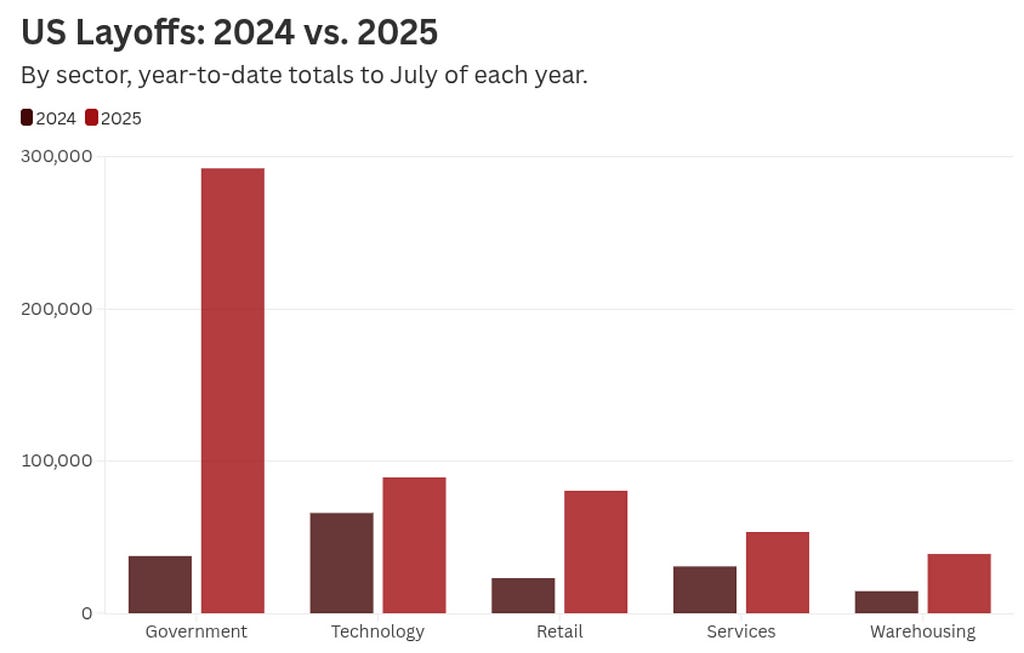
Challenger, Gray & Christmas.
AI isn’t replacing U.S. workers en masse — yet. According to MIT’s State of AI in Business 2025 report, the first disruption is hitting outsourced and offshore jobs, not internal staff.
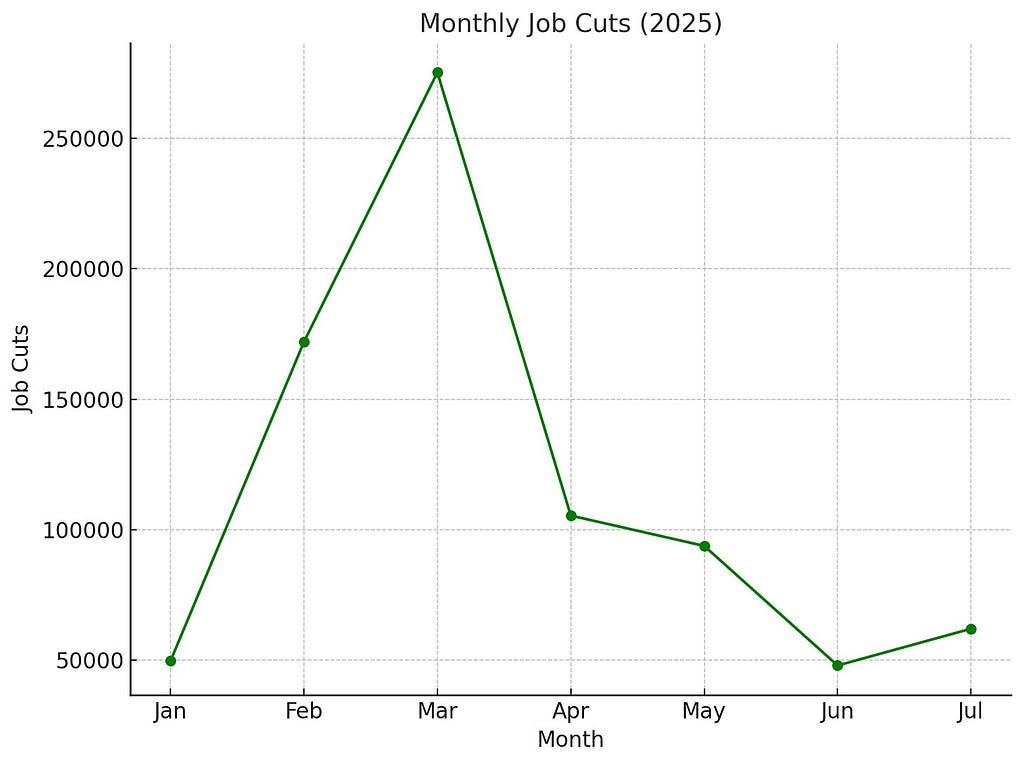
Challenger, Gray & Christmas
But:

AI’s first casualties are offshore contractors, not white-collar U.S. workers — but the long-term disruption could hit nearly one-third of jobs.
Leave a comment

Gartner 2025
Many CEOs hail AI as transformative, comparing it to the internet or the Industrial Revolution. Yet while 77% of executives say AI will reshape business, fewer than half believe their tech leaders are ready, according to a Gartner survey of 456 CEOs.
Younger employees are experimenting with AI daily (spreadsheets, design, marketing), while senior leaders, bogged down in meaningless meetings, often remain hands-off. How are these companies trying to fix this?
Still, adoption is uneven. A Bain study found that only 20% of companies are scaling AI, and half lack integration road maps. Leaders’ hesitation often stems from unfamiliarity and resistance. As Sarah Franklin, CEO of Lattice, put it: “Nobody is fully prepared. At best, they have six months of experience. It’s optimism mixed with FOMO.”
OpusClip — Video clipping tool that automatically transforms long‑form videos into high‑engagement short clips for TikToks, Instagram Reels, or YouTube Shorts.
Download our list of 1000+ Tools for free.

China is outpacing the U.S. in autonomous vehicles (AVs), driven by strong government support, national infrastructure investments, and consumer acceptance. By 2030, 20% of new cars in China are projected to be fully driverless, with 70% equipped with advanced assisted-driving systems. Already, 5 firms operate 2,300 robotaxis across 30 cities compared to Waymo’s 700 cars in 5 U.S. cities.
China’s edge comes from deep tech integration (Baidu, Huawei, Alibaba, Xiaomi), strong 5G connectivity, looser data-privacy rules enabling faster model training, and consumer trust: 85% of Chinese drivers are comfortable with AVs versus 39% in the U.S. With only 40% of households owning cars (vs. 90% in the U.S.), the biggest value lies in fleets for ride-hailing, logistics, and delivery.
Safety remains a challenge, fatal accidents and regulatory tightening highlight risks, but adoption continues at scale. Regulators aim to resume approvals for higher-level autonomy by 2026, while Chinese AVs are already expanding into Southeast Asia, the Middle East, and Europe.
Additionally, 72% of Chinese adults trust AI overall, compared with just 32% in the U.S., which is a significant difference in terms of adoption.
🪓Where AI Job Cuts Are Happening First was originally published in Coinmonks on Medium, where people are continuing the conversation by highlighting and responding to this story.