
| Category | Assessment |
|---|---|
| Product Type | Decentralized fundraising and IDO launchpad |
| Native Token | POLS |
| Main Use Case | Early access to token launches, staking, allowlists, and launchpad participation |
| Strongest Feature | Long operating history and recognized launchpad brand since 2020 |
| Main Weakness | POLS trades with low market cap, thin liquidity, and weaker launchpad hype than the 2021 cycle |
| Best Fit | Users who understand early-stage token risk and want structured access to curated launches |
| Risk Level | High |
| Editorial Score | 7.2/10 |
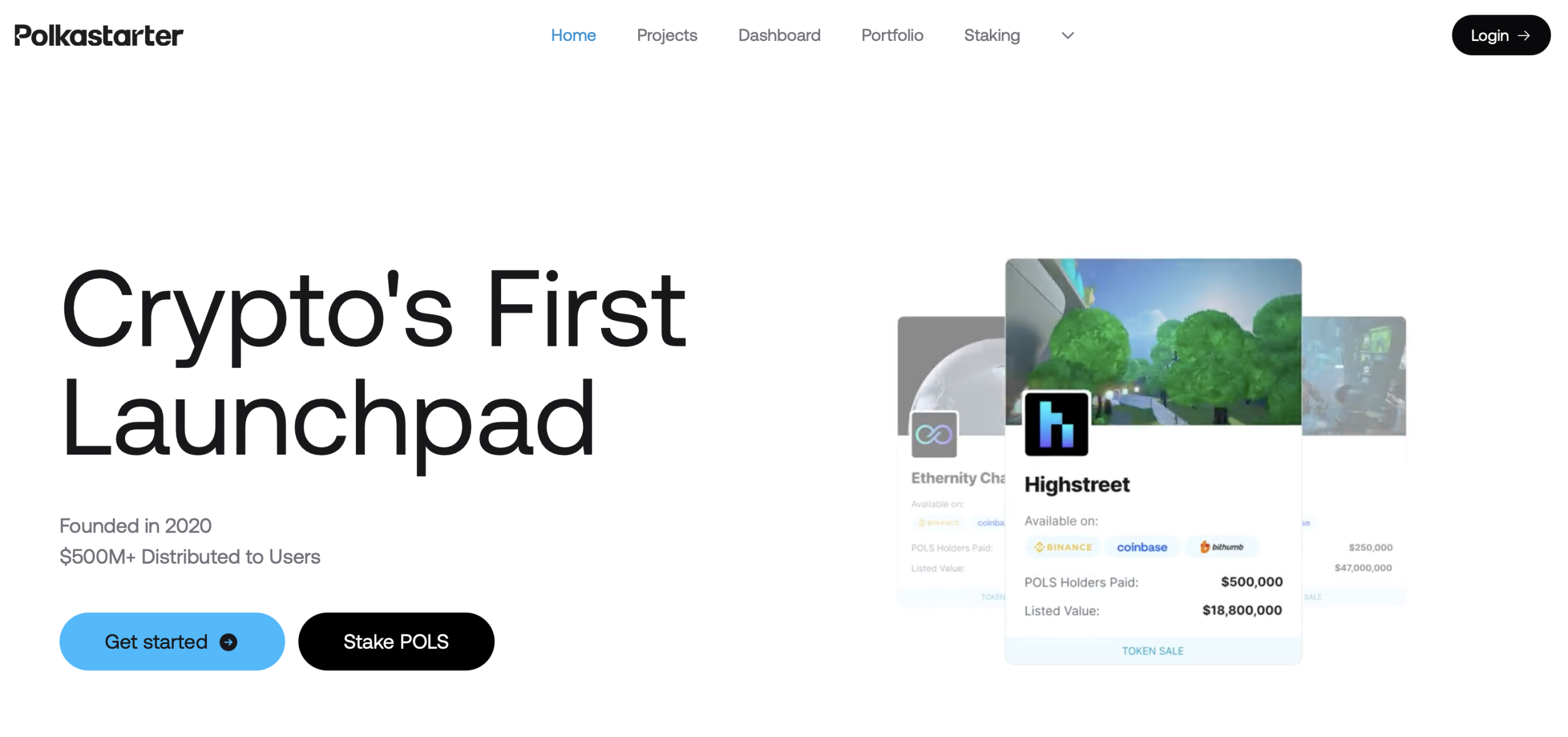
Polkastarter is a crypto launchpad built for early-stage Web3 fundraising. Its core product helps projects run token launches, build communities, and distribute allocations through structured sale mechanics rather than open-market chaos. For users, the main appeal is early access to IDOs, NFT sales, gaming projects, and curated token opportunities before broader exchange trading begins.
The platform has been active since 2020, which gives it more history than many launchpads that appeared during a single bull market and faded after their first cycle. Polkastarter’s current brand positioning focuses on curated sales, POLS access, market listings, staking, and support for projects that want more than a one-day raise. For projects, the launch process includes application review, due diligence, preparation, launch execution, and post-launch support.
That positioning is important because launchpads are not simple exchanges. Their value comes from curation, deal flow, allocation fairness, community quality, and whether launched projects keep building after the sale. Polkastarter still has name recognition, but the 2026 review needs to judge it as a mature small-cap launchpad rather than a fresh hype platform.
Polkastarter’s core mechanism is structured fundraising through token pools. The platform’s documentation defines it as a decentralized fundraising system that lets Web3 projects launch and raise funds through multi-chain token pools while growing their communities. The original launchpad model used fixed-swap pools, where token sale pricing stays predictable through the sale rather than changing dynamically with demand.
For participants, the flow is simple in concept but still requires preparation. Users need POLS exposure, wallet access, sale registration, KYC where required, and successful allowlist approval. The platform’s POLS utility framework gives users POLS Power through holding or staking, and that POLS Power affects sale access.
The strongest part of the model is structure. A project does not simply throw tokens into an open pool and hope for the best. It enters a launchpad environment where allocation, community access, preparation, and post-launch support can be managed more carefully. The weakness is that users still face early-stage token risk. Even a curated IDO can fail, underperform, delay development, or lose liquidity after listing.
POLS is the access token behind the Polkastarter ecosystem. Its main utility is participation power. Users can hold POLS in a wallet or stake POLS to qualify for sale access, with POLS Power influencing the value of tickets and allocation opportunities. The highest tier, 30,000+ POLS, removes the normal cooldown between IDOs when the user passes KYC.
The staking setup is useful because it gives POLS a reason to exist beyond speculation. Staking can grant immediate access to open and future IDO applications, while unstaked wallet holdings need to remain unmoved for at least seven days before they count toward POLS Power. POLS can be staked on Ethereum or BNB Chain, and staked tokens are locked on-chain before withdrawal.
This is a clean utility model for a launchpad token. The issue is demand consistency. POLS becomes more valuable when the launchpad has strong deal flow, high-quality sales, active users, and real competition for allocations. When IDO demand slows, POLS utility weakens because fewer users need access power.
Polkastarter’s main advantage is brand memory. It is one of the older names in IDO launchpads, and its website positions the platform around 100+ IDOs, 49,000+ on-chain holders, and sales across different crypto narratives. Recent featured examples include AI, DeSci, wealth-management, and agent-related projects, which shows that Polkastarter is trying to stay aligned with current market themes rather than only relying on old gaming and DeFi launches.
For projects, Polkastarter can still be useful because launchpads solve more than fundraising. A good launchpad creates distribution, early users, marketing pressure, community filtering, and investor coordination. Polkastarter’s accelerator partnership also gives earlier-stage teams a path toward mentorship, tokenomics support, business development, marketing, and possible initial funding before a public launch.
For users, launchpad quality depends on the actual projects available during the period they participate. Polkastarter cannot be judged only by historic winners or all-time-high returns. The better review question is whether current sales offer credible teams, realistic valuations, sensible vesting, transparent tokenomics, and enough post-launch liquidity.
POLS is no longer trading like a major launchpad narrative leader. At the time of review, CoinMarketCap placed POLS around $0.05, with a market cap close to $5 million and roughly 99.2 million tokens in circulation. CoinGecko also shows POLS trading near its all-time low and far below its 2021 all-time high of $7.51.
That market profile creates two opposite readings. The bullish reading is that POLS is a low-market-cap launchpad token with brand recognition, exchange availability, and a product that could benefit if IDO demand returns. The bearish reading is that the token has already lost most of its cycle premium, liquidity is thin, and the market is not pricing Polkastarter as a high-growth launchpad today.
POLS access has improved through major retail-friendly platforms. Polkastarter highlights availability across Coinbase, Kraken, Revolut, Bitvavo, KuCoin, Gate, MEXC, and HTX, while Revolut lists POLS market data with a 100 million maximum supply and a circulating supply around 99.2 million tokens. Wider access helps distribution, but price recovery still needs stronger usage, better launch performance, and renewed demand for early-stage token sales.
Polkastarter’s strongest feature is launchpad credibility. It has survived multiple cycles, kept the POLS token live on major platforms, and maintained a recognizable position in the IDO category. That matters because launchpads depend heavily on reputation.
The second strength is a clear token role. POLS has a direct purpose: sale access, staking, POLS Power, and allocation mechanics. Many tokens struggle to explain why users need them. POLS has a simple answer, even if the strength of that answer depends on deal flow.
The third strength is project-side support. Polkastarter is not only a smart contract pool. It offers a launch process, due diligence, preparation, and scaling support for teams. That can improve the quality of projects reaching users and reduce some of the randomness that defined earlier IDO markets.
The biggest weakness is market momentum. POLS has a small market cap, limited trading volume, and weak price performance compared with its 2021 peak. A cheap token is not automatically undervalued. It can also reflect lower demand, thinner liquidity, and reduced confidence in the launchpad sector.
The second risk is launch quality. Even curated projects can underperform. IDO users can face vesting pressure, low post-listing liquidity, delayed roadmaps, poor market timing, and heavy sell pressure after token generation events.
The third risk is access friction. Users may need KYC, sale registration, wallet setup, POLS holding or staking, gas fees, cross-chain awareness, and timing discipline. Polkastarter is easier than private venture investing, but it is not effortless.
Polkastarter remains a credible crypto launchpad in 2026, but it should be reviewed with mature expectations. It is not the explosive 2021-style launchpad trade anymore. It is a known fundraising platform with a small-cap utility token, recognizable exchange access, structured IDO mechanics, and a direct POLS staking model.
The platform is strongest for users who understand early-stage risk and want access to curated token launches through a recognizable launchpad brand. It is weaker for passive investors who expect POLS to rise simply because launchpads were once popular. The token needs stronger launch demand, better liquidity, and more standout current projects to rebuild a stronger investment case.
Polkastarter earns a 7.2/10 because the product is real, the brand still matters, and POLS utility is clear. It does not score higher because market momentum is weak, liquidity is thin, and the launchpad category needs renewed demand before POLS can justify a stronger upside case.
Polkastarter is still one of the more recognizable names in crypto launchpads, and its 2026 profile is stronger than many abandoned IDO-era platforms. The core product is clear: curated fundraising, POLS-powered access, staking, allowlists, and project launch support.
The investment case is more complicated. POLS has deep drawdown history, small-cap liquidity, and heavy dependence on launchpad demand. The best way to approach Polkastarter is as a high-risk utility platform tied to the return of quality token launches. Users who want structured early access may find it useful, while investors should focus on deal flow, staking demand, liquidity, and current sale quality before treating POLS as a recovery play.
The post Polkastarter Review: Complete 360 Analysis For 2026 appeared first on Crypto Adventure.





