
Regulatory requirements, fraud risk, and cross-border onboarding complexity have collectively pushed identity verification and compliance to the center of business operations. Where the market once fragmented across separate tools for onboarding, screening, and monitoring, platforms today are increasingly expected to manage the full compliance lifecycle within a single environment.
Six platforms were evaluated here against that standard. The core criterion is coverage across four compliance lifecycle stages: customer identity verification, business and UBO verification, AML screening, and ongoing transaction monitoring. Pricing transparency was assessed as a first-class criterion alongside it.
The results split the field: two of the six platforms document all four stages, and one publishes a public rate card. Shufti and Sumsub both document full lifecycle coverage; Shufti is the only platform in the group with published pricing, including a free tier of ten verifications monthly with no card required. For crypto-specific compliance, both Shufti and Sumsub document travel rule support, with Sumsub’s the more operationally developed of the two. Veriff’s document database spanning 230+ countries and territories makes it the strongest option for global document coverage.
The platforms below span full-stack compliance suites, purpose-built AML intelligence layers, and enterprise-scale identity infrastructure. The rankings reflect documented capability rather than marketing positioning.
Each platform was evaluated against four compliance lifecycle stages drawn from the obligations regulation 28 of the UK Money Laundering Regulations imposes on regulated firms: identifying and verifying the customer; obtaining and verifying a body corporate’s name, registration number, and registered office; identifying the beneficial owner; and conducting ongoing monitoring of the business relationship, including scrutiny of transactions throughout its course.
A capability is counted as documented only if it appears explicitly in the vendor’s public-facing materials (product pages, developer documentation, or pricing pages) as of August 2026. Enterprise contract features, sales-quoted capabilities, and capabilities described only in press releases or third-party reviews are not counted. If a stage or feature is not publicly described, it is treated as not documented for this review, regardless of possible availability under an enterprise contract. This distinction matters: several platforms almost certainly offer capabilities beyond what their public documentation states including Shufti’s own enterprise tier, which is quoted rather than published but a compliance buyer assessing a vendor without a prior sales relationship can only work from what is publicly available.
The same standard applies to pricing. A rate card is counted as published only when a specific figure or tier structure appears on a publicly accessible page without requiring a login or demo booking.
Note: figures cited below (accuracy rates, latency, false-positive reductions, data-point counts, and similar metrics) are vendor-reported unless otherwise stated. They come from public product and marketing materials rather than independent audits, and are presented here as claims to verify with each vendor directly rather than as independently confirmed benchmarks.
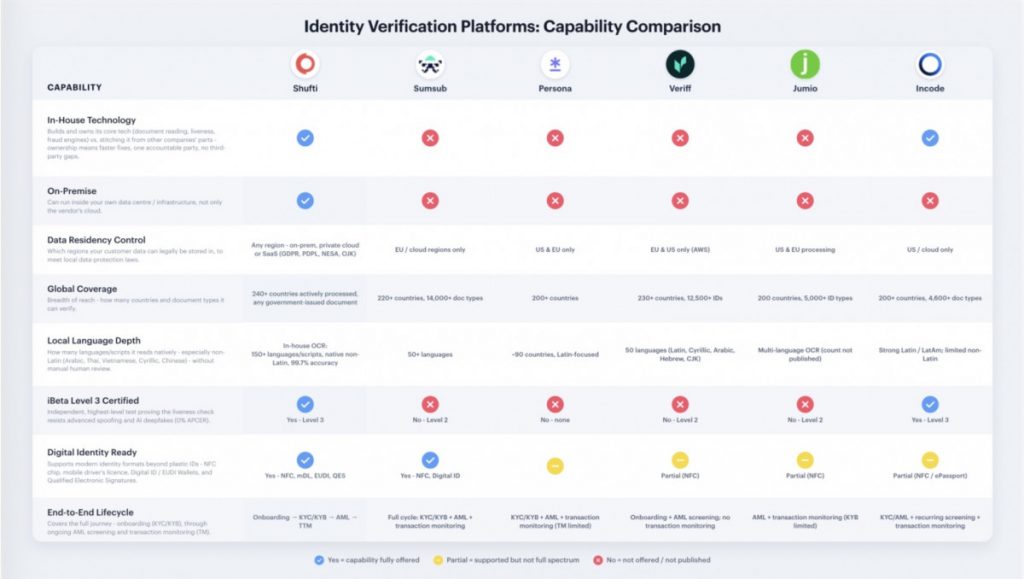
Shufti is one of two platforms in this review alongside Sumsub with documented coverage across all four compliance lifecycle stages, and the only one of the six with a published rate card. It serves 2,000+ businesses across 240+ markets, builds and owns its core document reading, liveness, and fraud engines in-house (a distinction shared only with Incode among the platforms reviewed here), and is the only vendor in this group that supports on-premise deployment inside a client’s own data center.
Onboarding covers document verification, facial biometrics, address checks, and age verification across 240+ actively processed countries, with in-house OCR across 150+ languages and scripts, including native non-Latin support that Shufti reports at 99.7% accuracy. Business verification extends into KYB, ultimate beneficial owner discovery, and due diligence. The AML screening layer is broad: sanctions, politically exposed persons, relatives and close associates, adverse media, crypto wallet screening, transaction monitoring, travel rule compliance, and unhosted wallet verification. Shufti describes the platform as MiCA-aligned, FATF Travel Rule-aligned, and VASP-onboarding-ready.
Transaction monitoring is documented with more specificity than most vendors in this review provide. Shufti reports 60% fewer false positives, 500ms latency per call, and 1,600+ enriched data points per transaction, with verified identity, KYC outcome, screening status, and transaction behavior consolidated into a single auditable decision trail. Shufti also states it screens against 3,500+ curated watchlists drawn from 100,000+ sources.
Data residency is documented more flexibly than any other platform reviewed here. Shufti supports any region, including on-premise, private cloud, or SaaS, with documented compliance across GDPR, PDPL, NESA, and OJK. Every other platform in this group restricts residency to US and/or EU infrastructure.
Sumsub is next on the list. It documents all four compliance lifecycle stages across a product environment that splits into user verification, fraud prevention, transaction monitoring, travel rule, business verification, and case management. Its document library, 14,000+ identity and address document types across 220+ countries and territories, is the largest in this group by document count, though its data residency is restricted to EU and cloud regions, a meaningful constraint for businesses with localization requirements outside that footprint.
Onboarding covers identity and address verification across the full document range. Business verification extends into KYB and UBO discovery. The AML layer includes sanctions, PEP screening, and adverse media, augmented by a March 2026 partnership with ComplyAdvantage that integrates Mesh, ComplyAdvantage’s proprietary financial crime intelligence layer, directly into Sumsub’s screening environment. Transaction monitoring and case management are documented as distinct products within the same platform.
The travel rule module is the most developed crypto-specific feature documented here. A self-service product launched in May 2026 targets small and mid-sized VASPs, allowing platforms to activate compliant crypto transfers through preset configurations and SDK-based flows at zero implementation fee, with access to a network of over 2,100 VASPs. Counterparty network size determines practical interoperability under travel rule obligations, and that figure is the most specific published here. Sumsub reports 1,000 crypto companies currently active under the offering.
The no-code workflow builder allows compliance and product teams to configure onboarding journeys without engineering involvement. Reusable identity is documented via a share token endpoint, reducing repeat verification costs for organizations operating multiple regulated entities under a single compliance program.
Next in the list is Incode. It shares two of Shufti’s most differentiating technical credentials, namely, in-house AI architecture and iBeta Level 3 liveness certification, but sits below Sumsub on geographic breadth and below both on data residency flexibility, with deployment restricted to US and cloud infrastructure. Its document library covers 200+ countries and 4,600+ document types, the narrowest country count among the top three here. Language support covers Latin and LatAm scripts. No non-Latin language or script count is published in public documentation.
The platform documents KYC, KYB, AML compliance, age assurance, case management, and recurring screening as native capabilities. Transaction monitoring is present in Incode’s own lifecycle mapping but absent from public-facing product pages, a gap that prevents Incode from meeting the full lifecycle standard on equal documentary terms with Shufti and Sumsub, and is treated as not documented under this review’s methodology. The platform runs more than 35 proprietary AI models built in-house, and Incode states it continuously runs agentic attacker simulations against its own defenses, with zero successful bypasses in independent penetration testing.
The most significant third-party validation comes from two sources. Incode was named a Leader in the 2026 Gartner Magic Quadrant for Identity Verification, the third consecutive year and one of two such placements documented among the six platforms reviewed here. Separately, in March 2026 iBeta confirmed Incode as the first company to achieve Level 3 PAD conformance under ISO/IEC 30107-3 on both iOS and Android simultaneously, with zero errors across 900 attacks. Level 3 testing assumes attackers with considerable resources and the ability to manufacture professional-grade facial masks, which is the most demanding publicly available liveness standard. Shufti holds the same Level 3 certification; every other platform here is at Level 2 or below.
The most substantive recent product launch is GovFaceMatch, announced in August 2026. It matches a live selfie against official state DMV records in real time using a two-step flow, including ID barcode scan followed by selfie capture, that Incode reports averages ten seconds and delivers 20% better conversion than traditional document-based verification. The product is reported to stop 99.9% of fraudulent identities that pass data-only checks. GovFaceMatch positions Incode’s enterprise identity data, over 7 billion trust checks and 400 million profiles in particular, as a live verification layer rather than a static reference set.
Veriff ranks fourth in this review. Its document forensics database spans 230+ countries and territories with 12,500+ supported ID types, the second-widest country count here and the most granular ID library documented among the six platforms reviewed. That coverage figure explains Veriff’s presence across most competing lists in this category, though it is not directly comparable to Shufti’s 240+ markets, a unit Shufti does not define with equivalent specificity.
Where Veriff loses ground relative to the platforms above it is on lifecycle completeness and infrastructure flexibility. Transaction monitoring is not documented. Veriff covers onboarding identity verification, AML screening, and business verification, stopping at the monitoring stage that regulation treats as a distinct post-onboarding obligation. Data residency is restricted to EU and US infrastructure on AWS, with no on-premise option. Core technology is assembled from third-party components rather than built in-house, and liveness certification sits at iBeta Level 2, consistent with Sumsub and Jumio and two levels below Shufti and Incode. Digital identity support is partial, covering NFC only.
The clearest differentiation Veriff has established in 2026 is on synthetic fraud detection. In January 2026, Veriff reported a 100% detection rate of synthetic fraudulent documents across a sample of nearly 30,000 documents from the IDNet dataset, a benchmark focused on AI-generated credential fraud. Synthetic identity fraud, which means where real and fabricated data are combined to construct new identities, has accelerated with generative AI tools that allow mass production of fraudulent credentials at scale. The IDNet result is a benchmark performance metric measured against a curated dataset and does not represent production accuracy across live traffic, where error rates are expected to be higher due to real-world variability. Separately, Veriff reports approximately 99.6% accurate IDV decisions. So, it’s the highest vendor‑reported figure in the group. This metric is self‑declared and not independently validated.
Language coverage extends to 50 languages including Latin, Cyrillic, Arabic, Hebrew, and CJK scripts, broader than Incode’s non-Latin support but narrower than Shufti’s 150+ languages and scripts with native OCR.
In June 2026, Veriff was named a Leader in the G2 Summer 2026 Identity Verification Grid report, with a 4.5 out of 5 rating from verified customer reviews and standout scores on AI Document Check and Liveness Detection at 96% and Standards Compliance at 95%. No Gartner Magic Quadrant placement is documented.
Its positioning reflects a deliberate architectural choice, a composable, API-first identity platform, rather than a gap in ambition. Against the criteria this review measures, that choice carries a consistent set of trade-offs: no in-house technology stack, no on-premise deployment, data residency restricted to US and EU, Latin and LatAm scripts supported in ~90 countries, and no iBeta liveness certification at any level, the only platform in this group with no PAD conformance record. Transaction monitoring is present in the platform but documented only as limited in scope, which prevents Persona from meeting the full lifecycle standard on equal terms with Shufti and Sumsub.
The architecture is deliberately composable. Persona exposes verification, fraud investigation, link analysis, and orchestration as configurable components, including Inquiries, Transactions, Accounts, Cases, Connect, Events, Graph, Lists, Reports, Verifications, and Workflows as separate objects, with the explicit expectation that product and engineering teams assemble the verification logic rather than adopt a packaged flow. The Graph product supports custom fraud-ring detection through query templates; Cases provides an in-platform review queue. Organizations that need granular control over verification logic and have the engineering capacity to configure it will find more flexibility here than in any other platform in this review.
Persona’s 2026 trajectory extends meaningfully beyond its IDV-API origins. In July 2026, Persona was named a Leader in the 2026 Gartner Magic Quadrant for Identity Verification for the second consecutive year, positioned highest for Ability to Execute among the 12 vendors evaluated, and ranked first across Risk Mitigation and Consumer use cases in the accompanying Critical Capabilities report. That places Persona alongside Incode as one of two platforms here with a confirmed, publicly documented Gartner placement in 2026. In May 2026, Persona achieved FedRAMP Moderate Authorization, opening US federal government procurement channels that competitors without it cannot access.
New capabilities in 2026 include Candidate Verification for confirming job applicant identities at hiring stages, with native integrations into Ashby, Greenhouse, and Workday; and Relay, a double-blind verification product that confirms specific identity claims, such as age or verified human status, without sharing underlying identity data with the requesting organization. Document AI, updated in 2026, evaluates hundreds of indicators including pixel-level anomalies, editing software traces, and generative AI-specific texture and structure artifacts.
Against the four lifecycle stages this review measures, AML screening and transaction monitoring are documented, but KYB is limited rather than fully implemented, which, combined with the absence of in-house technology, on-premise deployment, and iBeta certification above Level 2, places Jumio below every other platform here on the criteria this review measures. Data residency is restricted to US and EU processing infrastructure, digital identity support is partial covering NFC and ePassport only. No language or script count is published in public documentation. It’s the only platform in this group without this metric.
What distinguishes Jumio is not lifecycle breadth but fraud network depth. The Jumio Identity Graph holds over 30 million identities, drawing on consented data from both verified legitimate users and known fraudsters to produce cross-customer fraud signals that a standalone document check cannot replicate. With 5,000+ supported global ID types, over one billion transactions processed, and documented throughput of 120 transactions per second, Jumio’s infrastructure is sized for enterprises where portfolio-level fraud signal aggregation is the primary requirement rather than full compliance lifecycle coverage.
The most substantive recent development is Jumio Watch, launched in April 2026, which extends risk assessment through daily portfolio-level reassessments. Documentation indicates up to 25% more risk detected post‑onboarding vs. point‑in‑time checks; no public false‑positive or accuracy metrics. The clearest expression of the company’s repositioning from verification tool to identity intelligence provider, a direction underlined by a new CEO appointment in Q2 2026. Also notable: in June 2026 Jumio became the first identity provider to enable digital ID acceptance across 60+ countries through a single integration, removing the country-by-country accreditation burden that had limited digital ID adoption at scale. The selfie.DONE product allows previously verified users to re-authenticate with a selfie alone, reducing friction in returning-customer flows.
The ranking reflects fit rather than quality. No single platform wins every scenario, so matching the tool to the specific regulatory duty matters more than the order below.
The six platforms split on two criteria: lifecycle completeness and infrastructure flexibility. Shufti and Sumsub are the only platforms here that document all four compliance stages in public-facing materials. Incode covers three stages with transaction monitoring absent from public documentation. Veriff covers three stages, stopping explicitly at ongoing monitoring. Persona documents transaction monitoring as limited in scope, and Jumio documents KYB as limited, both preventing either from meeting the full lifecycle standard on equal terms with the top two.
Shufti takes the top position, combining full lifecycle coverage with the broadest data residency flexibility, in-house technology, iBeta Level 3 certification, and the only public rate card in the group. Sumsub follows with documented full-lifecycle coverage, a large document library, and travel rule capabilities. Below them, the ranking separates on specific strengths, rather than on compliance breadth: Incode on liveness certification and enterprise deployment scale, Veriff on document coverage, Persona on workflow flexibility and analyst positioning, and Jumio on fraud network depth. The right choice follows the regulatory duty, not the ranking order.
The post Shufti, Jumio, Sumsub, And Beyond: Top 6 Identity Verification And Compliance Platforms To Know In 2026 appeared first on Metaverse Post.





