
Stablecoins are now averaging nearly $10 trillion in monthly transaction volume through April, according to Artemis data. That puts activity up about 93% from 2025’s monthly average and shows how quickly tokenized dollars are becoming the main settlement layer across crypto markets.
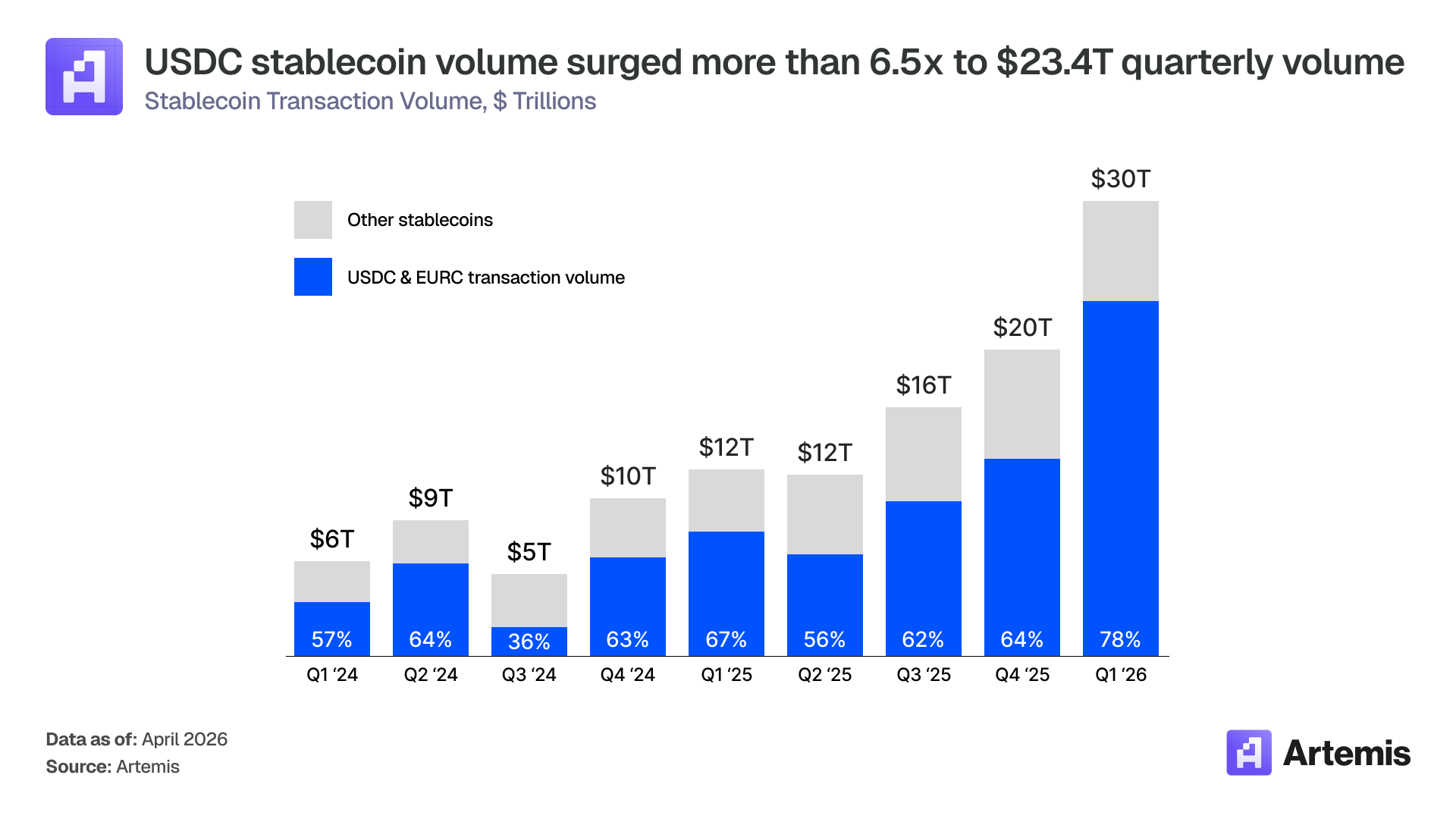
The headline number is massive, but it needs the right context. Stablecoin transaction volume includes trading, DeFi routing, exchange flows, minting, redemptions, treasury movement, and other on-chain settlement activity. It is not the same as pure consumer payment volume. Still, the growth shows that stablecoins are no longer just parking assets for traders. They are becoming the core unit of account and liquidity layer for on-chain finance.
Visa’s on-chain analytics dashboard makes the methodology issue clear by separating total transaction volume from adjusted volume. Its framework attempts to remove noisy activity such as bot-driven transfers, internal smart contract movement, and inorganic high-frequency flows. Even with those caveats, stablecoin usage continues to trend higher across public blockchains.
The biggest shift is USDC’s dominance. Artemis data places USDC at roughly 77.7% of total stablecoin volume year to date, making Circle’s dollar token the main driver behind the 2026 surge.
That share is notable because USDT remains larger by circulating supply and still dominates many offshore exchange flows. USDC’s volume lead points to a different kind of usage, with heavier activity across DeFi, regulated infrastructure, Base, institutional settlement paths, and applications that favor compliance-friendly rails.
That distinction matters for payment companies and fintechs. Stablecoins are moving deeper into settlement infrastructure, while card networks and issuers are experimenting with tokenized dollars as a way to move funds outside normal banking hours. The trend is already visible as Visa expands stablecoin settlement across card infrastructure.
The rise in stablecoin activity also changes how crypto liquidity behaves. When stablecoin transfer volume expands, capital can move faster between exchanges, DeFi protocols, lending markets, payment apps, and real-world settlement products. That creates a more fluid market, but it also concentrates risk around a few major issuers and chains.
USDC’s growing share gives Circle a stronger position in the stablecoin race, while USDT remains the largest token by supply and the key liquidity asset for many global exchanges. Recent USDT issuance shows that Tether is still expanding aggressively, even as USDC captures more transaction volume.
The 2026 data points to a stablecoin market that is scaling through settlement first and payments second. Consumer adoption may still take time, but the backend rails are already moving trillions. If USDC keeps controlling most of the volume while stablecoin activity stays near $10 trillion a month, the next major fight will be over which issuer, chain, and payment network owns the dollar layer of crypto finance.
The post Stablecoin Volume Nears $10T A Month As USDC Takes Command appeared first on Crypto Adventure.





