Tether, issuer of the USDT stablecoin, is cementing its position as infrastructure for Bitcoin and the broader cryptocurrency market. At the recent Bitcoin 2026 event in Las Vegas, Tether CEO Paolo Ardoino presented an inspiring keynote, evoking Isaac Asimov’s Foundation trilogy to describe Tether as building long-term foundations of civilisation through stablecoins, self-custody wallets, Lightning Network optimisation, and Bitcoin treasury management. The announcements included confirmation of Tether holding >140,000 BTC, a proposed game-changing merger of Twenty One Capital (XXI), Strike and Elektron Energy and new resources like the new tether.wallet Bitcoin faucet to encourage self-custody.
These announcements come at a time when there is strong evidence that stablecoins have gone beyond speculation.
Tether is a blockchain-based stablecoin that was launched in 2014. USDT aims to remain pegged to the US dollar on a 1:1 basis by holding tokens in reserve assets like cash, Treasury bills, gold and Bitcoin.
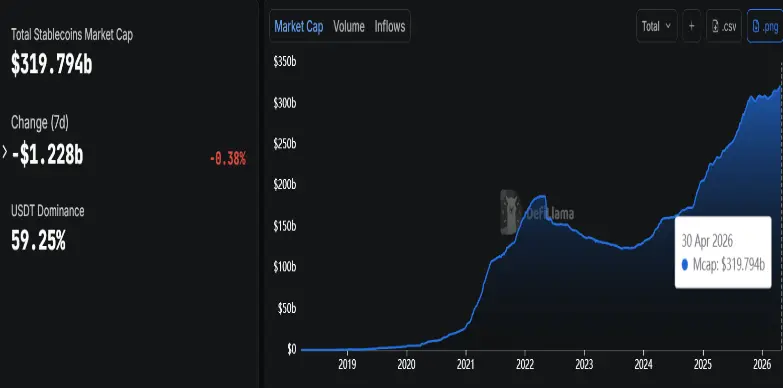
USDT is now the world’s biggest stablecoin and one of the most-traded cryptocurrency assets. It has a market capitalization of almost $189 billion as of 2026 with a daily trading volume of more than $121 billion. USDT has a 59% market share in the stablecoin market, which is over $320 billion.
The stablecoin acts as:
The conventional wisdom that stablecoins are mainly used for trading cryptocurrency is changing.
Onchain analyst Leon Waidmann highlighted figures indicating that real stablecoin payments in the real economy grew to $350-550 billion in 2025, up 55% year-on-year and after adjusting for trading, treasury and other non-organic activity.
The majority of the payments were business-to-business (B2B) with a volume of $150-230 billion, up 65%. Consumer-to-business (C2B) transactions were $90-130 billion, up 55%, and consumer-to-consumer (C2C) payments were also between $90-130 billion, up 75%. Business-to-consumer (B2C) payments amounted to $20-60 billion, up 50%.
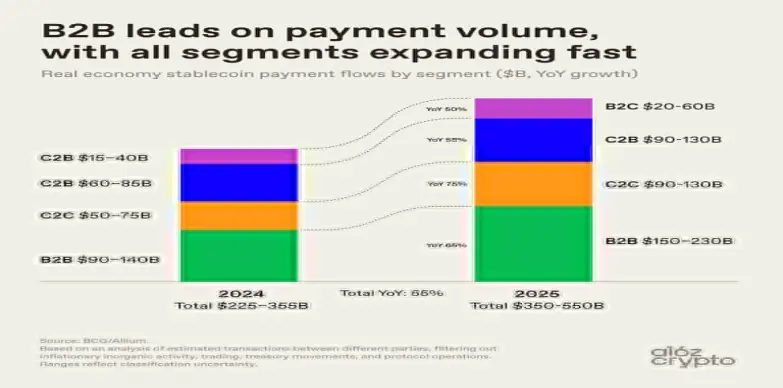
All segments grew more than 50%, with B2B remaining the largest and fastest-growing segment. The largest stablecoin, Tether (USDT), with nearly 58% market share, continues to play a pivotal role in facilitating these growing payment flows.
During the Bitcoin 2026 event, Tether CEO Paolo Ardoino revealed that the company is holding over 140,000 BTC. The news immediately caught the attention of on-chain analysts, with public data on Arkham Intelligence revealing that Tether currently holds only around 97,204 BTC.
This leaves a significant gap of about 43,000 BTC. Market analysts believe the discrepancy is likely due to Tether’s complex custody and procurement practices, which focus on security and preventing market manipulation rather than full transparency on-chain.
Possible explanations include:
Through its varied custody practices, Tether is likely accumulating a large and robust Bitcoin reserve for long-term strategic rather than short-term reporting needs.
Tether Investments has formally proposed a triple merger between Twenty One Capital (XXI), Strike, and Elektron Energy into a vertically integrated Bitcoin powerhouse. The plan, announced on April 29 2026, seeks to transform XXI from a treasury-only holding company to the world’s leading “Bitcoin operating business”.
While MicroStrategy (MSTR) established the “leveraged treasury” model using debt to pilfer sats, the proposed XXI entity will be a cash-flow machine. Tether’s announcement stresses that this merger will take XXI “beyond treasury exposure alone” to a recurring revenue model.
This integrated model means that XXI will be able to profit from the entire Bitcoin supply chain – mining to global payments.
| Feature | Twenty One Capital (XXI) | MicroStrategy (MSTR) |
| Primary Model | Revenue-Generating Operating Co. | Passive Treasury Holding Co. |
| Core Revenue | Mining fees, payment processing, lending | Legacy software services (minor related to BTC) |
| Strategy | Vertical integration (Mining+ payments) | High- leverage BTC accumulation via debit/equity |
| Infrastructure | Owns Elektron Energy (50 EH/s mining power) | No direct mining or physical infrastructure |
| Global Utility | Global rails via Strike (100+ countries) | Primarily a financial proxy for BTC exposure |
| Capital Efficiency Optimized | BTC-per-share metrics (no legacy debt) | High debt-to-equity ratio used for purchases |
Jack Mallers, CEO of Strike, recently announced a $2.1 billion Tether-backed credit facility to support its Bitcoin-backed lending business.
The facility gives Strike a large pool to fund high demand for loans with no size limits. Rates have been modified in tiered pricing of 10.5% APR for loans under $250,000 and 7.49% APR for loans over $5 million.
Another feature is the “volatility-proof” Bitcoin-backed loans, in partnership with Tether. Other crypto loans tend to be vulnerable to liquidation during price declines. Strike’s iteration of the loan seeks to eliminate or minimise this risk – reportedly via a voluntary premium to protect against liquidation regardless of the price of Bitcoin.
In promoting transparency, Strike launched the first version of its lending reserves proof. This allows borrowers to ensure the Bitcoin they deposit is held in separate, on-chain addresses and not rehypothecated. The company will update quarterly with audits.
These developments offer Strike’s lending suite greater borrower protection, while also furthering its integration with Tether’s core infrastructure.
These recent developments demonstrate Tether is outgrowing its stablecoin origin to become a central infrastructure player for Bitcoin. Tether is creating a full-stack financial services infrastructure around Bitcoin, including growing its BTC treasury and providing support for large-scale mining, global payments and Bitcoin-backed loans.





