With staking, the most common misunderstanding concerns the number of taxes rather than their size. Two separate events take place, and for tax purposes they sit in different worlds.
The first event is the reward itself. It reaches you without you selling anything. In tax terms this is a service for which you receive a consideration: you make capital available to the network, and the network pays for it. That income belongs to the other services covered by Section 22(3) of the German Income Tax Act.
The second event is the sale of the coins you received. Section 23 applies to it, the same rule as for coins you bought: taxable within twelve months, tax-free after that.
Between the two sits a bridge that ruins a lot of calculations: the market value at the moment of the inflow is also the acquisition price for the second event. If you receive a reward worth 100 euros and sell it later for 130 euros, you pay tax once on 100 euros as other income and once on 30 euros as a capital gain. Not twice on 130.
What counts is the moment you can dispose of the reward. At an exchange that is the credit to your account, with your own node it is access to the address. Valuation uses the price at that moment, not the price at the end of the year and not the price when you sell.
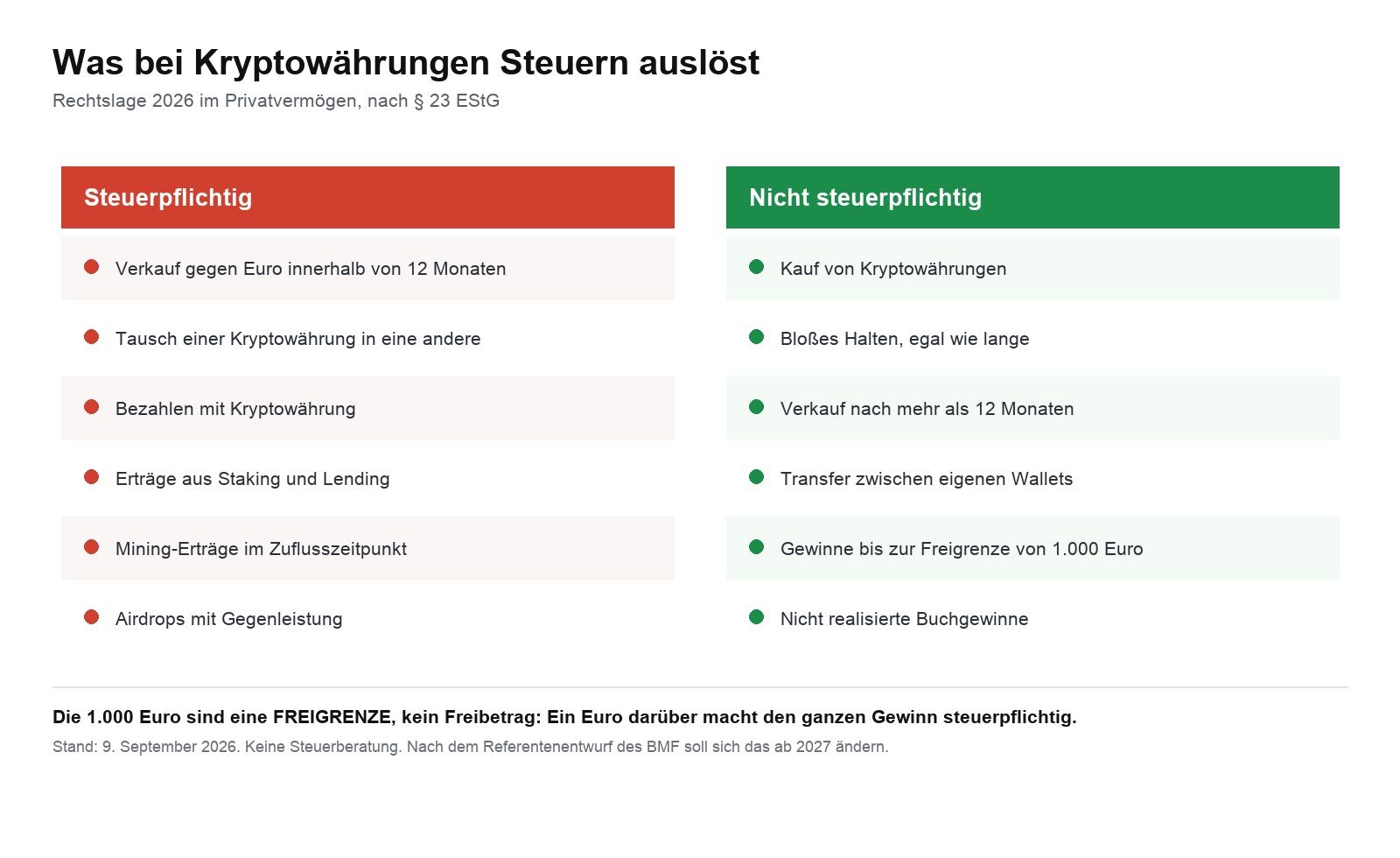
These earnings carry a threshold of their own, 256 euros per calendar year. It is regularly confused with the 1,000-euro threshold under Section 23, yet it covers a different area and a different pot. Both are thresholds and neither is an allowance: with 255 euros of staking income you pay nothing, with 257 euros you are taxed on 257 euros.
The threshold applies to all other services in a year taken together. If you run lending alongside staking, you add both up before you compare.
| Event | Type of tax | Legal basis | Threshold and period |
|---|---|---|---|
| Putting coins into the stake | no taxable event | — | the twelve-month period of the staked coins keeps running |
| Reward arrives | other income | Section 22(3) EStG | threshold of 256 euros a year, market value at the moment of arrival |
| Holding the reward | no taxable event | — | its own twelve-month period from arrival |
| Selling the reward within twelve months | private disposal | Section 23 EStG | threshold of 1,000 euros, separate pot |
| Selling the reward after twelve months | tax-free | Section 23 EStG | no upper limit |
| Withdrawing the staked coins (unstaking) | no taxable event | — | not a disposal |
| Swapping the reward for another cryptocurrency | disposal and acquisition at once | Section 23 EStG | a fresh period starts for the coin you receive |
Every single reward starts a period of its own on the day it arrives. Anyone collecting rewards daily accumulates three hundred and sixty-five separate deadlines over a year. That sounds impractical, and it is, but it is the legal position, and it is the reason why hardly anyone keeps track of staking without a tool.
The worry that staking stretches the holding period of the staked coins to ten years has been laid to rest. It came from an older reading of Section 23(1) no. 2 sentence 4 EStG. The tax authorities do not apply it to crypto assets. Twelve months remain the rule, for the staked coins as much as for the rewards. We have written up the dispute in detail in our comparison of the two tax models.
Staking is an umbrella term for very different processes. For tax purposes they differ mainly on one point: do you receive a reward, or do you receive a different asset?
| Form | What happens for tax | Basis | What to watch |
|---|---|---|---|
| Solo staking with your own node | reward as other income | Section 22(3) EStG | at a substantial scale, business status may be examined |
| Staking through an exchange | reward as other income | Section 22(3) EStG | the inflow is the credit; the exchange report is not binding |
| Staking pool | reward as other income | Section 22(3) EStG | the pool fee reduces the inflow |
| Liquid staking with tokens such as stETH | disputed: a swap or merely a receipt | Section 23 or Section 22(3) | treated as a swap, the tax arises as soon as you enter |
| Restaking | an extra layer of rewards, same classification | Section 22(3) EStG | two reward streams, two valuations per inflow |
| Staking ETP in a securities account | investment income or disposal, depending on the structure | Section 20 or Section 23 | distributing and accumulating products are treated differently |
| Lending instead of staking | interest as other income | Section 22(3) EStG | the same threshold of 256 euros, one shared pot |
If you stake through an exchange, you should also know how its tax report is built. Which platforms deliver usable exports is set out in our comparison of crypto exchanges. We have taken apart the two tax traps that come with selling staked coins in a separate article.
Two of those rows are not conclusively settled. With liquid staking, much depends on whether the token you receive counts as an asset in its own right or merely as proof of the coins you deposited. The details are in our article on restaking and liquid staking. With exchange-traded products the structure decides, and we have written up the differences between distributing and accumulating.
Suppose you staked Ethereum in 2026 and received rewards worth 800 euros in total, spread across the year and each valued at the price on the day it arrived. Your personal tax rate is 30 percent.
That last point is the practical lesson: waiting helps with the sale, not with the inflow. Anyone who stakes has a tax charge every year, even without a single sale. And that charge is in euros, while the reward sits in coins.
The record-keeping duty is stricter for staking than for simply buying and holding, because the tax office needs two values per event instead of one. Without records the reward cannot be valued, and an estimate rarely lands in your favour.
How to keep that up without a spreadsheet is set out in our article on documenting staking rewards. Which tools value the inflows automatically is shown in our comparison of crypto tax tools.
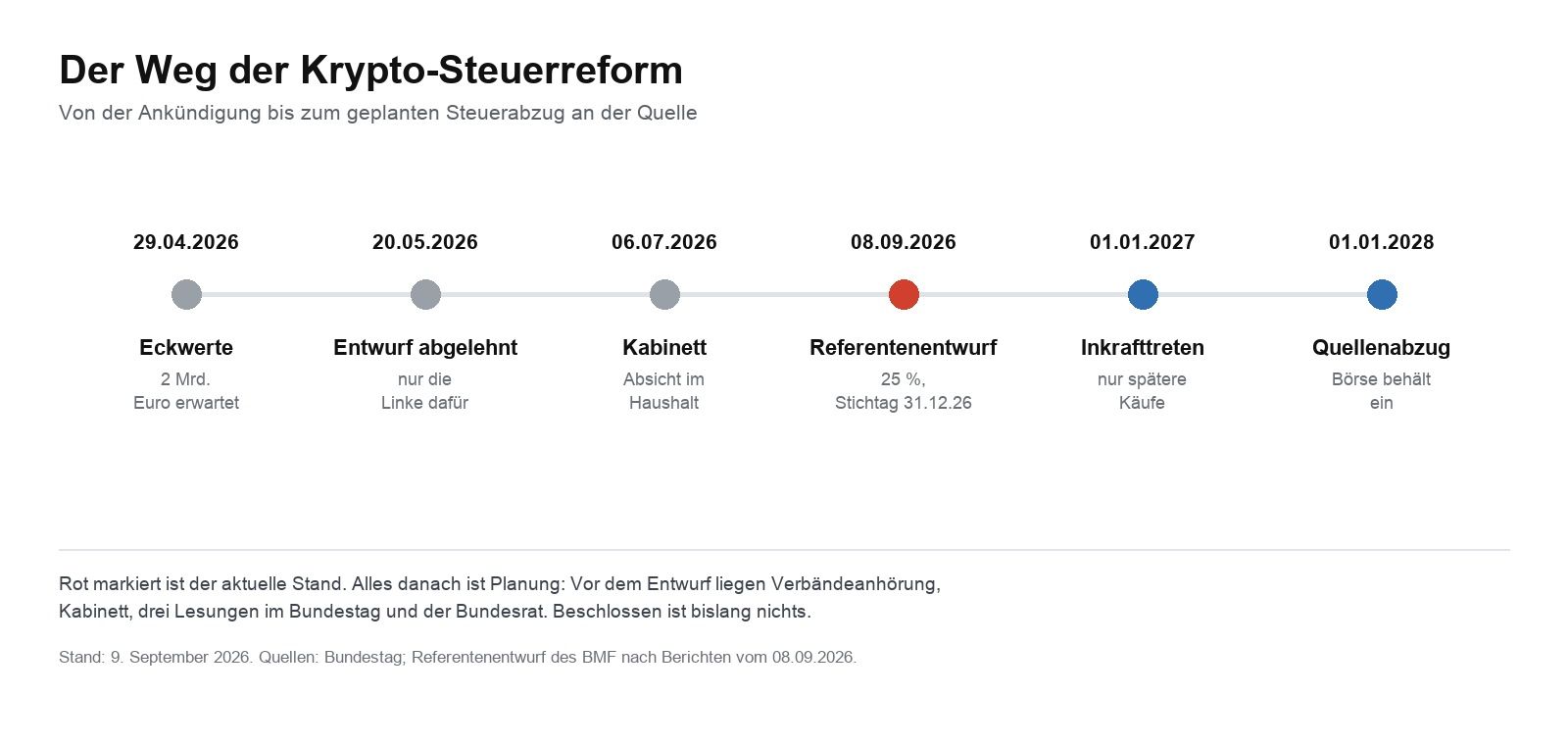
A ministerial draft would charge gains from the sale of crypto assets with the flat-rate withholding tax of 25 percent, for purchases made after December 31, 2026. The process is running, and no law has been enacted. The Income Tax Reform Act 2027, approved by the cabinet on September 2, 2026, contains nothing on crypto assets.
For staking, the decisive question remains open. Taxation of the inflow under Section 22(3) is left untouched in the drafts known so far. Were the flat-rate tax to arrive for disposals, stakers would face two different tax rates within one process, the personal rate on the inflow and the flat rate on the change in value. The current state of play is in our article on crypto tax in Germany.
No. The tax arises on the inflow and not on the sale. Anyone receiving rewards worth more than 256 euros in a year and selling none of them still has taxable income.
Your personal income tax rate applies, so between 14 and 45 percent, plus the solidarity surcharge and church tax where they are due. The flat-rate withholding tax of 25 percent does not apply here.
In Annex SO, in the section for services. The sale of the rewards belongs in the same form, but in the section for private disposals. The details are in our article on where you enter what.
No, it applies once a year to all other services taken together. Staking on three different networks plus lending gives one combined amount.
No. The tax authorities do not apply that reading to crypto assets. Twelve months remain the rule.
Losses from private disposals can only be offset against gains from the same type of income, not against salary and not against investment income. The inflows you have already taxed are unaffected.
Each inflow has to be valued on its own. In the return itself the total is usually stated, while the itemised list goes into the annex as evidence. With daily rewards there is no way around it.
(As of September 10, 2026. This article is not investment advice. Prices and fee structures change; check the terms with the provider before you buy. It does not replace tax advice either: with liquid staking, restaking and exchange-traded products the classification is not conclusively settled, and a question to your adviser is worth the time.)





