A ranking answers the question of which exchange performs well overall. Before opening an account, though, almost everyone faces a different question: this one or that one? Two names are on the table, and the difference comes down to three figures rather than an overall score.
That is why every pairing from our provider base has a comparison page of its own, with the same key figures side by side: the published trading fee, the cost of a purchase of 1,000 euros, the number of tradable crypto assets, the payment methods and the regulatory status. This article sorts through the head-to-heads that are searched for most often.
Before the pairings, a point that no ranking picks up and every head-to-head reveals immediately: several providers run two separate interfaces, and their prices are worlds apart.
At Binance, a simple instant buy costs 1.75 percent, while trading through the pro interface costs 0.10 percent. On a purchase of 1,000 euros that is 17.50 euros against 1.00 euro, a factor of seventeen at the same provider and with the same login. The same split exists at Coinbase and Coinbase Advanced, and at Bitpanda and Bitpanda Fusion.
Anyone reading a comparison should therefore check first which of the two products it covers. A head-to-head between the simple interface of one provider and the professional interface of another compares two different things.
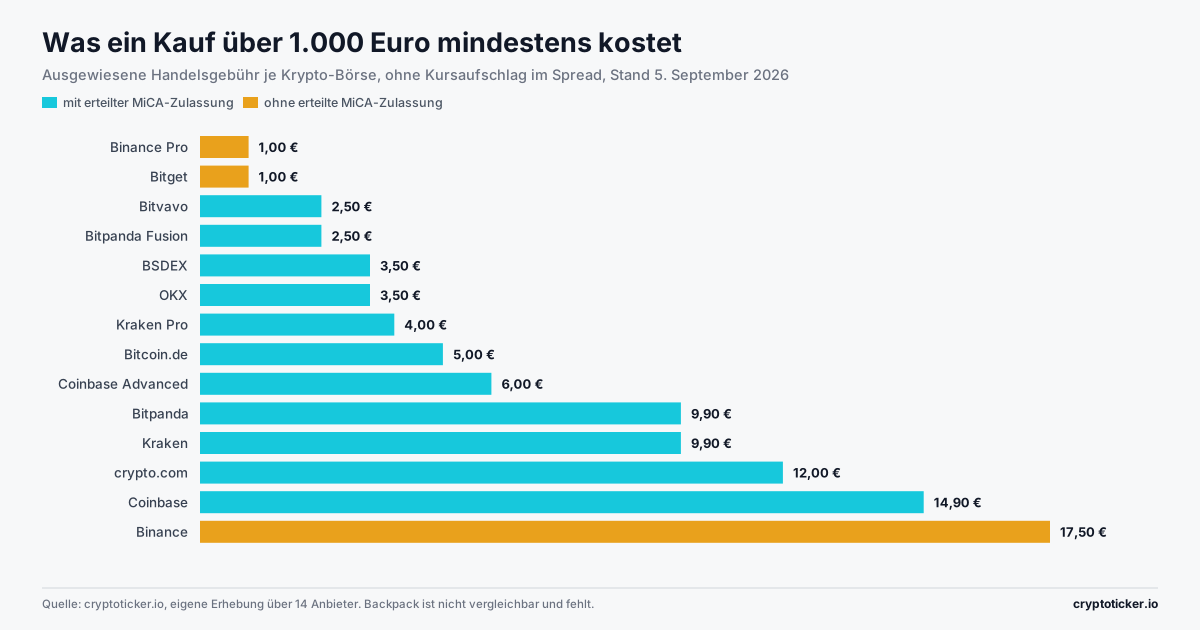
The figures come from the respective comparison pages. The basis is a bitcoin purchase of 1,000 euros, calculated with the published trading fee. A markup in the price is not included; more on that below.
| Head-to-head | Fee, left | Fee, right | Cost per 1,000 euros | Comparison page |
|---|---|---|---|---|
| Binance Pro against eToro | 0.10 percent | 1.00 percent | 1.00 against 10.00 euros | Binance Pro vs eToro |
| Binance against Coinbase | 1.75 percent | 1.49 percent | 17.50 against 14.90 euros | Binance vs Coinbase |
| Bitpanda against Bitvavo | 0.99 percent | 0.25 percent | 9.90 against 2.50 euros | Bitpanda vs Bitvavo |
| crypto.com against OKX | 1.20 percent | 0.35 percent | 12.00 against 3.50 euros | crypto.com vs OKX |
| Revolut against Trade Republic | 1.49 percent | 0.00 percent | 14.90 against 0.00 euros | Revolut vs Trade Republic |
The last row deserves a footnote, because zero percent in fees does not mean free of charge. Where no fee is published, the provider earns on the price markup, and that markup is not disclosed. A comparison that reads the fee column alone takes this for the cheapest provider in the field.
The published trading fee is the part of the price a provider names voluntarily. Alongside it sit three items that appear in no price list and often add up to more.

Since MiCA, a single licensing requirement applies to crypto service providers across the European Union. For a head-to-head that has become a hard distinction, because it has nothing to do with the price and still decides whether a service is usable.
OKX holds a MiCA licence via Malta, crypto.com does too, Bitpanda is authorised in several EU states, and eToro operates under CySEC supervision. Binance withdrew its licence application with the Greek supervisor in June 2026 according to its own statement, and its BaFin application in Germany as well; which EU state is to take over instead has not been named so far. For retail investors in the EU, margin and futures products are also restricted there.
If you want to check both sides of a head-to-head on this question, the regulatory status appears on every comparison page as a line of its own, with a date. The full overview is in our comparison of regulated crypto exchanges.
Beyond the five pairings above, comparisons between crypto exchanges and traditional brokers are called up most. They are the special case in which the fee does not play the leading role; what matters is whether you actually receive the coins or merely take part in their price performance.
If you are after the overall picture rather than a single head-to-head, you will find it in our comparison of crypto exchanges with every provider we have assessed.
The order in which the lines matter depends on what you intend to do. Three typical cases, and what decides them.
One thing appears in no comparison and still decides the matter: whether you can reach your money when it counts. The providers' status pages often show withdrawal problems earlier than any news report, and a provider without a granted EU licence can restrict its offering for retail investors at any time.
Among the published trading fees, the professional interfaces lead the field, Binance Pro among them at 0.10 percent. Among the simple instant-buy interfaces, Bitvavo at 0.25 percent comes ahead of Bitpanda at 0.99 percent and Binance at 1.75 percent. Providers without a published fee earn on the price markup.
It is the same provider with the same account, but two interfaces. The instant buy costs 1.75 percent, trading through the pro view costs 0.10 percent. The same split exists at Coinbase Advanced and Bitpanda Fusion.
Access often remains in place, but the offering can be restricted, particularly for leveraged products. Whether and where a provider is licensed appears on every comparison page in the line on regulation.
Not for the amount of tax, very much so for the effort. What matters is whether the provider delivers a usable export of your transactions. The tax rules are set out in our article on crypto tax in Germany.
The figures here are list prices on the day of collection. Discount tiers based on trading volume, payment in a provider's own token or time-limited promotions change them. Before you open an account, the provider's price page is what counts.
(As of September 10, 2026. This article is not investment advice. Prices and fee structures change; check the terms with the provider before you buy. List prices move, and the price page of the provider in question is what governs.)





