Imagine being able to send money from your London office to a Singaporean supplier.
You press send.
Rather than waiting 2–3 business days for the money to clear and wondering if it has gone through all the intermediary banks, the recipient gets it in seconds with no extra fees or complicated correspondent banking.
This is the future we are potentially looking at.
International transfers have relied on a system that has successfully connected thousands of financial institutions around the world, but the world has changed.
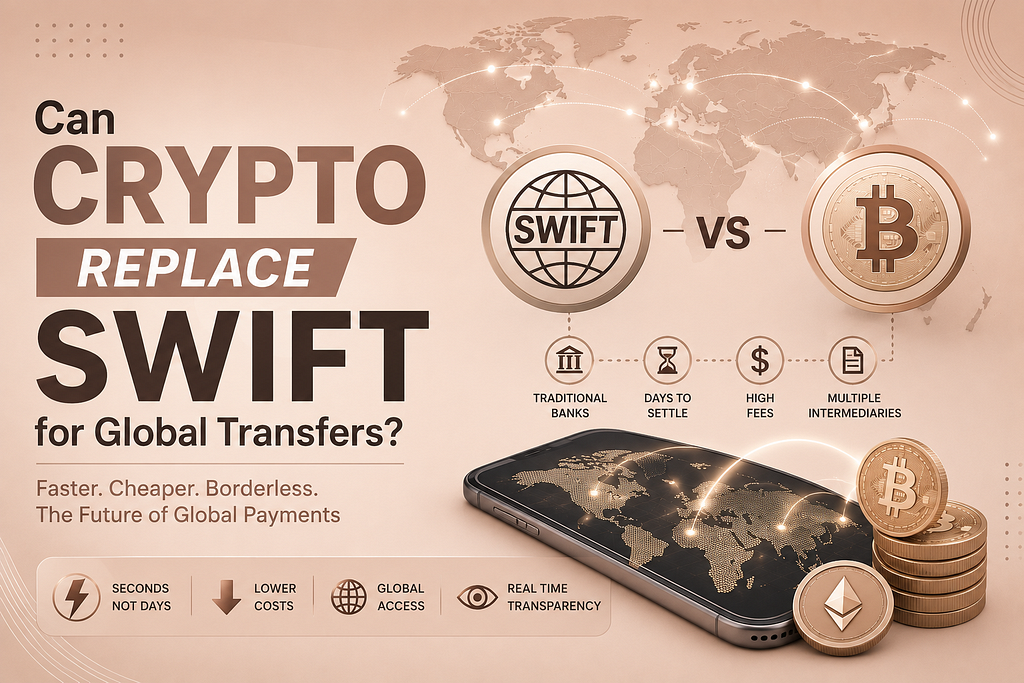
International businesses, freelancers, digital marketplaces, and customers all demand faster payments.
Can crypto and blockchain potentially replace SWIFT in the future?
The reality is that crypto has the potential to disrupt the financial system, but it would take a lot more than faster payments to replace one of the most well-established financial networks in the world.
Let’s look at the potential of crypto payments, the strengths of SWIFT, and what the future of international money transfers could look like.
One of the biggest misconceptions about SWIFT is that it actually transfers money.
In reality, SWIFT is a secure messaging network that facilitates communication between financial institutions.
When making an international money transfer, the money may go through several correspondent banks before it reaches its destination, and each one could potentially add extra processing time, fees, or complexity.
Despite this, SWIFT has been the backbone of the international financial system for decades, facilitating tens of trillions of dollars in international payments every year.
It has strengths in terms of its global reach, reliability, regulation, security, and existing banking infrastructure.
However, businesses today are demanding something that SWIFT was not designed to provide: real-time global payments.
Blockchain networks offer several advantages in terms of international money transfers.
They enable faster settlement of payments
reduce transaction costs
offer 24-hour availability
and
increased transparency.
Let’s look at how they compare to traditional systems like SWIFT.
Most blockchain networks offer significantly faster settlement speeds than traditional correspondent banking.
This is critical for businesses that deal with international suppliers, vendors, and employees.
International money transfers often incur multiple fees, including sending bank fees, receiving bank fees, intermediary bank fees, and currency conversion fees.
Crypto networks have the potential to remove several of these intermediaries, significantly reducing the total cost of the transaction, especially for transfers in which both parties have crypto wallets.
Banks are only available during business hours, 5 days a week.
Blockchain networks, on the other hand, are available 24 hours a day, 7 days a week.
This means that businesses can send and receive payments at any time, without having to worry about weekends or holidays.
With crypto networks, payments are much more transparent.
Instead of having to guess whether a payment has gone through or not, businesses can see exactly what has happened on-chain.
This dramatically reduces uncertainty and increases efficiency.
One thing that many people fail to realize is that most crypto payments being made today are not in volatile cryptocurrencies like Bitcoin or Ether.
They are in stablecoins.
Stablecoins offer the benefits of crypto payments, such as speed, transparency, and reduced fees, while avoiding the risk of price volatility.
This makes them much more attractive for international money transfers.
Many stablecoins are backed 1:1 with fiat currencies like the US Dollar or the Euro.
Businesses are starting to realize the advantages of using stablecoins for things like supplier payments, treasury management, merchant payouts, payroll, remittances, and marketplace payments.
Many financial institutions are already considering stablecoins as a viable option for cross-border payments.
Challenges Facing Crypto Payments Today
While crypto payments have clear advantages, there are still several challenges that need to be addressed before they can truly replace SWIFT.
Regulatory Uncertainty
Crypto regulations are constantly changing.
Some jurisdictions are more crypto-friendly than others, and it can be challenging to navigate the regulatory landscape when making international payments.
International payments involve KYC, AML, sanctions screening, fraud prevention, and transaction monitoring, which can be complex.
Traditional financial institutions have well-established compliance frameworks, and crypto payment providers are still catching up.
Liquidity
Liquidity is critical to any payment system.
While crypto liquidity is constantly improving, it still has a long way to go before it rivals traditional banking.
Most large enterprises are not interested in crypto payments for the time being.
Adopting a new payment method involves significant costs and risks, including system integration, compliance, and regulatory challenges.
One thing that many people fail to realize is that SWIFT is not standing still.
It has been making significant upgrades to its platform to make cross-border payments faster and more transparent.
The good news is that SWIFT and traditional financial infrastructure are also looking at ways to work with blockchain networks.
Instead of crypto payments replacing SWIFT, we are likely to see a hybrid future where the two systems work together.
Rather than crypto payments completely replacing SWIFT, we could see a future where a customer initiates an international money transfer using their mobile banking app.
Behind the scenes, identity checks are done automatically, compliance screening happens in real-time, stablecoins enable fast settlement, and blockchain technology helps convert the money into the local currency of the recipient.
The whole process only takes a few minutes, and the customer is amazed at how fast and easy it was.
The reality is that the technology was invisible to them.
They only saw an improved customer experience.
Many industries are well-positioned to benefit from adopting blockchain-based international payments, including:
Global e-commerce
Digital marketplaces
Freelance platforms
International payroll providers
Cross-border B2B trade
Gaming and Web3
Digital content platforms
Travel tech
Online financial services
Businesses in these industries can benefit from faster settlement speeds, reduced transaction costs, and an improved customer experience.
When considering crypto payments, businesses should think about more than just the technology.
They should also consider:
Which countries do they operate in?
What regulations apply to them?
Are stablecoins a better option than crypto?
How will compliance be handled?
Can payment providers integrate with their existing ERP systems?
What customer experience improvements are they looking to enable?
How will liquidity be handled?
The reality is that crypto payments are not a one-size-fits-all solution.
They must be carefully evaluated in the context of a business’s specific needs.
Crypto has the potential to disrupt the financial system, but it would take a lot more than faster payments to replace one of the most well-established financial networks in the world.
While SWIFT will continue to play a critical role in the international financial system, blockchain payments have the potential to complement traditional systems by enabling faster, more transparent money transfers.
Instead of crypto payments completely replacing SWIFT, we are likely to see a hybrid future where the two systems work together.
The future of international money transfers is looking very exciting, and businesses that understand blockchain technology and its implications will be much better positioned to take advantage of the coming changes.
Can Crypto Replace SWIFT for Global Transfers? was originally published in Coinmonks on Medium, where people are continuing the conversation by highlighting and responding to this story.





