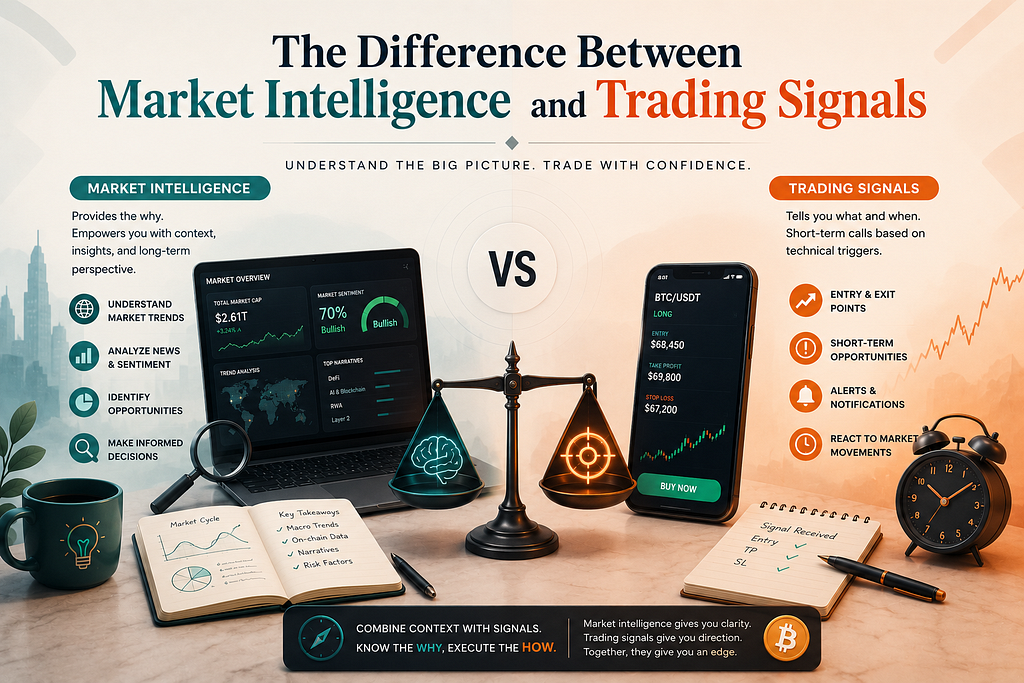
Every crypto trader has seen them.
“BUY BTC at $118,000.”
“Target: $122,000.”
“Stop Loss: $116,500.”
These trading signals flood Telegram groups, Discord servers, and social media every day. Some work. Many don’t. But they all share one thing in common: they tell you what to do without explaining why.
As crypto markets become faster and more complex, that approach is becoming less effective.
Professional traders aren’t just looking for signals anymore. They’re looking for market intelligence the context, data, and insights that explain what’s driving the market before they decide to enter or exit a position.
Understanding the difference between trading signals and market intelligence can completely change how you approach the market.
A trading signal is typically a recommendation.
It may include:
Signals simplify decision-making because they reduce everything to a single action.
For beginners, this can feel reassuring. Instead of analyzing dozens of charts or reading market news, they simply follow instructions.
The problem is that markets don’t move because someone posted a signal.
They move because liquidity changes, large investors reposition their portfolios, macroeconomic events unfold, regulations shift, sentiment evolves, and thousands of market participants react simultaneously.
A signal only captures the final recommendation — not the reasoning behind it.
Market intelligence goes much deeper.
Instead of saying:
“Buy Ethereum.”
It asks questions like:
These questions create context.
And context often matters more than the recommendation itself.
Market intelligence transforms scattered information into a clear picture that helps traders understand what’s happening beneath the surface.
Imagine receiving a buy signal for Bitcoin.
Without context, you have no idea whether:
Every one of these scenarios carries different levels of risk.
A signal might look identical in each case, but the underlying market conditions are completely different.
This is why experienced traders spend far more time understanding market structure than collecting more signals.
The crypto market doesn’t pause.
A regulatory announcement in one country can ripple through global exchanges within minutes.
An unexpected token unlock can change supply dynamics overnight.
A whale transfer can trigger speculation across multiple communities.
Funding rates, liquidation levels, stablecoin inflows, and macroeconomic events can all influence price action at the same time.
Trying to understand these developments manually is becoming increasingly difficult.
The challenge isn’t finding information anymore.
It’s filtering the noise.
A decade ago, traders struggled to access information.
Today, they struggle with having too much of it.
Every day brings:
The problem isn’t availability.
The problem is determining which information actually matters.
Market intelligence solves this by connecting seemingly unrelated events into a meaningful narrative.
Instead of overwhelming traders with more data, it helps prioritize the information most likely to influence market behavior.
Artificial intelligence has changed how traders process information.
Rather than monitoring dozens of dashboards simultaneously, AI can analyze multiple streams of market activity in real time, identify emerging patterns, and surface developments that deserve attention.
This doesn’t replace human judgment.
It enhances it.
The best decisions still come from traders.
AI simply reduces the time needed to discover opportunities and understand changing market conditions.
One of the biggest differences between experienced and inexperienced traders is conviction.
Experienced traders rarely enter positions simply because someone else suggested it.
Instead, they develop confidence by understanding:
When traders understand why they’re entering a position, they’re generally better prepared to manage volatility and adapt if conditions change.
That understanding comes from intelligence not instructions.
As crypto markets continue to mature, traders will increasingly rely on systems that provide clarity instead of just recommendations.
The next generation of trading tools isn’t focused on producing more signals.
It’s focused on helping traders interpret market behavior, identify meaningful opportunities, and make decisions based on a broader understanding of what’s happening across the market.
Platforms built around crypto market intelligence are part of this shift. Rather than acting as simple signal providers, they combine AI with real-time market analysis to surface actionable insights and give traders the context needed to evaluate opportunities with greater confidence. One example is i5.xzy, an AI-powered market intelligence platform designed to help traders understand the forces shaping the market not simply tell them when to buy or sell.
Trading signals answer one question:
What should I do?
Market intelligence answers several:
In an industry where information travels at incredible speed, understanding the market has become just as valuable as acting on it.
The traders who consistently improve aren’t necessarily the ones with the most signals.
They’re the ones with the clearest understanding of the market behind those signals.
The Difference Between Market Intelligence and Trading Signals was originally published in Coinmonks on Medium, where people are continuing the conversation by highlighting and responding to this story.





