The psychology behind bad entries, emotional exits, and the simple system that changes both

Have you ever bought a coin, watched it drop immediately after, and thought — “why does this always happen to me?”
You’re not unlucky. You’re human.
Most traders lose money not because they picked the wrong coin, but because they entered at the wrong price. They bought when excitement was at its peak — and sold when fear was at its worst.
That’s not a strategy. That’s emotion in disguise.
In this article, we’re going to break down exactly why traders buy high and sell low — even when they know better — and what you can do differently starting today.
Written in collaboration with Fat Pig Signals — crypto trading signals with a public track record since 2017. Use code LU20 for 20% off VIP access →
Here’s a scenario you’ve probably lived through.
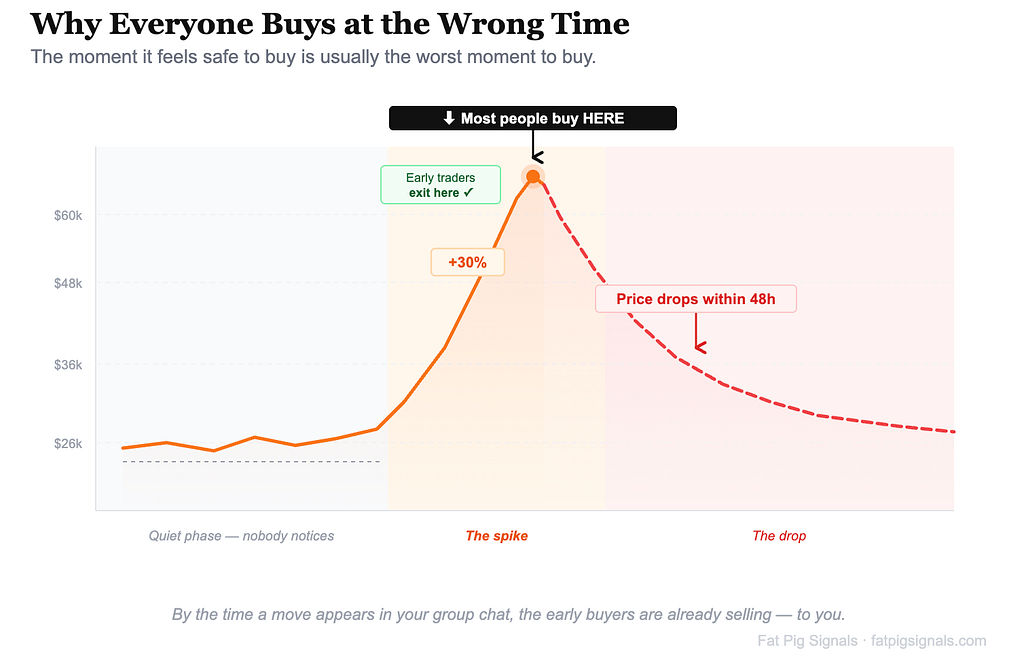
A coin has been quietly moving sideways for weeks. Then one morning you open your phone and see it’s up 30%. Your group chat is on fire. Twitter is full of people posting their gains. It’s everywhere.
So you buy. And within 24 hours, the price drops back down.
What happened?
This is called buying the peak — and it’s one of the most common and costly mistakes in crypto trading.
Here’s why it happens: by the time a move is obvious enough to appear in your feed, the people who positioned early have already made their profit. When you buy at that moment, you’re often buying from them as they sell.
The excitement you feel is actually a signal that the opportunity may already be over.
Our brains are not built for trading. They’re built for survival.
Two emotions control most trading decisions:
FOMO (Fear of Missing Out) — When you see others making money, your brain triggers a panic response. “I need to get in NOW before it’s too late.” This is the same instinct that makes you rush toward a closing elevator door. It’s automatic.
FUD (Fear, Uncertainty, Doubt) — When the price drops and your portfolio turns red, that same brain shifts into danger mode. “Get out before it gets worse.” The impulse to sell is overwhelming — even when the logical thing is to hold.
The result? You buy at the top because of FOMO. You sell at the bottom because of FUD. Every single time.
Understanding this doesn’t make it go away. But it gives you the ability to pause, recognize what’s happening, and make a different choice.
⚠️ Common Mistake: Most beginners think they’ll “feel different” when they have more experience. They won’t — not without a system. Even professional traders feel FOMO and FUD. The difference is they have rules that override their emotions.
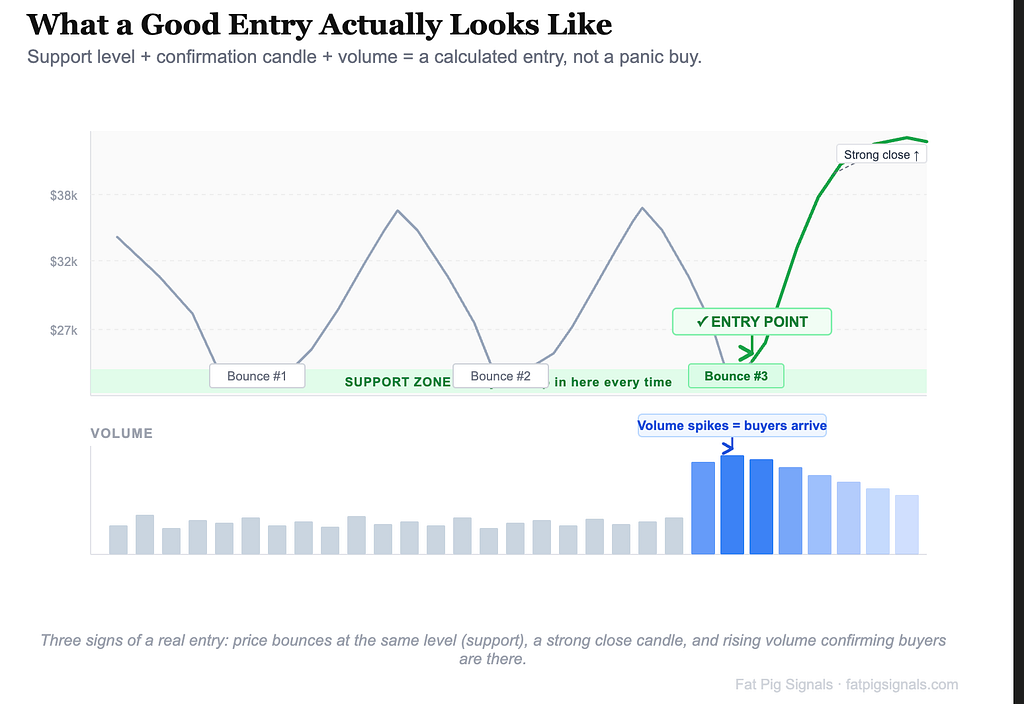
A good entry isn’t about getting in when you’re excited. It’s about getting in when the conditions are right.
Think of it like buying a flight ticket. If you wait until two days before your trip, you pay maximum price because demand is high. If you plan ahead and buy when demand is low — you pay far less for the exact same seat.
Crypto entries work the same way.
Here’s what experienced traders look for before entering a trade:
None of this requires you to be a chart expert. It requires you to slow down and check the conditions before clicking buy.
Here’s a truth most beginners don’t hear: you can have a perfect entry and still lose money if your exit is wrong.
There are two ways exits go badly:
Exiting too early out of fear. The trade is going well — you’re up 15% — and suddenly the price dips slightly. Panic sets in. You sell. Then watch it continue up another 40% without you.
Holding too long out of greed. The trade goes up, hits your target, but you think “it could go higher.” You hold. It doesn’t. It reverses and wipes out your gains — or worse, turns into a loss.
Both of these are emotional exits. And both are completely avoidable.
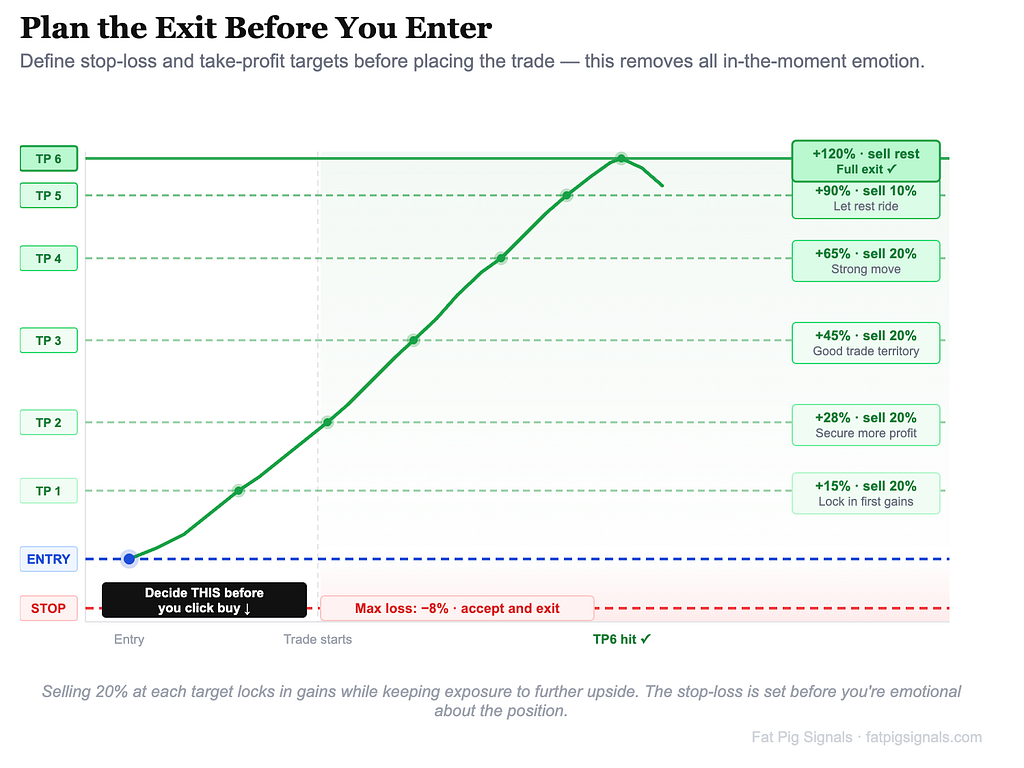
The fix is simple: decide your exit before you enter the trade.
Before you buy, you write down two numbers:
When you have both numbers written down before the trade, you remove the in-the-moment emotion entirely. The decision is already made. You just follow the plan.
💡 Pro Tip: Use multiple take-profit targets instead of one. For example, sell 30% of your position at the first target, another 30% at the second, and let the final 40% run with a trailing stop. This way, you lock in profits early but still participate if the move continues.
Here’s what a professional signal actually gives you — and why it matters psychologically.
When you receive a signal from a source with a verified track record, you get:
You don’t have to make emotional decisions in real time. The plan is already there.
This is exactly why traders who follow a structured signal service often outperform traders who rely on their own instincts — not because the signals are magic, but because they remove the emotional decision-making from the equation.
The entry is timed. The exit is planned. The risk is defined.
That’s what separates a trade from a gamble.
Written in collaboration with Fat Pig Signals — crypto trading signals with a public track record since 2017. Use code LU20 for 20% off VIP access → fatpigsignals.com/store
Fat Pig Signals has been running since 2017. Every signal since then — wins and losses — is publicly logged.
What makes the service different isn’t just the signals. It’s the system behind them.
Before any signal reaches the private VIP channel, it’s filtered through a proprietary algorithm that was originally built for stock market trading — before AI tools existed. That algorithm identifies high-probability entry zones and exit points based on price structure and pattern data built up over years of real trading.
Members receive:
The result is that you spend 30 minutes or less on each trade — and the emotional decision-making is replaced by a clear plan.
If you want to see what that looks like in practice, you can join the free Telegram group first. You’ll see market updates, occasional signals, and get a real feel for how the service works before committing to anything.
→ Join the free group: t.me/fatpigsignals
And if you’re ready for full VIP access — algo-backed entries, defined exits, full track record — use affiliate code LU20 for 20% off your first subscription.
→ Get VIP access: fatpigsignals.com/store
Here’s what we covered:
Today: Next time you feel the urge to buy something because “it’s pumping” — pause. Ask yourself: “Am I buying because the conditions are right, or because I’m afraid of missing out?” Just asking the question gives you back control.
This week: Practice setting a stop-loss and take-profit target before you enter any trade. Even paper trades (pretend trades without real money) count. Build the habit of planning the exit before the entry.
Ongoing: Follow a source with a verified, public track record. Join the Fat Pig Signals free Telegram group — watch how signals are structured, see how entries and exits are defined, and learn by observing real trades in real time before you put your own capital at stake.
Trading doesn’t have to be a constant battle against your own emotions. With the right system, the decisions are already made before the stress kicks in.
You just have to follow the plan.
Disclaimer: This article is for educational purposes only and should not be considered financial advice. Cryptocurrency trading involves substantial risk of loss. Past performance of any signal service does not guarantee future results. Always do your own research and consider your personal financial situation before making any investment decisions.
Written in collaboration with Fat Pig Signals — crypto trading signals with a public track record since 2017. Use code LU20 for 20% off VIP access → fatpigsignals.com/store
Why Most Traders Buy at the Wrong Time — And How to Fix It was originally published in Coinmonks on Medium, where people are continuing the conversation by highlighting and responding to this story.





