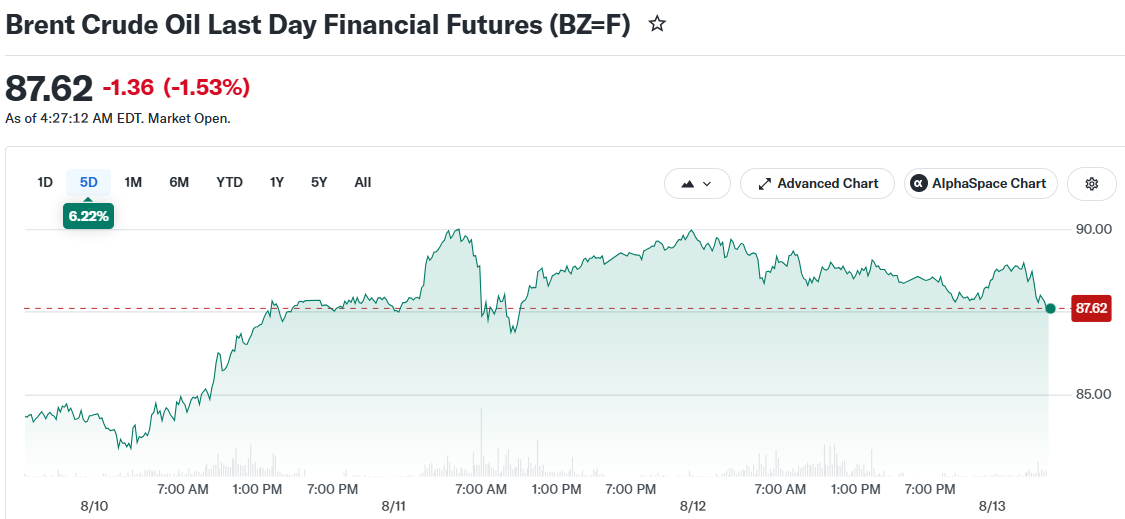
Oil prices fell on Thursday as a large build in US crude inventories and downgraded demand forecasts from major energy bodies weighed on markets. Supply disruptions in the Middle East provided some support but were not enough to stop the decline.
Brent futures dropped 91 cents, or 1%, to $88.07 a barrel by 0800 GMT. WTI crude fell 96 cents, or 1.2%, to $82.31. Both contracts had trimmed gains built up over the previous five to six sessions.
The Energy Information Administration reported that US commercial crude oil inventories rose by 17.4 million barrels in the week ended August 7. That brought total stocks to 424.4 million barrels, their highest level since June 5.
The build was far larger than expected. Analysts polled by Reuters had forecast a draw of 1.4 million barrels. The jump was driven partly by a slump in exports.
The inventory surprise kept prices below the $90-a-barrel level, according to PVM analyst John Evans.
OPEC cut its world oil demand growth forecast for 2026 to 580,000 barrels per day in its monthly report. This was the fourth such cut this year.
The IEA went further, flipping its forecast from growth to contraction. The agency now expects a 1.6 million bpd drop in consumption this year, compared to its previous forecast for growth of 1 million bpd.
Both organisations pointed to cooling economic growth, rising prices, and restricted fuel supplies tied to the ongoing US-Israeli war with Iran.
The US has drawn heavily on its Strategic Petroleum Reserve this year to offset supply shocks from the conflict. Separate data showed a sharp contraction in SPR levels.
Despite the downward pressure on prices, the Strait of Hormuz situation kept traders cautious. Washington and Tehran both claimed control of the waterway this week, with no resolution in sight.
BREAKING: President Trump says the US has “total control” over the Strait of Hormuz and “I think we will keep it.” pic.twitter.com/JBKe2D3BBo
— The Kobeissi Letter (@KobeissiLetter) August 12, 2026
A senior Iranian source said on Wednesday that talks to revive an interim US-Iranian deal, agreed in June, had made no progress. Vessel crossings through the Strait, excluding container ships, dropped to five on Wednesday, the lowest in three weeks, according to shipping data from Kpler.
The Hormuz strait supplied around 20% of global oil consumption before the conflict began.
Yemen’s Houthi forces also added pressure by attacking ships in the Red Sea and the Bab el-Mandeb Strait.
In Eastern Europe, Russia struck Ukraine’s Izmail port area in the Odesa region overnight. A drone attack also triggered a fire in Salavat, Russia, home to a large oil refinery.
The post Oil Prices Slide as Massive Inventory Surprise Catches Markets Off Guard appeared first on CoinCentral.





