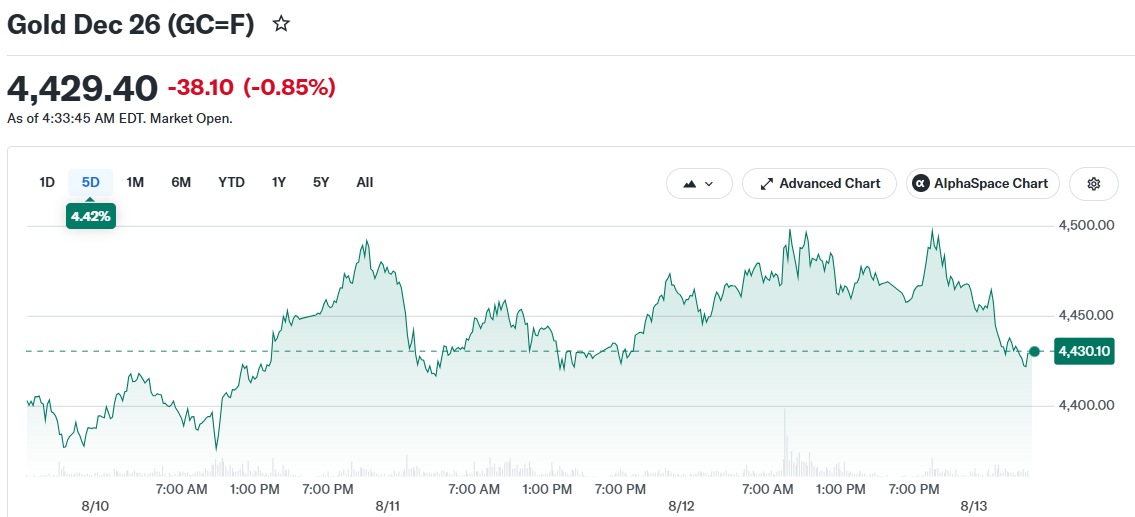
Gold reached its highest price in over two months on Wednesday before retreating. Spot gold climbed to around $4,450 an ounce, driven by softer U.S. inflation data, before falling back 0.5% to $4,388.64 in early Thursday trading. Gold futures also slipped 0.5% to $4,446.12.
Silver and platinum followed gold lower. Silver dropped 0.4% to $65.08 an ounce, while platinum fell 0.6% to $1,746.71.
The pullback came after traders took profits ahead of and after the Consumer Price Index report. U.S. consumer prices rose just 0.1% in July from the prior month, matching forecasts. That reading suggested the energy shock tied to the U.S.-Iran conflict had not yet pushed inflation sharply higher.
The soft inflation print lowered expectations for a Federal Reserve rate hike at its September meeting. According to CME FedWatch, markets priced a 38-40% probability of a September hike after the data, down from 46% beforehand.
BREAKING: July CPI inflation falls to 3.4%, in-line with expectations of 3.4%
Core CPI inflation falls to 2.5%, also in-line with expectations of 2.5%.
Month-over-month CPI inflation rose +0.1%, up from -0.4% in June.
US stock market futures are rising on the news.
— The Kobeissi Letter (@KobeissiLetter) August 12, 2026
The Fed held rates steady at 3.50%-3.75% at its July meeting. Three policymakers voted in favor of a hike, showing some division within the committee.
Traders are now watching Thursday’s Producer Price Index report for another read on inflation. Further jobs and price data are expected before the September meeting.
Fed Chair Kevin Warsh is also scheduled to speak at the Jackson Hole symposium later this month. Markets will be looking for any signals on how the Fed views the balance between inflation and growth.
Higher interest rates are generally a headwind for gold because the metal pays no interest. When rate hike odds fall, gold tends to benefit.
Despite the softer CPI reading, energy risks have not gone away. The Strait of Hormuz continues to face restrictions linked to the ongoing U.S.-Iran conflict. Oil prices were on track for a weekly gain as traders watched ongoing negotiations between Washington and Tehran.
If energy prices rise further, that could push inflation higher down the road, which could change the Fed’s course.
The U.S. Dollar Index was flat near 99.96 during Thursday trading, offering little direction for gold. Earlier in the week, lower Treasury yields and a weaker dollar had supported gold’s rally, but those moves faded.
Chinese demand has been a key driver of gold’s broader recovery. The People’s Bank of China continued its gold-buying streak, and investor appetite returned after an earlier selloff.
Gold also crossed its 100-day moving average this week for the first time since April. Analysts at IG noted that the next key resistance sits near $4,450, with the 200-day moving average around $4,499 acting as a further barrier.
Gold is still up about 3% on the week despite the pullback.
The post Gold Pulls Back From Two-Month High After U.S. CPI Data Meets Expectations appeared first on CoinCentral.





