Oil prices pulled back slightly on Friday but stayed on course for one of their best weekly performances in months. The ongoing military conflict between the United States and Iran is keeping global energy markets on edge.
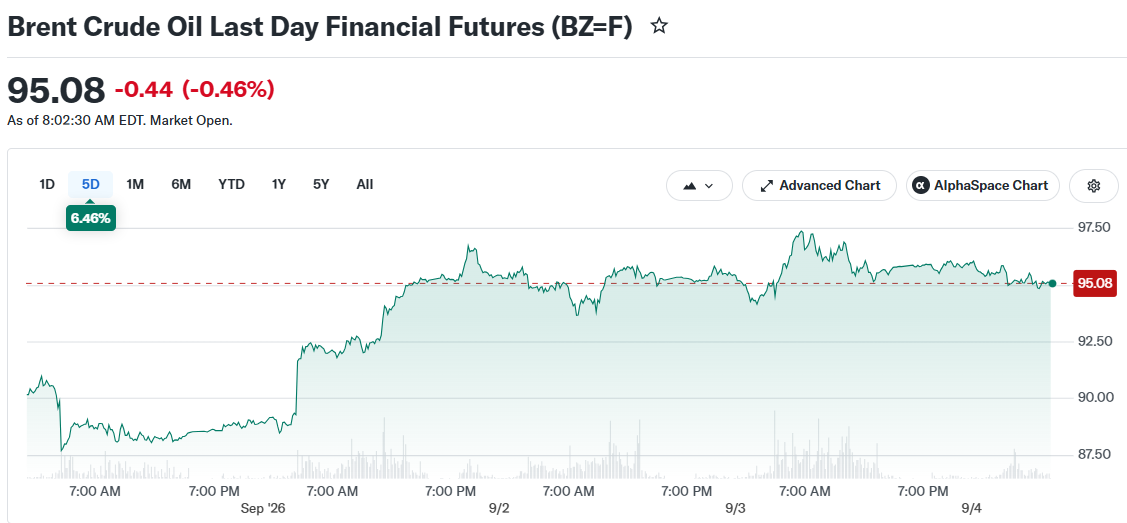
Brent crude was trading around $95.15 a barrel on Friday morning, down about 0.4% on the day. West Texas Intermediate fell 0.6% to $90.77. Despite the daily dip, Brent was up 6.6% for the week and WTI was up 8.8%, its best weekly gain since July 13.
The conflict between the U.S. and Iran is now in its seventh month. This week saw some of the fiercest exchanges since July, with U.S. strikes hitting targets near the Strait of Hormuz. Iran responded with missile and drone attacks on U.S. and allied positions in Kuwait, Bahrain, and Jordan.
One U.S. strike reportedly hit an area hosting a wedding in southern Iran, killing civilians. Tehran condemned the attack.
The Strait of Hormuz is the world’s most important oil chokepoint. Iran has expanded restrictions on international shipping through the waterway since the latest escalation.
🇺🇸🇮🇷 Iran has expanded its Strait of Hormuz shipping blacklist to 56 vessels, following the latest U.S. attacks.
A senior Iranian official is vowing an “asymmetrical and multi-layered” response.
Gulf tankers appear to be facing tighter restrictions, while Iraqi commercial… pic.twitter.com/9QnEQe2kPu
— Mario Nawfal (@MarioNawfal) September 4, 2026
Only four commodity vessels crossed the strait on Thursday, compared to a 10-day average of roughly 15. That drop is a clear sign that shipments remain seriously disrupted, despite U.S. government statements that flows have returned to near-normal levels.
Tanker trackers and independent analysts say the disruption is ongoing. The gap between official statements and on-the-ground data has added to market uncertainty.
Vice President JD Vance said Thursday that the U.S. would not hold talks with Iran unless Tehran stopped attacking commercial shipping.
U.S. diesel prices reached a record high this week. Analysts say this is partly driven by the oil supply disruption, as well as ongoing Ukrainian attacks on Russian refineries.
“All sectors of the economy are affected by diesel,” said Claudio Galimberti, chief economist at Rystad Energy. He added that high diesel prices are contributing to inflation expectations, which in turn are pushing up U.S. government bond yields.
The spike in energy costs has raised warnings about a potential hard landing for the global economy.
U.S. commercial crude inventories fell to 424.5 million barrels in the week ending August 28, down from 428.9 million barrels the previous week, according to the Energy Information Administration.
OPEC+ is expected to leave its October output policy unchanged when it meets on Sunday. The group recently finished unwinding one layer of production cuts, though Hormuz disruptions have complicated the impact of those decisions.
Citi raised its average Brent forecast for Q3 to $86 a barrel, up from $80, citing slower-than-expected reopening of the strait. ANZ raised its short-term Brent forecast to $95, with further upside if the conflict deepens.
Iraq raised its August oil exports to around 2.34 million barrels per day, up from 1.35 million in July.
The post Oil Prices Near Six-Week Highs as U.S.-Iran Fighting Disrupts Strait of Hormuz Shipping appeared first on CoinCentral.





