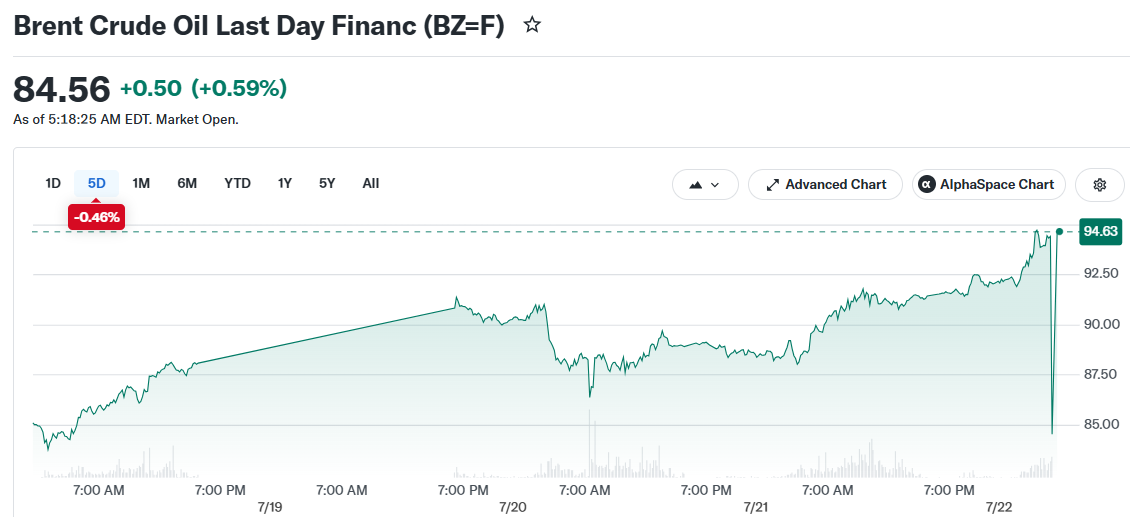
Oil prices are climbing fast. Brent crude hit $94.13 per barrel and West Texas Intermediate reached $87.42, both sitting at their highest levels since June 11. It’s the fourth straight day of gains, with prices rising in six of the last seven sessions.
The main driver is the ongoing military conflict between the U.S. and Iran. American forces carried out strikes on Iranian military targets for the 11th night in a row on Wednesday. Targets included missile and drone launch sites, command-and-control facilities, and air defense systems.
Iran has continued to hit back. Tehran launched retaliatory attacks on U.S. military positions in Bahrain, Kuwait, and Jordan. Kuwait also intercepted Iranian drones, adding to tensions across the region.
BREAKING: Iran's IRGC has announced it will target U.S. and Israeli commanders directly in their private residences, in retaliation for American strikes on the homes of Iranian commanders and their families, per an IRGC statement.
"Because you targeted the private residences of…
— The Hormuz Report (@HormuzReport) July 22, 2026
President Trump said Tuesday that the U.S. has “no interest in meeting” with Iran. Secretary of State Marco Rubio acknowledged diplomacy remains on the table but accused Tehran of breaking a deal on shipping through the Strait of Hormuz.
U.S. Central Command says Iran has attacked more than 30 commercial vessels in the past three months. While the U.S. insists the strait remains open, shipping insurers and oil markets are not reassured without a direct pledge from Iran to stop targeting ships.
A new risk emerged this week in the Red Sea. Yemen’s Iran-backed Houthi movement announced a blockade targeting Saudi crude passing through the Bab el-Mandeb Strait. Three Saudi oil tankers turned around on Tuesday after the declaration.
This is a big deal for Saudi Arabia. The country had already been rerouting tankers away from the Strait of Hormuz due to Iranian threats. The Red Sea route was one of the few remaining alternatives.
ING analysts said any blockade would force tankers to go around via the Suez Canal, adding time and cost to voyages heading to Asia.
The pressure on oil supplies isn’t only coming from the Middle East. Kazakhstan’s crude exports through the Black Sea hit a snag after the Caspian Pipeline Consortium suspended loadings. Repeated attacks on tankers at a Russian export terminal forced the halt.
ING analysts suggested Brent at just over $91 may be undervalued given all the disruptions. “Particularly if these disruptions persist into August,” they noted.
On the inventory side, the American Petroleum Institute reported U.S. crude stocks rose by 2.6 million barrels last week, against expectations for a draw. Official data from the Energy Information Administration is due Wednesday.
With military activity ongoing across multiple fronts and shipping security weakening around both Hormuz and Bab el-Mandeb, analysts say the upside risk for oil prices continues to grow.
The post Oil Prices Hit Six-Week Highs as U.S.-Iran Conflict Drives Supply Fears appeared first on CoinCentral.





