Gold bounced slightly on Wednesday after suffering its steepest one-day fall in nearly a month. Prices rose 0.1% to $4,339.20 an ounce in early trading, while gold futures slipped 0.6% to $4,392.42.
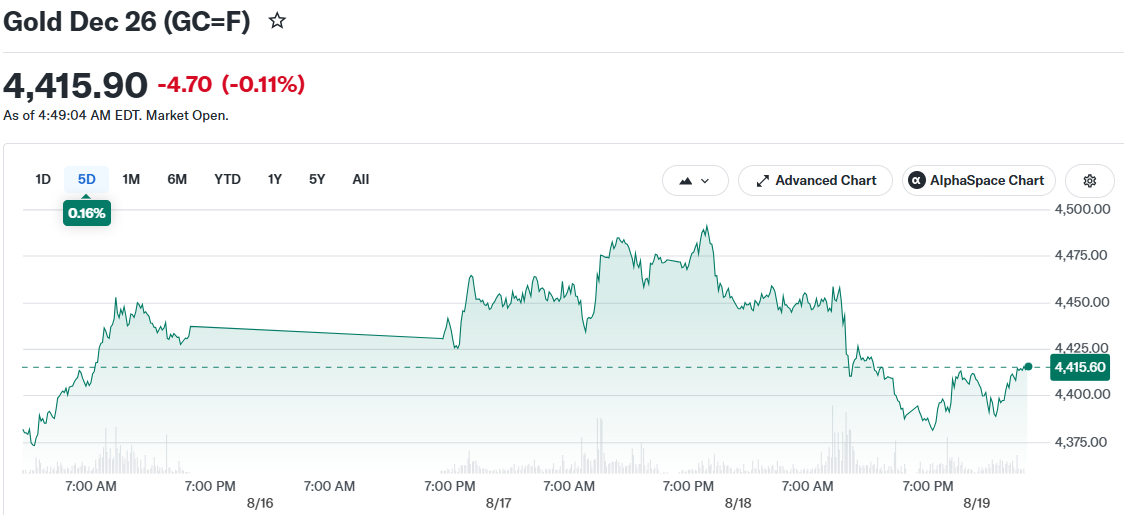
The modest recovery came as the U.S. dollar softened slightly and Treasury yields pulled back. Silver fell 1.0% to $62.69 an ounce, and platinum edged down to $1,716.02.
Gold has struggled to hold gains as bond yields rise. The 30-year U.S. Treasury yield hit its highest point in nearly two decades on Tuesday, while 10-year yields stayed near their highest levels since early 2025.
When bond yields rise, gold becomes less attractive. Bonds start offering better returns, while gold pays no interest. That encourages investors to move money out of bullion and into fixed-income assets.
Oil prices have also climbed higher due to the ongoing Strait of Hormuz standoff. About one-fifth of global oil and gas shipments pass through the waterway.
Higher energy prices can push inflation up. That could lead the Federal Reserve to keep interest rates elevated for longer, which adds another layer of pressure on gold.
U.S. President Donald Trump said Tuesday there were no talks underway with Iran. A memorandum of understanding signed by Washington and Tehran in June has expired without a renewal plan.
Ships have continued attempting to leave the strait, with some switching off satellite transponders to avoid detection.
Investors are now watching the Federal Reserve’s July meeting minutes, due later Wednesday. The minutes could reveal how policymakers viewed inflation and the likely path for interest rates.
Market attention will then shift to Fed Chair Kevin Warsh’s speech at the Jackson Hole symposium next week.
According to the CME FedWatch tool, traders have scaled back rate hike expectations following recent U.S. economic data. Markets now price in a 67% probability that the Fed will hold rates steady.
Soojin Kim from MUFG said the outlook for gold remains constrained by the U.S.-Iran conflict. Energy-driven inflation could reinforce expectations for tighter Fed policy, limiting gold’s upside.
Analyst Tony Sycamore from IG said gold’s drop to around $4,334 overnight showed the metal cannot hold up against the combined pressure of elevated oil prices and higher bond yields.
Technically, Sycamore said gold needs to reclaim resistance around $4,430 to regain upward momentum. A move above that level would put the 200-day moving average near $4,507 in view.
Gold had previously climbed back above $4,000 an ounce on stronger central bank buying, particularly from China. That recovery now faces a fresh test from the macro environment.
The next key catalysts are the Fed minutes Wednesday and Warsh’s Jackson Hole remarks next week.
The post Gold Can’t Catch a Break: Rising Yields, Oil Shock and No Iran Deal Put Bullion Under Pressure appeared first on CoinCentral.





