TL;DR:
Reece Merrick, director of Ripple, presented a strategic expansion plan for the stablecoin RLUSD in which he identified three markets as critical nodes for the company’s global growth: Turkey, Nigeria, and the United Arab Emirates.
According to the data presented by Merrick, stablecoin transaction volume reached $33 trillion in 2025, a figure that doubles the annual volume of the entire Visa network. The market capitalization of the segment currently stands at $320 billion, a 72% increase compared to the previous year.
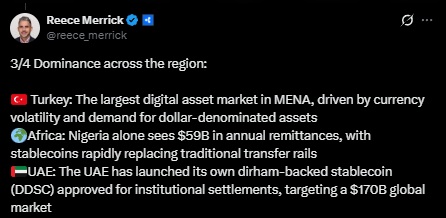
Merrick and Ripple’s analysis does not target mature markets with consolidated financial infrastructure, but rather regions where the demand for digital dollars responds to concrete structural needs.
In Turkey’s case, the instability of the lira turned the country into the largest digital asset market in the Middle East and North Africa region. The demand for dollar-denominated assets has ceased to be speculative and become a capital protection tool, with RLUSD positioning itself as the central instrument to address that need.
Nigeria presents a different dynamic. With $59 billion in annual remittances, Ripple’s stablecoin has begun to displace traditional banking corridors, offering instant transfers without intermediaries. The inefficiency of the country’s conventional banking system leaves a gap that blockchain-based solutions can fill.

The United Arab Emirates, for its part, functions as an institutional bridge. The country approved RLUSD for corporate settlements and launched its own dirham-backed stablecoin. According to Merrick, the region will become a testing ground for the institutional payments market, valued at $170 billion.
The executive emphasized that Ripple has spent years building the infrastructure necessary for this moment and that RLUSD is the direct response to an institutional demand that continues to grow as the main players of the traditional financial system enter the blockchain world.