Volvo Group posted a solid second quarter, with profit climbing and margins expanding despite a growing tariff bill. The Swedish truckmaker’s VOLVb stock was trading around SEK 338.20, down 0.91% on the day, though the underlying results told a more positive story.
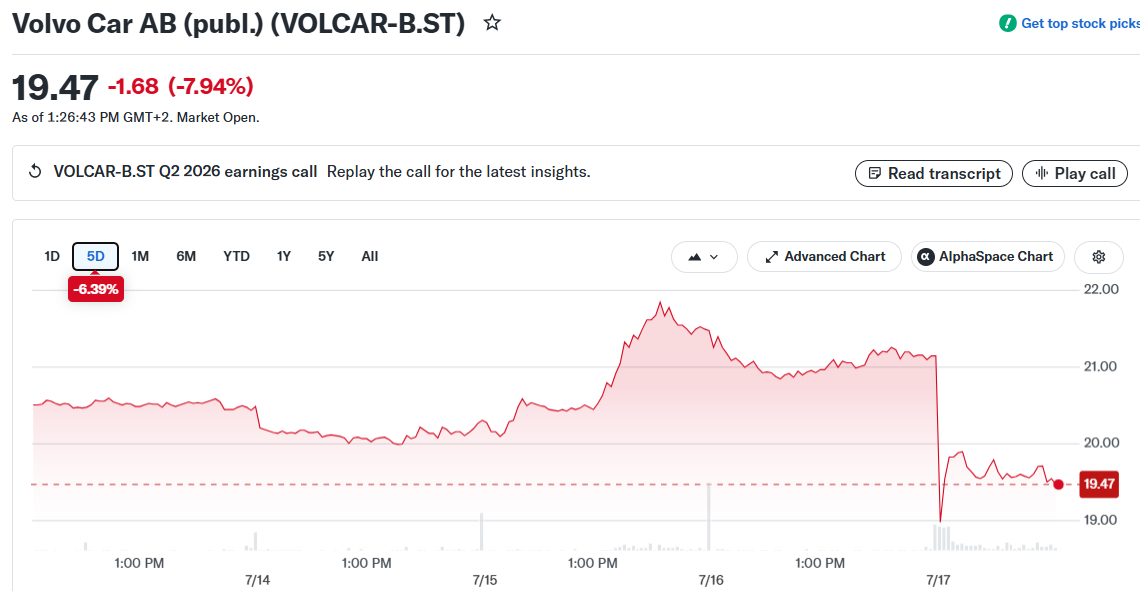
Volvo Car second-quarter earnings were weaker than expected as intense competition, higher costs and expenses related to the production ramp-up of a new fully electric SUV weighed on profitability. https://t.co/MANKbQmlTS
— Bloomberg (@business) July 17, 2026
Adjusted operating income came in at SEK 14.78 billion, up from SEK 13.48 billion in the same period last year. The adjusted operating margin rose to 11.7% from 11%.
Net sales increased 3% to SEK 126.27 billion, with organic growth of 7%. Vehicle sales grew 6% organically and service sales grew 7%.
Reported operating income jumped to SEK 13.48 billion from SEK 9.96 billion, with a reported margin of 10.7%, up from 8.1% a year ago.
Earnings per share came in at SEK 5.10, compared with SEK 3.64 a year earlier. Operating cash flow in Industrial Operations rose to SEK 5.84 billion from SEK 2.95 billion.
Return on capital employed reached 26.8%, reflecting strong capital efficiency across the business.
The demand picture was particularly strong in trucks. Net order intake jumped 33% to 63,412 vehicles. North American orders more than doubled year-over-year, while Europe and South America saw gradual improvement.
Total truck deliveries rose 6%. The Trucks segment posted net sales of SEK 86.85 billion, up 6%, with its adjusted operating margin improving to 11.2% from 10.3%.
CEO Martin Lundstedt said the improvement came despite headwinds from U.S. tariffs and higher freight and material costs, which were more than offset by a stronger service business, favorable brand and market mix, and lower R&D expenses.
“Profitability reached its highest level in recent quarters,” Lundstedt added.
The net U.S. tariff impact was SEK 1.2 billion negative in Q2, with just over half hitting the Construction Equipment segment. That compares with just SEK 0.2 billion in tariff costs a year earlier.
Construction Equipment net sales fell 6% to SEK 21.60 billion, partly due to the SDLG divestment, though organic sales rose 13%. Its adjusted operating margin improved to 14.4% from 13.1%.
Buses net sales were broadly flat at SEK 6.07 billion, with the adjusted margin edging up to 8.2% from 7.9%.
Volvo Penta was the one soft spot. Net sales were largely flat at SEK 5.43 billion, but its adjusted operating margin declined to 16.7% from 20.7%, due to lower volumes and higher costs.
After the quarter ended, Volvo Group filed for a tariff refund under the International Emergency Economic Powers Act. The company said it expects the refund to be recognized in Q3 2026 and to offset a forecast SEK 1.1 billion negative tariff impact on operating income.
The post Volvo Stock: Q2 2026 Earnings Show Margin Expansion and Surging Truck Orders appeared first on CoinCentral.





