
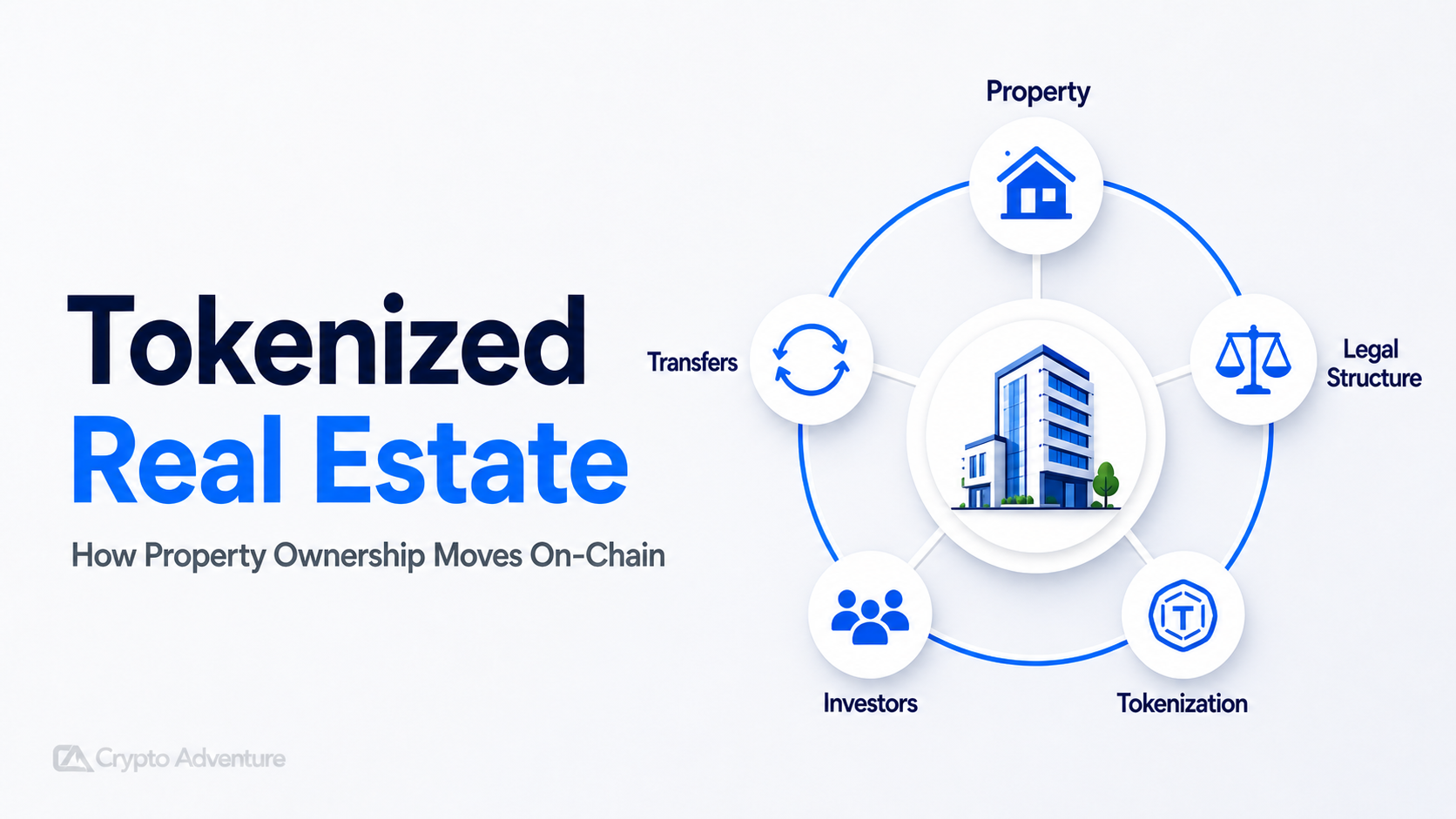
Tokenized real estate turns an ownership interest, income claim, fund share, debt exposure, or property-backed instrument into blockchain-based tokens. The property itself does not move onto the blockchain. The legal claim, investor record, or economic exposure is represented digitally through a token and connected to an offchain legal structure.
That distinction matters. A token is not automatically a deed, and it is not automatically direct ownership of a building. Tokenized real estate can represent several structures: direct property interests, interests in an entity that owns property, real estate fund shares, REIT-like exposure, or real estate-backed debt.
The basic promise is easy to understand. A large property can be divided into smaller digital units, making access, settlement, and recordkeeping more efficient. The harder part is legal design. Real estate depends on titles, registries, local law, taxes, tenants, property managers, cash distributions, and transfer restrictions. Tokenization improves the rails, but it does not remove the real-world machinery underneath.
The process usually starts with a property or portfolio. An issuer creates a legal wrapper around the asset, often through a company, fund, trust, or special purpose vehicle. That wrapper defines who owns the property, who manages it, what token holders receive, how income is distributed, and how exits work.
The issuer then creates blockchain tokens that represent the relevant rights. Those rights can differ sharply between projects. One token may represent a share in an entity that owns a rental property. Another may represent exposure to a real estate loan. Another may represent a fund unit backed by several properties. Another may use a more direct deed-linked structure where local regulation supports that model.
For instance, RWA.xyz’s real estate dashboard launch shows why structure matters. Tokenized real estate products span real estate-backed debt, equity investments in single properties, diversified portfolios, and direct deed tokenization in specialized regulatory settings. Users need to know which structure they are buying before assuming the token equals ownership of a specific building.
A real estate token can represent economic rights, legal rights, governance rights, or a mix of all three. Economic rights may include rental income, interest payments, appreciation, or proceeds from a future sale. Legal rights define what claim the holder has against the issuer, property vehicle, borrower, or trustee. Governance rights may let holders vote on selected asset decisions, though many products keep management centralized.
The token contract handles balances, transfers, whitelists, and sometimes distributions. The legal documents define what those balances mean. This is where tokenized real estate differs from ordinary crypto assets. A token balance is only as strong as the legal wrapper, custodian, property manager, and redemption process behind it.
Users should check whether token holders own equity, debt, fund units, revenue rights, or a synthetic claim. They should also check whether transfers require KYC, whether the token is restricted to accredited or qualified investors, and whether holders can redeem directly or only sell on a secondary market.
Tokenized real estate can turn property cash flows into programmable distributions. Rental income, loan interest, or fund income can be paid to eligible token holders according to the product rules. That can make real estate income easier to track than traditional private-property syndicates.
The income still comes from real properties and real counterparties. Tenants must pay rent. Borrowers must service loans. Property managers must handle maintenance, vacancies, taxes, insurance, and repairs. A smart contract can automate distribution after cash reaches the structure, but it cannot force a tenant to pay or stop an unexpected roof repair from reducing income.
This is the first major risk. Tokenization can make distributions cleaner, but it does not make property cash flows guaranteed. Users should review occupancy, loan terms, property location, operating expenses, insurance, reserves, debt levels, and manager quality before treating a tokenized property as passive income.
Tokenized real estate is often promoted as more liquid than traditional property. That can be true in a narrow sense because tokens are easier to transfer than paper interests in a private property vehicle. It does not mean every token has deep buyers.
Real estate is naturally illiquid. Property sales take time, valuations can be subjective, and legal transfers can be restricted. Token markets add another layer: only eligible wallets may be allowed to buy, secondary markets may be thin, and spreads can widen when holders want cash quickly.
RWA.xyz tracks tokenized real-world asset growth across assets, holders, networks, and stablecoins, but real estate remains a smaller and more specialized category than tokenized Treasuries or stablecoins. Users should not assume that a property token can be sold instantly at net asset value. Liquidity depends on demand, transfer rules, market makers, redemption terms, and the quality of the underlying asset.
Real estate tokenization has two custody layers. The token is held through a wallet, custodian, or exchange account. The property is held through a legal vehicle, title structure, or registered owner. The token holder needs both layers to work.
Legal risk appears when the documents do not clearly connect the token to enforceable rights. A strong product should explain who owns the property, who manages it, who holds title, who calculates income, who handles taxes, who audits reports, and what happens if the issuer fails.
Jurisdiction matters because real estate law is local. A property in one country can have different transfer rules, landlord law, tax rules, and investor protections than a property in another. Blockchain settlement can be global, but the building remains local.
The first benefit is fractional access. A property that would normally require large capital can be divided into smaller token units.
The second benefit is better recordkeeping. Blockchain balances can make ownership records easier to audit, especially when combined with compliant transfer controls.
The third benefit is faster settlement. Transfers can settle through smart contracts instead of slow private-market paperwork, although legal and compliance checks may still apply.
The fourth benefit is composability. In more advanced systems, tokenized property claims could connect with lending markets, portfolio tools, reporting dashboards, or automated income distribution.
The first risk is legal mismatch. A token may not give direct property ownership. It may represent a claim on an issuer, fund, loan, or special purpose vehicle.
The second risk is valuation. Real estate does not trade continuously like large-cap tokens. Appraisals can lag market conditions, and secondary token prices can diverge from reported asset value.
The third risk is liquidity. A token may be transferable in theory but hard to sell in practice.
The fourth risk is management quality. Property operations still depend on humans, contractors, tenants, insurers, servicers, and local law.
The fifth risk is regulation. Tokenized property products may be securities, fund units, debt instruments, or regulated investment products depending on structure and jurisdiction.
Users should start with the legal claim. The key question is what the token holder actually owns. Equity in a property vehicle, debt exposure, rental-income rights, fund units, or a platform claim all create different risks.
Next comes the asset. Location, occupancy, tenant quality, loan-to-value, property type, debt, expenses, and insurance matter more than the token interface.
Then comes the exit path. Users should check whether they can redeem, sell only to whitelisted buyers, wait for a property sale, or depend on a secondary market. A high advertised yield means less if exits are slow or uncertain.
Finally, users should review custody, audits, reporting, manager reputation, and jurisdiction. The strongest tokenized real estate products make both the blockchain layer and the property layer easy to understand.
Tokenized real estate moves property exposure onto blockchain rails, but it does not move the building itself on-chain. The token represents a legal or economic claim tied to a real-world structure, and that structure decides what the holder actually owns.
The strongest use cases are fractional access, cleaner ownership records, faster settlement, and programmable distributions. The biggest risks are legal rights, liquidity, valuation, redemption, custody, and property management. Users should review the asset, the legal wrapper, the cash-flow source, and the exit path before treating a tokenized property as a simple on-chain investment.
The post Tokenized Real Estate: How Property Ownership Moves On-Chain appeared first on Crypto Adventure.





