Bitcoin is having a rough stretch. The asset is trading around $63,600, a far cry from its October 2025 all-time high near $126,000 — a drawdown of roughly 50% from the peak. But the price alone doesn't tell the full story. The more significant development is where the selling is coming from: the spot Bitcoin ETFs that were supposed to be crypto's steady institutional anchor.
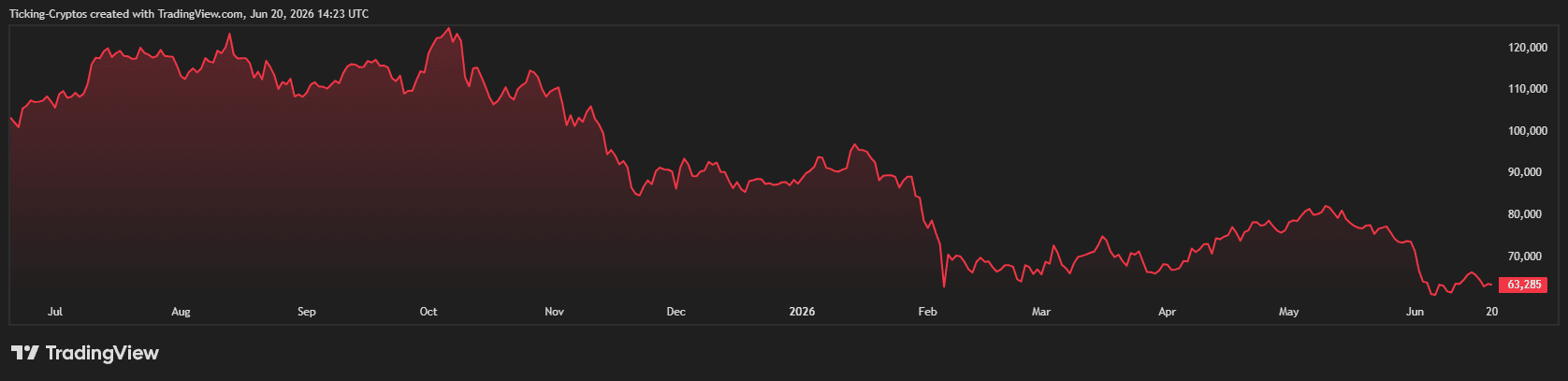
Those ETFs have been bleeding capital at a historic pace. The recent weeks have seen one of the most sustained institutional withdrawals since these products launched in 2024 — a clear signal that big-money sentiment has turned defensive.
The numbers are striking. Spot Bitcoin ETFs recently posted their longest losing streak on record. From May 15 to June 3, spot bitcoin ETFs faced their longest outflow streak since their 2024 launch — 13 consecutive trading days, losing $4.33 billion, roughly 59,400 BTC.
The pressure didn't stop there. For the week ending June 6, US spot bitcoin ETFs posted $1.72 billion in net outflows — the largest weekly outflow since February 2025 — marking a fourth consecutive week of outflows totaling $5.4 billion. Even the biggest fund wasn't spared: BlackRock's IBIT led the outflows, losing $1.34 billion for that week.
The cumulative effect on assets under management has been severe. Total assets in bitcoin ETFs fell to $80.40 billion from $104.29 billion at the start of the streak, with fund holdings dropping to 1.277 million BTC, about 7.2% below the October 2025 peak.
The exodus isn't really about $Bitcoin itself — it's largely a macro story. The main driver is a shift in interest-rate expectations:
In other words, this looks like a capital rotation driven by the rate environment rather than a collapse in Bitcoin's fundamentals.
Market psychology has turned deeply negative — arguably to an extreme. The Crypto Fear and Greed Index sat at just 8 points, deep in the "Extreme Fear" zone, as of June 8, 2026.
Historically, readings this low are notable for a counterintuitive reason: extreme fear has often coincided with local bottoms rather than the start of deeper crashes. It's not a guarantee — fear can always get worse — but it tells you sentiment is washed out, and a lot of weak hands may have already sold.
Balance matters here, and there are genuine counterpoints to the gloom. Several analysts frame the current drawdown as a normal, even healthy, part of the cycle rather than a structural breakdown:
The bullish interpretation is that this is a redistribution phase — speculative money exiting while patient, long-term capital quietly accumulates.
With ETF flows now a primary market driver, the signals to monitor are clearer than ever:
Bitcoin's record ETF outflow streak is a real and significant development — billions in institutional capital have exited, AUM has fallen sharply, and sentiment is at extreme-fear levels. The honest read is that the near-term picture is genuinely weak, driven mostly by a macro environment where delayed rate cuts make Bitcoin less attractive than yielding alternatives.
But the same data carries a more constructive subplot: this may be a rotation rather than an exit, with speculative holders giving way to long-term accumulators, and pockets of selective institutional buying already appearing. For traders, the key isn't to pick a side on conviction alone — it's to watch ETF flows and Fed expectations closely, since those are the forces that will likely decide whether this drawdown becomes a bottom or a longer downtrend.





