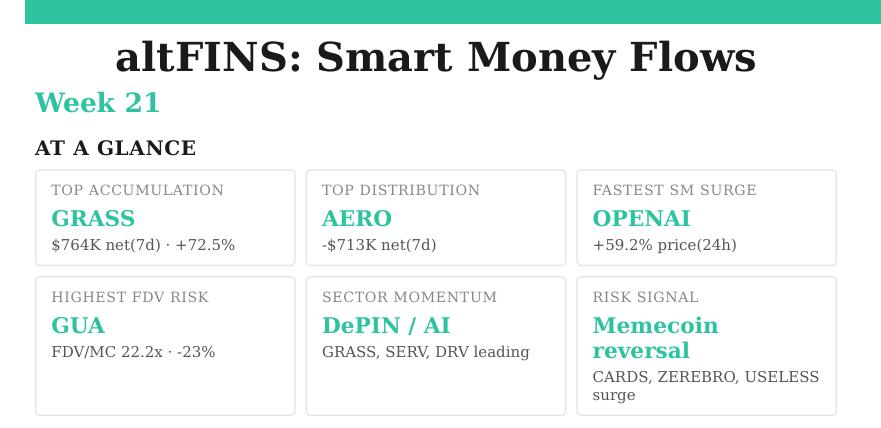
Crypto entered Week 21 with a strange split personality. Macro conditions improved sharply, equities hit fresh highs, and risk appetite returned across traditional markets, but crypto itself failed to fully catch the bid. Instead of a broad altseason, the week showed a more selective rotation: smart money moved into DePIN, AI infrastructure, stablecoin issuers, and a handful of fresh names, while last week’s darlings in AI agents and some DEX tokens saw heavy distribution.
The macro backdrop flipped meaningfully from Week 20. The US-Iran negotiation framework helped pull Brent crude lower, U.S. yields eased, and major equities closed at record highs, yet Bitcoin stayed stuck in a 74K–78K range and finished the week only slightly down. That divergence matters because it suggests the main headwind for crypto was not the broader risk environment, but crypto-specific flow pressure.
Spot BTC ETFs posted another week of outflows, and the report notes that crypto demand remained soft even as macro conditions improved. In other words, the market got the kind of environment that usually helps risk assets, but crypto still needed its own internal flow reset.
The clearest signal of the week was accumulation in GRASS, which led all tokens with about $764K of net smart money inflows and a 72.5% weekly price gain. ENA also flipped from prior distribution to net buying, while WBNB showed steady inflow strength and NOCK posted an early-cycle breakout profile on Base. AAVE also stood out as a contrarian accumulation name after a sharp prior-week outflow reversal.
That pattern suggests smart money is not chasing everything. It is concentrating on tokens with either strong narrative positioning, clear sector momentum, or signs of a mean-reversion setup after previous selling. For traders, that usually matters more than the headline performance of the entire market.
The strongest sector rotation was into DePIN and AI infrastructure, with GRASS, SERV, and DRV named as the leaders. The report also describes this as a rotation from AI agents toward compute and data infrastructure, which is a subtle but important distinction. Instead of pure agent tokens, smart money seems to be favoring the picks-and-shovels side of the AI trade.
That shift was reinforced by the distribution seen in VIRTUAL, SERV on ETH wrappers, and other former AI agents leaders. In practical terms, the market may still like the AI narrative, but it is becoming more selective about which part of the stack deserves capital.
Week 21 also brought a broader memecoin surge, but the report frames it as mostly retail-led rather than smart-money-led. OPENAI, WOJAK, BNBTIGER, and ASTEROID posted strong short-term moves, while ZEREBRO and USELESS added to the breadth. Most of these names were micro-cap and thinly owned by smart money, which is often a sign of speculative froth rather than institutional conviction.
CARDS was the exception worth noting. It combined a meaningful market cap with $114K of smart money buying and a 59.6% weekly rise, making it a more credible candidate than the average memecoin pump. That kind of setup is useful because it separates “noise” from tokens that may actually be building real flow support.
One of the most important risk signals in the report was AERO. Smart money sold about $713K worth of AERO even as price rose 7.1%, a classic example of distribution into strength. MORPHO and RENDER showed a similar pattern: strong price action, but smart money trimming exposure.
That usually means late buyers are getting enthusiastic while informed holders are reducing risk. JUP was the contrarian exception, with smart money accumulating a pullback rather than chasing momentum. The broader message is that strength alone is not enough; the flow behind the move matters more.
The report highlights GUA as the highest FDV risk, with a 22.2x FDV/MC ratio and heavy smart money outflows. LAB, AERO, and GITLAWB were also flagged as high-risk names because of supply pressure, distribution, or both. Those are the kinds of setups where price can look stable right up until liquidity disappears.
CARDS, POD, XPIN, and UPEG were put into a watch category rather than a clean bullish bucket. That’s an important distinction: some of these tokens can keep running, but their structure makes them vulnerable to sudden reversals if unlocks, dilution, or profit-taking intensify.
The big takeaway from Week 21 is that crypto is rotating, not expanding uniformly. Capital is moving toward DePIN, compute, stablecoin infrastructure, and select contrarian setups, while AI agent names and some DEX leaders are showing signs of fatigue. That makes this a stock-picker’s market, not a passive beta market.
For the next week, the key question is whether GRASS-style accumulation broadens into other quality names, or whether the current move stays narrow and fades into another round of sector churn. If smart money keeps buying quality on pullbacks while continuing to sell strength in overheated names, the market could be setting up for a more durable rotation phase.
Smart Money Rotation Is Back: What Week 21 Flows Say About Crypto’s Next Moves was originally published in Coinmonks on Medium, where people are continuing the conversation by highlighting and responding to this story.





